



| HEADLINE |

|
Awami League
Published : Sunday, 5 May, 2019 at 9:59 PM
From Wikipedia


 The Bangladesh Awami League, often simply called the Awami League or AL, is one of the two major political parties of Bangladesh.
The All Pakistan Awami Muslim League was founded in Dhaka, the capital of the Pakistani province of East Bengal, in 1949 by Bengali nationalists Abdul Hamid Khan Bhashani, Shawkat Ali, Yar Mohammad Khan, Shamsul Huq, and joined later Huseyn Shaheed Suhrawardy who went on to become Prime Minister of Pakistan. The Pakistan Awami Muslim League was established as the Bengali alternative to the domination of the Muslim League in Pakistan and over centralisation of the government. The party quickly gained massive popular support in East Bengal, later named East Pakistan, and eventually led the forces of Bengali nationalism in the struggle against West Pakistan’s military and political establishment.
The party under the leadership of Sheikh Mujibur Rahman, the founding father of Bangladesh, led the struggle for independence, first through massive populist and civil disobedience movements, such as the Six Point Movement and 1971 Non-Cooperation Movement, and then during the Bangladesh Liberation War.
After the emergence of independent Bangladesh, the Awami League won the first general elections in 1973 but was overthrown in 1975 after the assassination of Sheikh Mujibur Rahman. The party was forced by subsequent military regimes onto the political sidelines and many of its senior leaders and activists were executed and jailed. After the restoration of democracy in 1990, the Awami League emerged as one of the principal players of Bangladeshi politics.
The incumbent Prime Minister of Bangladesh, Sheikh Hasina, has headed the party since 1981.
Struggle for Independence and Mujib era (1966–75)
The 6-point demands, proposed by Mujib, were widely accepted by the East Pakistani populace, as they proposed greater autonomy for the provinces of Pakistan. After the so-called Agartala Conspiracy Case, and subsequent end of the Ayub Khan's regime in Pakistan, the Awami League and its leader Sheikh Mujib reached the peak of their popularity among the East Pakistani Bengali population. In the elections of 1970, the Awami League won 167 of 169 East Pakistan seats in the National Assembly but none of West Pakistan’s 138 seats. It also won 288 of the 300 provincial assembly seats in East Pakistan.This win gave the Awami League a healthy majority in the 313-seat National Assembly and placed it in a position to establish a national government without a coalition partner. This was not acceptable to the political leaders of West Pakistan who feared the 6 points were a step towards breaking up the country and led directly to the events of the Bangladesh Liberation War. The Awami League leaders, taking refuge in India, successfully led the war against the Pakistani Army throughout 1971. Leader Sheikh Mujib was arrested by the Pakistan army on 25 March 1971, but the Bangladeshi people continued the fight to free themselves for nine months.
After victory on 16 December 1971, the party formed the national government of Bangladesh. In 1972, under Sheikh Mujib, the party name was changed to “Awami League”. The new government faced many challenges as they rebuilt the country and carried out mine clearing operations.
In January 1975, facing violent leftist insurgents Mujib declared a state of emergency and later assumed the presidency, after the Awami League dominated parliament decided to switch from parliamentary to a presidential form of government. Sheikh Mujib renamed the League the Bangladesh Krishak Sramik Awami League, and banned all other parties. The consequences lead to a critical political state. BAKSAL was dissolved after the assassination of Sheikh Mujibur Rahman.
On 15 August in 1975, during the time of K M Shafiullah as a Head of the Army stuffs some junior members of the armed forces in Dhaka, led by Major Faruk Rahman and Major Rashid, murdered Sheikh Mujibur Rahman and all his family members, including his wife and minor son. Within months, on 3 November 1975, four more of its top leaders, Syed Nazrul Islam, Tajuddin Ahmed, Captain Muhammad Mansur Ali and A. H. M. Qamaruzzaman were killed inside the Dhaka Central Jail as they were on behalf of BAKSAL. Only Sheikh Hasina and Sheikh Rehana, two daughters of Mujib, survived the massacre as they were in West Germany as a part of a cultural exchange program. They later claimed political asylum in the United Kingdom. Sheikh Rehana, the younger sister, chose to remain in the UK permanently, while Sheikh Hasina moved to India and lived in self-imposed exile.
Ideology
The Bangladesh Awami League styles itself as the leader of the “pro-liberation” forces in Bangladesh, promoting secular and social democratic sections of the political establishment in the country. The party constitution states, and in two cases defines the reason for, four fundamental principles in guiding its philosophy and policies. They include:
Democracy
Socialism
Secularism
Nationalism
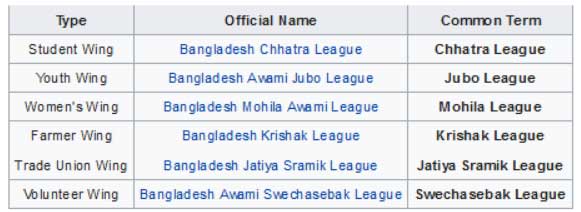
Wings:
Loading...
Loading...







Editor : Iqbal Sobhan Chowdhury
Published by the Editor on behalf of the Observer Ltd. from Globe Printers, 24/A, New Eskaton Road, Ramna, Dhaka.
Editorial, News and Commercial Offices : Aziz Bhaban (2nd floor), 93, Motijheel C/A, Dhaka-1000.
Phone: PABX- 41053001-06; Advertisement: 41053012; 01793317829, 01550707291, E-mail: [email protected], [email protected] Online: email: [email protected] 41053014; 01550707297 Advertisement: 01550707296
Published by the Editor on behalf of the Observer Ltd. from Globe Printers, 24/A, New Eskaton Road, Ramna, Dhaka.
Editorial, News and Commercial Offices : Aziz Bhaban (2nd floor), 93, Motijheel C/A, Dhaka-1000.
Phone: PABX- 41053001-06; Advertisement: 41053012; 01793317829, 01550707291, E-mail: [email protected], [email protected] Online: email: [email protected] 41053014; 01550707297 Advertisement: 01550707296


