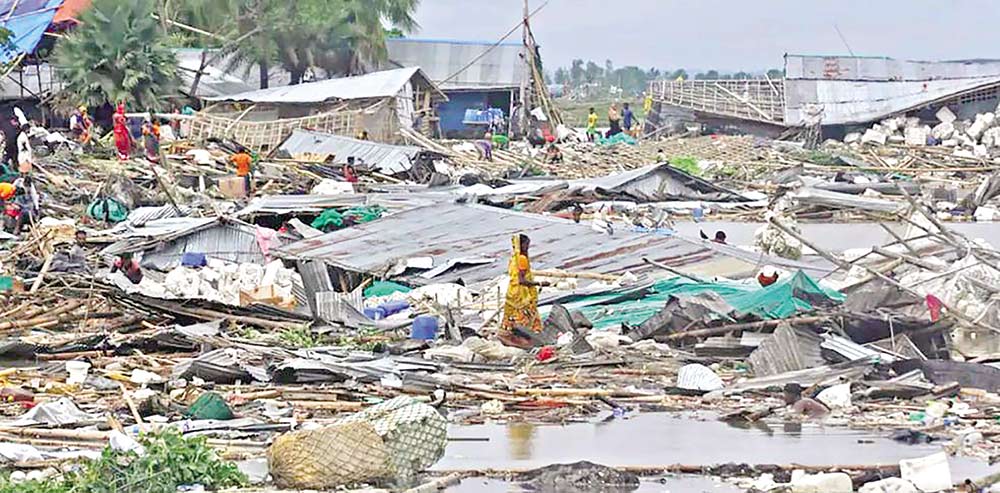
Bangladesh's hard-won economic resilience is entering a perilous phase as the twin shocks of climate change and mounting external debt tighten their grip on the economy, economists have warned, flagging growing risks to macroeconomic stability.
A fresh study by the Centre for Policy Dialogue (CPD) cautions that climate-induced "loss and damage" is no longer a distant environmental concern but an immediate fiscal threat. The report argues that repeated climate disasters, when combined with rising global interest rates and export volatility, could undermine the country's short-term debt sustainability.
The findings reinforce concerns raised globally by the Intergovernmental Science-Policy Platform on Biodiversity and Ecosystem Services (IPBES), which has warned that the international financial system remains structurally skewed against nature.
In 2023 alone, some $7.3tn (£5.1tn) in public and private finance worldwide directly damaged ecosystems, while only $220bn was channelled into biodiversity protection and restoration. Such imbalances, IPBES argues, are generating systemic risks that threaten financial stability and long-term growth.
For Bangladesh-ranked among the world's most climate-vulnerable nations-the implications are stark.
According to the CPD, economic losses from climate-induced disasters surged nearly tenfold over the past decade. Between 2009 and 2014, losses stood at around Tk 18,425 crore. That figure ballooned to Tk 1,79,200 crore between 2015 and 2020.
Overall losses during 2009-2020 reached roughly Tk 2,00,000 crore, based on estimates from the Bangladesh Bureau of Statistics, with floods accounting for more than half of the devastation.
At the same time, Bangladesh's external debt has crossed the $100bn mark-almost double its level of a decade ago. More alarmingly, the ratio of foreign debt to exports has climbed from 59 per cent in FY2011-12 to nearly 117 per cent in FY2022-23, indicating that export earnings are no longer keeping pace with external borrowing.
"This indicates that export growth has lagged behind the expansion of external loans, particularly in recent years, heightening the risk of an unsustainable debt burden," the CPD report observes.
The fiscal strain is intensifying at a delicate moment. As Bangladesh prepares to graduate from the Least Developed Country (LDC) category in November 2026, it faces a challenging macroeconomic landscape marked by low revenue mobilisation, liquidity stress in the banking sector and a depreciating exchange rate.
Compounding the pressure, a growing share of new borrowing is being secured on less concessional terms, exposing the exchequer to higher refinancing costs amid tightening global liquidity conditions. Economists warn that if climate-related shocks continue to mount, they could become the primary catalyst for immediate debt distress.
Analysts argue that policymakers must urgently calculate the "marginal cost" of debt sustainability attributable to climate factors-essentially measuring how much additional borrowing risk stems directly from environmental vulnerabilities. This assessment is becoming critical as variable-rate loans grow more expensive and global aid priorities shift.
Despite the escalating risks, climate-related spending accounts for only 4-5 per cent of the annual development budget-modest relative to the scale of exposure and the size of the economy.
Experts stress that the debate must move beyond headline allocations to the effectiveness, transparency and financing terms of climate expenditure.
"We need far greater clarity on the composition of climate finance-how much is domestically sourced, how much external, and under what conditions," an economist noted, urging the government to prioritise grant-based funding for non-income-generating adaptation projects.
Global credit agencies have already reacted. Moody's, S&P Global and Fitch Ratings have downgraded Bangladesh in recent months, citing heightened external vulnerability, weakening foreign exchange reserves and mounting liquidity risks.
Without a decisive recalibration of climate finance strategy and debt management, economists warn, Bangladesh's growth narrative could face its most formidable headwinds yet-where environmental shocks and financial fragility reinforce each other in a tightening economic storm.





