



| HEADLINE |

|

Prof Yunus-led interim government paved way for democracy
Published : Saturday, 21 February, 2026 at 12:00 AM
Khandaker Azizur Rahman


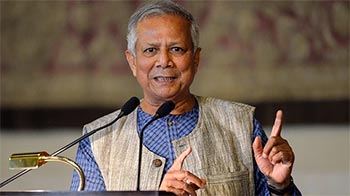 After the student-led uprising in August 2024, Bangladesh was in complete chaos, with economic and institutional instability prevailing across the country. At that critical time, Nobel Prize winner Professor Muhammad Yunus took on the responsibility of leading the interim government. As an economist and social worker with no prior political experience, the huge challenge he accepted will be written in golden letters in history of Bangladesh. From August 8, 2024, to February 17, 2026, about one and a half years, his government had some shortcomings but such a short amount of period the successes he showed pulled the country out of the darkness of fascism and opened new paths for democracy, economy, international respectand most importantly the sovereignty of the country is secured.
In administrative reforms, Professor Yunus showed unmatched firmness. Despite non-cooperation from officials with fascist mindset appointed by the previous government, he formed six reform commissions. These worked on election system, police, judiciary, administration, anti-corruption and constitution reforms, laying a strong foundation. The July Charter, signed by 24 political parties, was one of this government's biggest achievements. It includes limits on the prime minister's term, forming an upper house of parliament, judicial independence and measures to prevent fascism. In the referendum held with the February 12, 2026 election, people gave a huge "yes" vote to approve it. This revived the flow of democracy and became a milestone in Bangladesh's history.
His leadership in economic recovery was outstanding. When he took office, foreign reserves were near $15 billion and food inflation had risen to 14%. But by the time he left, reserves crossed $34.5 billion (IMF calculation around $29-30 billion). Remittances hit a record $30.33 billion (some reports say up to $32.8 billion), exports grew by 9% and foreign direct investment doubled. Food inflation halved, overall inflation fell to 8.48% (lowest in 35 months). The taka became stable, and the banking sector recovered. These gains brought stability back to people's daily lives.
In foreign policy, his courage and foresight were perfect. He replaced one-sided policy with "360-degree diplomacy" and re-established Bangladesh as a dignified nation. During the Hasina era, aggressive India had almost turned Bangladesh into a vassal state. Against this, Yunus showed intelligence, courage and restraint to raise Bangladesh's head high again and secure its sovereignty and unity. Deals with China on Teesta River, ports and industrial zones, tariff reduction with the US (from 37% to 20%); economic partnership with Japan; release of detained expatriates from UAE, all came from his vision. He gained international support on the Rohingya crisis and UN help for investigating the July mass killings. These efforts brightened Bangladesh's image in the world.
His contribution to the military sector was also notable. He took steps to modernize the navy, air force and army by increasing training, adding modern technology like advanced radars, aircraft, drones and medium- and short-range missiles. He prepared the path for new contracts, leaving them ready for the next government. This will surely make our armed forces even more modernand confident. He opened selection boards for navy and air force and ensured justice for deprived soldiers. In such a short time, these were unbelievable successes. If the new government does not continue this trend, sovereignty could face risks again.
His government took important steps in other areas too, like justice for July-August martyrs, commissions to investigate disappearances and killings, restoring law and order, bringing back freedom of expression. They completed full investigation of sensitive cases like the BDR mutiny killings, which past governments failed to do. By honoring the youth uprising, he inspired the dream of building a "new Bangladesh." He set an example of democracy by handing over power peacefully.
Some criticisms exist, but what he achieved amid crisis was extraordinary. Under Professor Yunus's leadership, Bangladesh came out of fascism's darkness and regained democracy, economic stability and international dignity. If the July Charter is fully implemented, the path of fascism will close forever. The people of the country owe him deep gratitude. Let the new government carry forward this legacy and build the "new Bangladesh."
The writer is Head of Photography, The Daily Observer

Loading...
Loading...
Also read



Editor : Iqbal Sobhan Chowdhury
Published by the Editor on behalf of the Observer Ltd. from Globe Printers, 24/A, New Eskaton Road, Ramna, Dhaka.
Editorial, News and Commercial Offices : Aziz Bhaban (2nd floor), 93, Motijheel C/A, Dhaka-1000.
Phone: PABX- 41053001-06; Advertisement: 41053012; 01793317829, 01550707291, E-mail: [email protected], [email protected] Online: email: [email protected] 41053014; 01550707297 Advertisement: 01550707296
Published by the Editor on behalf of the Observer Ltd. from Globe Printers, 24/A, New Eskaton Road, Ramna, Dhaka.
Editorial, News and Commercial Offices : Aziz Bhaban (2nd floor), 93, Motijheel C/A, Dhaka-1000.
Phone: PABX- 41053001-06; Advertisement: 41053012; 01793317829, 01550707291, E-mail: [email protected], [email protected] Online: email: [email protected] 41053014; 01550707297 Advertisement: 01550707296


