



| HEADLINE |

|

The ‘farm chicken’ remark and certain misunderstandings
Published : Friday, 17 July, 2026 at 12:00 AM
Khatune Jannat


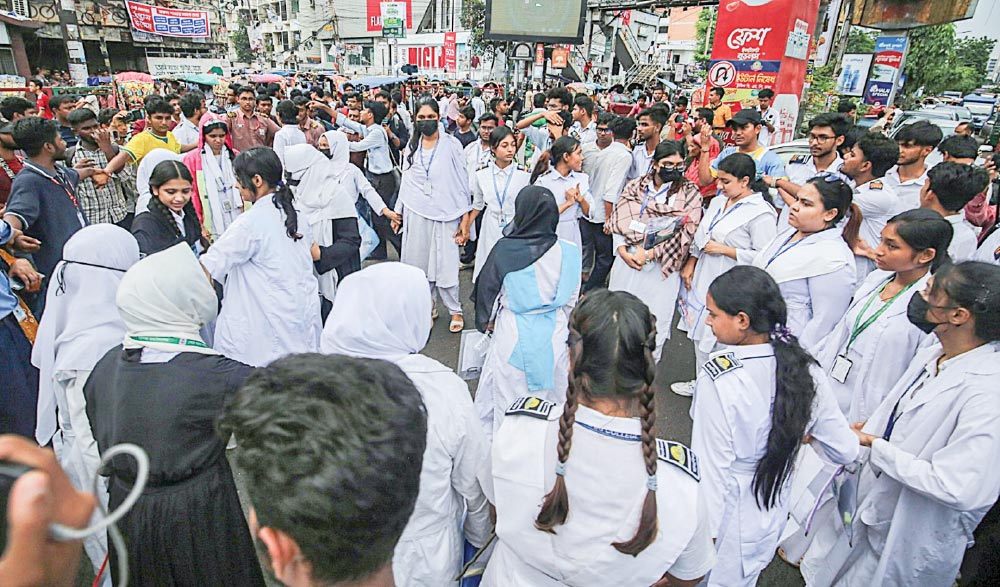
 Recently, a storm of intense discussion and criticism erupted across the country regarding a leaked audio clip of a phone conversation between Education Minister Dr ANM Ehsanul Hoque Milon and an HSC examinee. The controversy centred on a specific phrase, “farm chicken,” which quickly went viral, prompting widespread outrage on social media and eventually triggering demonstrations by HSC candidates.
However, public controversies often evolve faster than careful examination of the facts. Was the minister truly mocking students, or was a casual, personal expression taken out of context? To answer that question, it is necessary to look beyond viral clips and political rhetoric and examine the complete conversation, the context in which the words were spoken, and the minister’s broader record in the education sector.
The captions accompanying the viral clip aggressively claimed that the Education Minister insulted students by calling them “farm chickens.” Out of context, this phrase could naturally hurt any student’s feelings. However, listening to the full audio paints a different picture. In the clip, while expressing concern about students taking exams during heavy rainfall and risking their health, the Minister spoke in an informal, domestic tone: “They are like farm chickens... I have a daughter too, and she is just like a farm chicken. Getting drenched in just a little rain gives her a fever...”
 It is evident that this choice of words did not stem from disdain, ridicule, or sarcasm. Instead, it is a very familiar expression used by middle-class and urban parents in Bangladesh. In urban life, parents often use this term affectionately�"sometimes with mild regret�"for children who are not accustomed to harsh weather or rigorous physical labour outdoors.
Such informal language often reflects the way a parent speaks about his own children. Dr Ehsanul Hoque Milon did not treat the students as outsiders; he thought of them with the same affection he had for his own family. His comparison stemmed from deep anxiety that weather changes might cause students to fall sick and lose their chance to sit for their exams. Furthermore, he immediately coordinated with the Bangladesh Meteorological Department and relevant authorities to take necessary measures to protect student health.
Following the public backlash, Dr Ehsanul Hoque Milon also expressed regret in Parliament on July 14, 2026, clarifying his personal remarks had never been intended to offend or hurt HSC examinees. On the same day, he announced that 11,729 candidates who had missed examinations because of adverse weather or other unavoidable circumstances would be allowed to retake the affected papers. The government also suspended officials responsible for errors in the Physics First Paper question and decided to award full marks for two disputed questions to ensure that no candidate would be disadvantaged. Despite these measures, protests by HSC examinees continued in several parts of the country, with demonstrators demanding the minister’s resignation.
Dr ANM Ehsanul Hoque Milon’s sincerity towards students and education is nothing new. Those familiar with the history of Bangladesh’s education system know that during his tenure as the State Minister for Education under the BNP government from 2001 to 2006, his contributions were revolutionary.
At that time, academic cheating and question paper leaks were major challenges. Milon risked his safety to conduct surprise raids at various examination centres�"sometimes travelling by helicopter�"to curb cheating and establish a new culture of fair testing. His strict measures ensured proper evaluation based on merit and significantly curtailed question paper leaks. Additionally, his policies promoting female education, upgrading school and college infrastructure in remote areas, and improving teacher training standards remain highly memorable.
Since taking charge again as the Education Minister in February 2026, Dr ANM Ehsanul Hoque Milon has initiated extensive reforms over the past five months to salvage the sector from the previous administration’s chaotic curricula, flawed evaluation methods, and bureaucratic bottlenecks.
He strictly banned the practice of government officials taking expensive foreign trips funded by state money under the guise of absurd training programmes, such as learning how to cook or observing water hyacinth removal. He delivered a clear message that such waste of state funds will no longer be tolerated.
Minister Milon has taken initiatives to eliminate academic backlogs and session jams. Emphasising “learning with happiness,” he is prioritising sports, cultural activities, family values, and moral education within the syllabus. To reduce disparity, he also made a far-reaching decision to allocate a 20 per cent scholarship quota for students of private kindergartens alongside government primary schools.
In addition, he is maintaining an uncompromising stance against corruption and political nepotism, actively blocking the previous government’s manipulation regarding private university trustee boards to build corruption-free campuses.
However, one of the biggest problems with social media today is the tendency to judge a quote without its context. It is time to reflect on whether it is fair to portray a well-intentioned conversation in a negative political light just to chase cheap likes, comments, and views.
The choice of words may not have been formal, but the underlying intent was entirely benevolent and affectionate. Parents and teachers say many things to children out of discipline or love that would sound offensive if spoken by a stranger.
Ehsanul Hoque Milon dedicated his entire political career to refining the education sector and nurturing merit. Trolling him online or demanding his resignation solely on the basis of a single remark is therefore highly unfair. Viewed in its full context, the remark appears to have been less a slight than an expression of parental concern and genuine anxiety for students’ safety.
The writer is Teacher, Department of Sociology, National University Bangladesh

Loading...
Loading...
Also read



Editor : Iqbal Sobhan Chowdhury
Published by the Editor on behalf of the Observer Ltd. from Globe Printers, 24/A, New Eskaton Road, Ramna, Dhaka.
Editorial, News and Commercial Offices : Aziz Bhaban (2nd floor), 93, Motijheel C/A, Dhaka-1000.
Phone: PABX- 41053001-06; Advertisement: 41053012; 01793317829, 01550707291, E-mail: [email protected], [email protected] Online: email: [email protected] 41053014; 01550707297 Advertisement: 01550707296
Published by the Editor on behalf of the Observer Ltd. from Globe Printers, 24/A, New Eskaton Road, Ramna, Dhaka.
Editorial, News and Commercial Offices : Aziz Bhaban (2nd floor), 93, Motijheel C/A, Dhaka-1000.
Phone: PABX- 41053001-06; Advertisement: 41053012; 01793317829, 01550707291, E-mail: [email protected], [email protected] Online: email: [email protected] 41053014; 01550707297 Advertisement: 01550707296


