



| HEADLINE |

|

World Cup’s new ‘invisible team’ is AI
Published : Friday, 17 July, 2026 at 12:00 AM
Sohel Mahmud


 The first sign that the 2026 FIFA World Cup may be different appears before a ball is kicked. In FIFA’s world, the tournament is no longer just a contest of legs, lungs and nerves; it is also a contest of data, cameras, sensors and machine-generated judgment. The drama on the pitch will still be human, but behind it stands new digital machinery that is already reshaping how the game is watched, officiated and understood.
The very ball is connected- the official match ball, Adidas Trionda, includes an embedded motion sensor that sends data to officiating systems and helps with decisions such as offside and touch detection. It can record movement data many times per second and share that information in real time. That is why it is useful for VAR and semi-automated offside technology, because it helps officials identify exactly when and how the ball was played.
FIFA and Lenovo have announced a cluster of AI-powered tools for the tournament, including Football AI Pro, AI-enabled 3D player avatars and an updated Referee View broadcast system. The aim is to enhance officiating, improve match analysis and deepen fan engagement, while also democratising access to data across all 48 teams. That promise matters, because football technology has often widened the gap between rich and poor; the question now is whether AI narrows it or simply moves the frontier further away.
Start with the referee, who must decide in real-time what television viewers can replay forever. Semi-automated offside technology is being sharpened for 2026 by AI-enabled 3D player avatars and a connected match-ball system, allowing officials to combine player tracking, body modelling and ball data to identify marginal offside calls more quickly and more clearly.
Football has spent years arguing about whether technology makes the game colder, yet the most persuasive case for AI here is not glamour but fairness. If a system can help confirm the moment a ball is played and where each player is in relation to it, then it can reduce the kind of prolonged uncertainty that has made VAR such a lightning rod. Still, no machine can dismiss controversy altogether.
For coaches, the appeal is more straightforward. Football AI Pro, built on FIFA’s football language model and Lenovo’s AI infrastructure, is designed to turn vast volumes of match data into useful tactical insight before and after games, not during live play. In plain terms, it can help staff ask better questions: where did a team lose control in midfield, which patterns produced chances, how did the opposition press, and which set-piece routines deserve a second look.
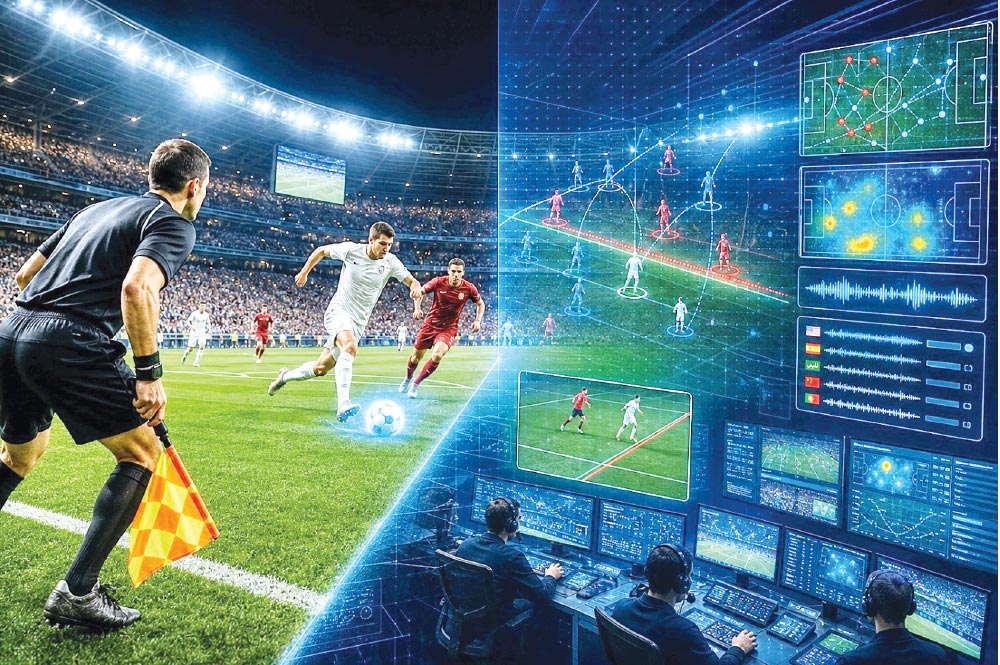 The attraction is obvious, but so is the risk. Coaches have always lived by interpretation, and a model is only as good as the patterns it is trained to find. AI can spot tendencies that a human analyst might miss, but it can also tempt staff into trusting patterns that look precise and may not travel well from one opponent to another.
The same tension runs through player performance. AI-enhanced tracking and digital avatars will feed not only officiating but also performance analysis, offering a more detailed reading of movement, spacing and physical load. That should help teams manage training, recovery, and tactical roles with greater care. It may also improve how smaller federations use scarce resources, because advanced insight is no longer reserved only for the biggest budgets.
For broadcasters, AI is quietly becoming part of the grammar of the match. Referee View footage, stabilised with AI software, is meant to give viewers a steadier, first-person perspective from the referee’s position. That may sound like a small production tweak, but it changes the texture of the broadcast.
The fan experience may be where the technology is least controversial and most visible. AI can personalise highlights, translate content across languages, improve accessibility and make broadcasts feel more immediate. That is a genuine benefit, though it comes with a subtle price: the more personalised sport becomes, the less common the viewing experience may be.
Stadium operations are also being digitised in the background. Lenovo says its systems will support an Intelligent Command Centre, digital twins of venues and smart way finding to help monitor conditions, streamline movement and respond to operational issues in real time. In a tournament spread across three countries and 104 matches, that sort of coordination is not a luxury. It is the plumbing of modern mega-events. Security, traffic, energy use and crowd flow are all easier to manage when the system can detect trouble earlier and squeeze decision time.
Yet the ethics of this new order deserve more than a passing nod. AI in football raises familiar questions about privacy, surveillance, bias and who benefits when data becomes a competitive resource. There is also a more philosophical concern: the more football leans on automation, the more the sport risks treating judgment as a technical output rather than a human skill.
And still, the direction of travel is unlikely to reverse. FIFA has made clear that these tools are not a side experiment but part of its strategic agenda for the global game. That means future tournaments will probably go further. By 2030 or 2034, one can imagine richer player models, more conversational coaching tools, more immersive broadcast layers and tighter links between officiating, analysis and fan interfaces.
Football has always been a game of instinct pretending to be simple. The beauty of it lies in the fact that a perfect plan can still be undone by a deflection, a bad bounce or a moment of genius. What AI may change is the precision with which football sees itself. And if the 2026 World Cup becomes the most intelligent tournament in history, the deeper question is whether the game is becoming more understandable or simply more measured by machines.
The writer is an AI/ML data scientist, telecom and fintech expert, and analytics researcher

Loading...
Loading...
Also read



Editor : Iqbal Sobhan Chowdhury
Published by the Editor on behalf of the Observer Ltd. from Globe Printers, 24/A, New Eskaton Road, Ramna, Dhaka.
Editorial, News and Commercial Offices : Aziz Bhaban (2nd floor), 93, Motijheel C/A, Dhaka-1000.
Phone: PABX- 41053001-06; Advertisement: 41053012; 01793317829, 01550707291, E-mail: [email protected], [email protected] Online: email: [email protected] 41053014; 01550707297 Advertisement: 01550707296
Published by the Editor on behalf of the Observer Ltd. from Globe Printers, 24/A, New Eskaton Road, Ramna, Dhaka.
Editorial, News and Commercial Offices : Aziz Bhaban (2nd floor), 93, Motijheel C/A, Dhaka-1000.
Phone: PABX- 41053001-06; Advertisement: 41053012; 01793317829, 01550707291, E-mail: [email protected], [email protected] Online: email: [email protected] 41053014; 01550707297 Advertisement: 01550707296


