



| HEADLINE |

|

July Uprising: Universities, expectations and outcomes
Published : Thursday, 16 July, 2026 at 12:00 AM
Redoan Ahammed Sagor


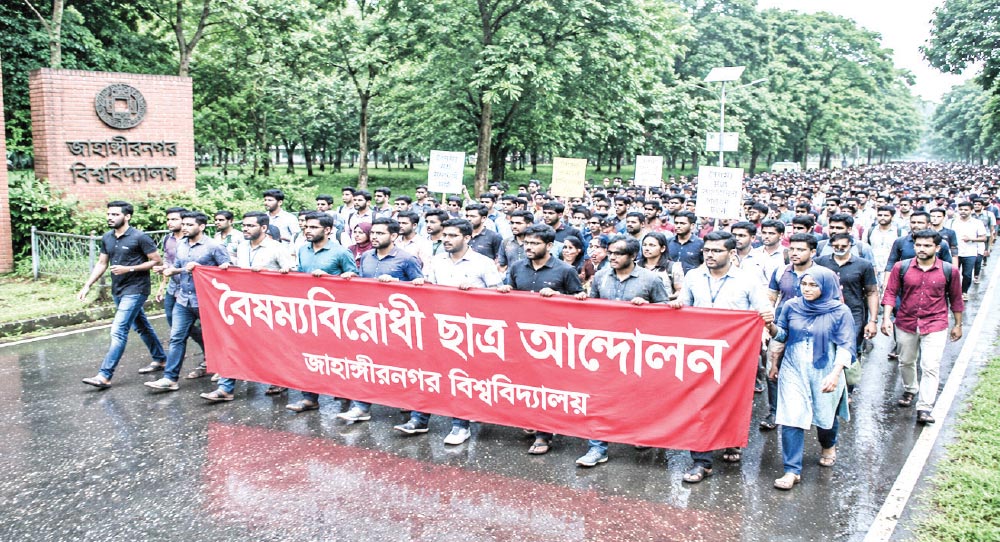 Universities in Bangladesh have never been mere institutions of higher learning. At critical moments in the country’s history, they have acted as catalysts for social and political transformation. From the Language Movement and the Mass Uprising of 1969 to the Liberation War and the democratic movement of the 1990s, students have repeatedly emerged as agents of change. The July Uprising of 2024 followed the same historical trajectory, placing university students at the centre of a movement that reshaped the national political landscape.
Two years later, however, the central question is no longer how the movement unfolded, but what it ultimately achieved. What did students expect in 2024? Which of those expectations have been realised? Which remain unmet? And why do these gaps continue to exist despite a major political transition?
The movement initially began with demands for reform of the quota system in public-sector recruitment. As events unfolded, its agenda expanded significantly. Students increasingly raised concerns about administrative transparency, freedom of expression, good governance and a more participatory political culture. The movement eventually contributed to a profound shift in the country’s political environment and paved the way for the formation of an interim administration.
Jahangirnagar University emerged as one of the most active centres of the movement. Through rallies, demonstrations, cultural protests, human chains and discussions, students maintained sustained participation throughout the period. Teachers also expressed solidarity on different occasions, while social media became a crucial tool for communication, coordination and mobilisation.
Yet the movement came at a considerable cost. Violence, injuries, arrests, legal cases and psychological pressures affected many students. Academic activities were disrupted and numerous families endured uncertainty. Such sacrifices are not unique in the history of mass movements, but they serve as a reminder that political change is often built upon personal hardship.
One of the movement’s most visible achievements has been the revival of civic and political consciousness among young people. The July Uprising demonstrated that organised and peaceful participation can influence public debate and shape national discourse.
Students showed an ability to mobilise broad public support around shared concerns despite ideological differences.
A second achievement has been the renewed interest in political participation within educational institutions. For years, many students remained disengaged from campus politics due to disillusionment with partisan student organisations. Following the uprising, however, discussions surrounding representation, elections, accountability and student rights gained fresh momentum. At Jahangirnagar University, the initiative to revive the student union after more than three decades has been viewed by many as a reflection of this renewed engagement.
The movement also encouraged a broader reconsideration of democratic culture. Universities do not simply produce graduates; they cultivate citizens. Freedom of expression, critical inquiry, tolerance of dissenting views and peaceful debate are essential components of that mission. The experiences of July reinforced the importance of these values within both academic institutions and wider society.
Despite these achievements, many expectations remain unfulfilled. Two years later, students continue to raise concerns regarding the quality of education and research, accommodation shortages, campus security, transportation facilities, administrative accountability and employment opportunities. Political transition alone has not resolved these longstanding structural challenges.
Jahangirnagar University reflects many of these contradictions. The movement represented a rare moment of unity among students across ideological divides. Yet the post-uprising period has also witnessed growing disagreements, competing narratives and a gradual erosion of trust.
Perhaps the most significant unresolved issue remains accountability.
On July 15, 2024, protesters on the campus were attacked during the movement. Subsequent demands for justice became one of the defining issues of the post-uprising period. Although the university administration later imposed disciplinary measures against individuals accused of involvement, subsequent reviews and revisions of some of those decisions generated controversy among students.
Many student activists argue that a culture of impunity persists and that accountability has been inconsistently applied. The administration, on the other hand, maintains that disciplinary actions were based on available evidence and institutional procedures. According to university authorities, direct evidence was often available in cases involving students, while allegations against some teachers proved more difficult to establish conclusively.
The decision to designate July 15 as a “Black Night” at Jahangirnagar University reflects an institutional acknowledgement of the trauma and significance of those events. Yet symbolic recognition alone cannot resolve deeper questions regarding accountability and institutional reform.
Ultimately, the significance of the July Uprising extends beyond the political changes it helped produce. It represents a generation’s demand for participation, transparency and democratic governance. At the same time, it reveals the difficulties of translating revolutionary aspirations into lasting institutional change.
The true legacy of the movement will therefore not be determined solely by what happened in 2024, but by what follows in the years ahead. If universities can become stronger centres of free inquiry, accountability, democratic practice and intellectual independence, the ideals of July may leave a lasting mark on Bangladesh’s future. If not, many of the aspirations that inspired the movement will remain unfinished.
The July Uprising succeeded in awakening civic consciousness and expanding democratic engagement among students. Whether it ultimately succeeds in delivering accountability, institutional reform and lasting democratic culture remains a question that history has yet to answer.
This writer is student at the Department of Philosophy, Jahangirnagar University

Loading...
Loading...
Also read



Editor : Iqbal Sobhan Chowdhury
Published by the Editor on behalf of the Observer Ltd. from Globe Printers, 24/A, New Eskaton Road, Ramna, Dhaka.
Editorial, News and Commercial Offices : Aziz Bhaban (2nd floor), 93, Motijheel C/A, Dhaka-1000.
Phone: PABX- 41053001-06; Advertisement: 41053012; 01793317829, 01550707291, E-mail: [email protected], [email protected] Online: email: [email protected] 41053014; 01550707297 Advertisement: 01550707296
Published by the Editor on behalf of the Observer Ltd. from Globe Printers, 24/A, New Eskaton Road, Ramna, Dhaka.
Editorial, News and Commercial Offices : Aziz Bhaban (2nd floor), 93, Motijheel C/A, Dhaka-1000.
Phone: PABX- 41053001-06; Advertisement: 41053012; 01793317829, 01550707291, E-mail: [email protected], [email protected] Online: email: [email protected] 41053014; 01550707297 Advertisement: 01550707296


