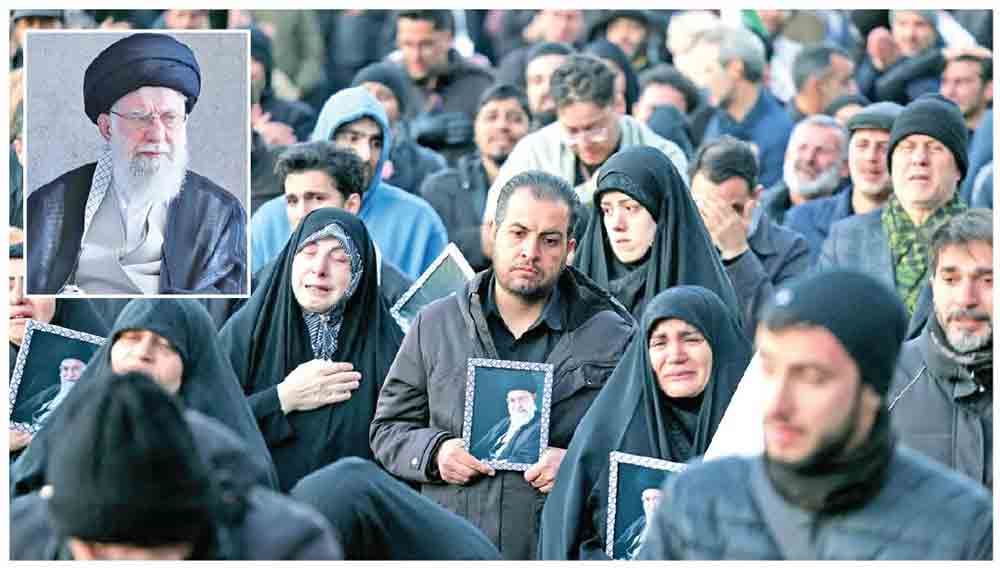
DUBAI, MAR 1: Ayatollah Ali Khamenei, Iran's supreme leader since 1989, was killed in the opening salvo of a massive US and Israeli attack that extended into a second day Sunday, as the two powers seek to topple the Islamic republic.
Iranian state television confirmed Khamenei's death early Sunday, hours after President Donald Trump announced the killing of the 86-year-old cleric he described as "one of the most evil people in History.
Iran announced a 40-day mourning period and seven public holidays following the death of supreme leader Ayatollah Ali Khamenei, who had been in power since 1989.
"With the martyrdom of the supreme leader, his path and mission neither will be lost nor will be forgotten, on the other hand, they will be pursued with greater vigour and zeal," a presenter said.
"The attack came weeks after Iranian authorities ruthlessly put down mass protests, killing thousands.
Loud explosions again pierced Tehran in the early hours, as Trump vowed no let-up in the strikes until the fall of the Islamic republic and urged security forces to stand down.
"This is the single greatest chance for the Iranian people to take back their Country," Trump said in a statement.
Iran responded to the attack with a flurry of missile and drone strikes across the Middle East, killing at least two people in Abu Dhabi and another in Tel Aviv as explosions rocked the showcase cities of Gulf Arab monarchies.
The Israeli army said that Ali Shamkhani, a top advisor to Khamenei, and the head of Iran's powerful Revolutionary Guards, General Mohammad Pakpour, were both also killed.Along with Khamenei, Iranian media said that his daughter, son-in-law and granddaughter were killed.
One prominent survivor, Ali Larijani, head of Iran's Supreme National Security Council, vowed defiance.
"The brave soldiers and the great nation of Iran will teach an unforgettable lesson to the international oppressors," he said.
Meawnhile, Israel and the US have launched fresh waves of intensive attacks across Iran on the second day of their military campaign to overthrow the country's government, which has plunged the Middle East into a new regional conflict with no certain timeline or outcome.
The renewed violence on Sunday comes amid heated rhetoric from Washington and Tehran that suggests further escalation in the coming hours and days.
"This is a really serious and deteriorating situation, [with] rising risks of increasing Iranian indiscriminate retaliatory attacks," the British defence secretary, John Healey said on Sunday morning. Healey accused Iran of "lashing out".
Iranian retaliation has targeted Israel as well as civilian infrastructure and US military bases across the Arab Gulf states. Loud blasts were heard for a second day on Sunday in Dubai and over Qatar's capital, Doha, witnesses said.
Puffs of white smoke from missile interceptions were glimpsed in the skies over Dubai, while billows of dark smoke rose over its port, one of the busiest in the Middle East.
Dubai's Burj Al Arab hotel and its airport, which handles more than 1,000 flights a day, were damaged in Iranian attacks overnight on sites that also hit airports in Abu Dhabi and Kuwait. The airport in Dubai, the world's busiest international travel hub, remained shut, along with other major Middle East airports, causing one of global aviation's most severe disruptions in years.
Air raid sirens sounded repeatedly across Israel early on Sunday, with a series of loud explosions heard in Jerusalem and Tel Aviv as Israel's sophisticated air defence system sought to intercept the latest Iranian offensive. �"AFP





