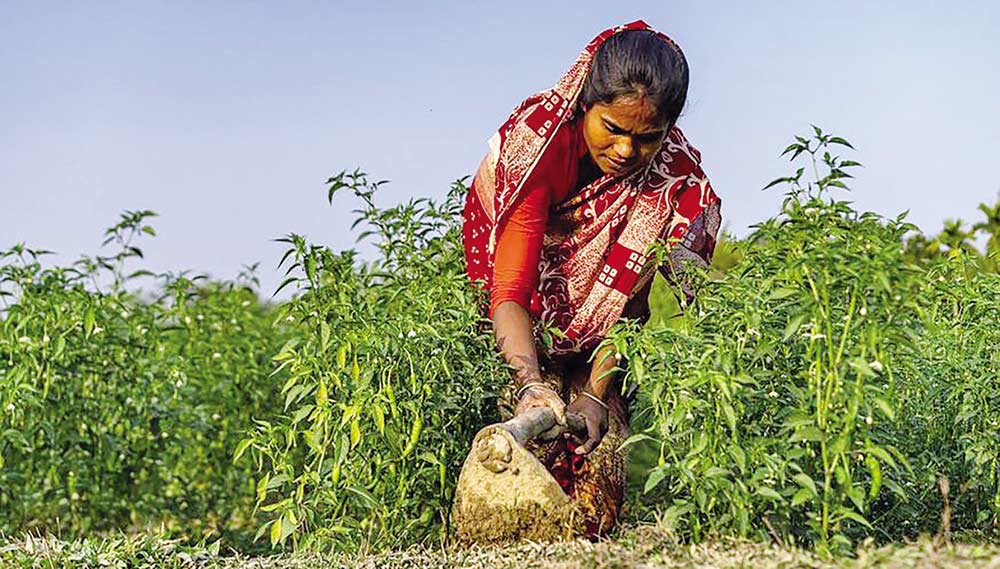
Female agricultural workers in Bangladesh are earning at least 26 per cent less than their male counterparts, exposing a persistent and widening gender wage gap in the country's largest employment sector.
According to the latest survey by the Bangladesh Bureau of Statistics (BBS), a male agricultural labourer received an average daily wage of Tk 625 in December, while a female worker earned only Tk 462. The findings, published Sunday on the BBS website under the report Crop Statistics and Agricultural Labour Wages, underscore deep-rooted inequality in rural labour markets.
The survey, conducted in December and covering workers aged 15 years and above engaged in agricultural labour, reveals that the disparity is not an isolated phenomenon but part of a broader and entrenched pattern across informal sectors.
Syed Sultan Uddin Ahmed, head of the Labour Reform Commission and executive director of the Bangladesh Institute of Labour Studies (BILS), described the wage gap as a clear violation of basic human rights.
"Such wage disparity exists across all informal sectors, including agriculture. Not only are wages low, but discrimination is layered on top," he said.
He noted that in regions such as the Barendra belt, women are reportedly paid as little as half of what men receive, often openly declared. This imbalance, he added, contributes to social strain within families and is cited as one of the factors behind multiple marriages among men.
The Labour Reform Commission has recommended the introduction of a national wage structure applicable across institutional, non-institutional, public and private sectors to ensure a minimum standard of living. It has also proposed the creation of a worker database, identity cards, and district-level government offices to address labour grievances, enabling workers to seek redress for exploitation and unfair treatment.
Ahmed added that if the proposed Labour Law Amendment Ordinance-currently under parliamentary consideration-is passed, it could help reduce wage inequality and improve enforcement mechanisms.
The BBS compiles agricultural wage data on a monthly basis by collecting information from upazilas through interviews with 10 daily labourers per area. The average national wage is then calculated based on aggregated district-level data.
The 2024 Labour Force Survey by BBS shows that agriculture remains the largest employment sector, accounting for 44.67 per cent of the workforce. Women's participation in the labour force stands at 2.37 crore, of whom 2.28 crore are employed.
Despite their significant contribution, women remain disproportionately underpaid and undervalued. According to the Campaign for Sustainable Livelihoods (CSRL), rural women in Bangladesh are engaged in 17 out of 21 types of agricultural work.
A study by the Centre for Policy Dialogue (CPD) further indicates that women often work three times more than men, yet their labour is frequently excluded from being recognised as a formal source of household income.
The survey also highlights the persistence of traditional payment practices, where wages are often supplemented with meals. In December, male workers receiving three meals earned Tk 523 on average, compared to Tk 385 for female workers. Even when meals are excluded, the gap remains stark, with men earning Tk 625 daily compared to Tk 462 for women.
The findings reveal that wage inequality persists regardless of whether workers are compensated with food or cash alone, indicating a systemic imbalance rather than isolated disparities.
As Bangladesh continues to rely heavily on its agricultural workforce, the widening gender wage gap raises urgent questions about equity, economic justice, and the need for structural reform in labour practices.





