



| HEADLINE |

|
JS passes 7 election-linked Ordinances as laws
Published : Tuesday, 7 April, 2026 at 12:00 AM
Special Correspondent


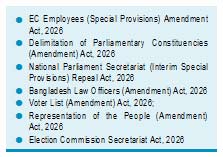 The government has taken a significant step toward formalizing the previously issued ordinances of the interim government as seven important bills including the 'Voter List (Amendment) Act, 2026; Representation of the People (Amendment) Act, 2026; and Election Commission Secretariat were passed in the Jatiya Sangsad (Parliament) on Monday, while three other bills were deferred for further discussion amid objections from lawmakers.
 The Parliament session was chaired by Deputy Speaker Qaiser Kamal, where Law, Justice and Parliamentary Affairs Minister Md. Asaduzzaman placed a total of 10 bills for consideration. Following voice votes, seven bills were approved, reflecting broad consensus on key electoral and administrative reforms.
The other bills passed into law include the Election Commission Employees (Special Provisions) Amendment Act, 2026; Delimitation of Parliamentary Constituencies (Amendment) Act, 2026; National Parliament Secretariat (Interim Special Provisions) Repeal Act, 2026 and Bangladesh Law Officers (Amendment) Act, 2026.
These laws are primarily aimed at strengthening electoral governance, enhancing administrative efficiency, and ensuring smoother parliamentary operations.
Three bills were held back due to objections raised by members of parliament, are - National Human Rights Commission (Repeal and Re-enactment) Act, 2026; Supreme Court Secretariat Repeal Act, 2026 and Supreme Court Judges Appointment Ordinance (Repeal) Act, 2026.
According to parliamentary sources, these bills involve sensitive institutional and judicial structure related issues. They will undergo further scrutiny and are expected to be reintroduced after detailed discussions.
During the session, Land Minister Mizanur Rahman Minu introduced the "Land Use Control and Agricultural Land Protection (Amendment) Bill."
The proposed legislation was referred to a special parliamentary committee for detailed examination, reflecting the importance of safeguarding agricultural land and ensuring planned land use.
The interim government had promulgated a total of 133 ordinances, with an initial plan to convert 98 of them into formal laws. Under Article 93 of the Constitution, ordinances must be placed before Parliament and passed within 30 days of its first sitting.
In line with this requirement, the first batch of 10 bills was tabled on Monday, with the remaining 88 expected to be presented in phases.
Loading...
Loading...
Also read



Editor : Iqbal Sobhan Chowdhury
Published by the Editor on behalf of the Observer Ltd. from Globe Printers, 24/A, New Eskaton Road, Ramna, Dhaka.
Editorial, News and Commercial Offices : Aziz Bhaban (2nd floor), 93, Motijheel C/A, Dhaka-1000.
Phone: PABX- 41053001-06; Advertisement: 41053012; 01793317829, 01550707291, E-mail: [email protected], [email protected] Online: email: [email protected] 41053014; 01550707297 Advertisement: 01550707296
Published by the Editor on behalf of the Observer Ltd. from Globe Printers, 24/A, New Eskaton Road, Ramna, Dhaka.
Editorial, News and Commercial Offices : Aziz Bhaban (2nd floor), 93, Motijheel C/A, Dhaka-1000.
Phone: PABX- 41053001-06; Advertisement: 41053012; 01793317829, 01550707291, E-mail: [email protected], [email protected] Online: email: [email protected] 41053014; 01550707297 Advertisement: 01550707296


