



| HEADLINE |

|
BNP's 100 Days In Power
Govt falls short of expectations on governance, anti-corruption: TIB


 Transparency International Bangladesh (TIB) has said the BNP government's first 100 days in office have fallen short of public expectations in ensuring good governance, accountability and corruption control, despite some positive initiatives.
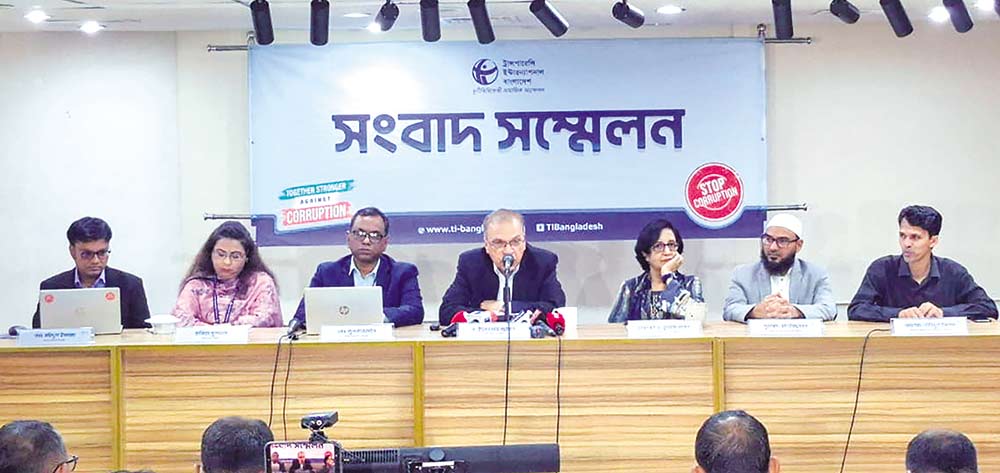
The observation came in a report titled "100 Days of the Government after the 13th National Parliament Election: Monitoring the Implementation of Good Governance and Anti-Corruption Promises", unveiled at a press conference at the MIDAS Centre in Dhaka on Sunday.
According to TIB, one of the key aspirations of the July uprising and mass movement was the establishment of a well-governed, accountable and corruption-free state. However, economic instability, high inflation, weaknesses in the banking sector, law and order challenges, and crises in the power and energy sectors have slowed reform efforts.
The report acknowledged several government measures, including limiting the use of official vehicles and facilities, avoiding state protocol and introducing ministry-based monitoring initiatives. However, it said these steps were insufficient to establish institutional good governance.
TIB noted that no effective initiative had been taken to restructure key institutions such as the Anti-Corruption Commission (ACC), the Human Rights Commission and the Information Commission during the government's first 100 days. It also identified the absence of a long-term anti-corruption framework as a major weakness.
The organisation further observed that while the government moved to convert 97 of the 133 ordinances issued during the interim administration into laws, some provisions strengthening executive authority had been retained despite limited reforms relating to judicial independence, human rights and anti-corruption.
Although the government declared a policy of "zero tolerance" towards corruption, TIB said there had been no visible progress in investigating allegations against influential figures from political parties, business groups and professional organisations. Allegations of partisan influence in state-owned banks, local government institutions, educational establishments and development projects also remain unresolved. Presenting the report, TIB Executive Director Dr Iftekharuzzaman said the government's performance reflected both positive and negative trends.
"In some cases we are seeing good initiatives. In some cases we are seeing old trends. Some laws have been made to strengthen the power of the executive branch. After the formation of the government, some appointments have been made that are clearly partisan. This is completely unexpected," he said.
Loading...
Loading...
Also read



Editor : Iqbal Sobhan Chowdhury
Published by the Editor on behalf of the Observer Ltd. from Globe Printers, 24/A, New Eskaton Road, Ramna, Dhaka.
Editorial, News and Commercial Offices : Aziz Bhaban (2nd floor), 93, Motijheel C/A, Dhaka-1000.
Phone: PABX- 41053001-06; Online: 41053014; 01550707296 Advertisement: 41053012; 01550707291
E-mail: [email protected] [email protected]
Published by the Editor on behalf of the Observer Ltd. from Globe Printers, 24/A, New Eskaton Road, Ramna, Dhaka.
Editorial, News and Commercial Offices : Aziz Bhaban (2nd floor), 93, Motijheel C/A, Dhaka-1000.
Phone: PABX- 41053001-06; Online: 41053014; 01550707296 Advertisement: 41053012; 01550707291
E-mail: [email protected] [email protected]


