



| HEADLINE |

|

Pahela Baishakh celebrated in colour
Published : Thursday, 16 April, 2026 at 12:00 AM
Special Correspondent


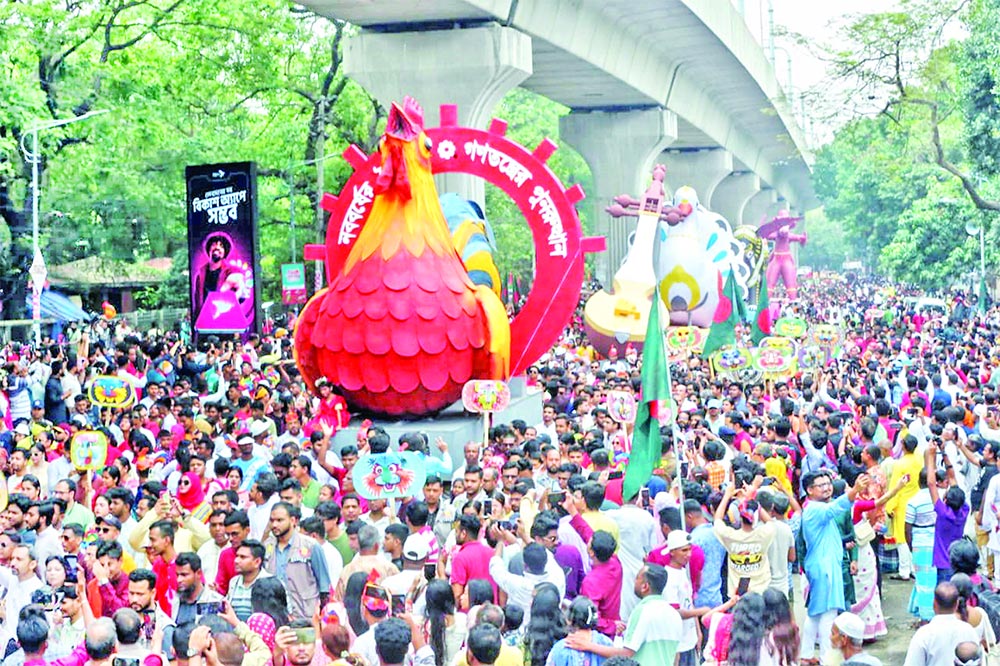 The nation on Tuesday celebrated Pahela Baishakh, the first day of Bangla New Year 1433, with vibrant festivities, deep-rooted traditions and widespread participation across the country, reflecting unity, cultural pride and renewed hope.
From the capital Dhaka to remote districts, people from all walks of life joined the celebrations, leaving behind the sorrows and fatigue of the outgoing year and welcoming the New Year with optimism and enthusiasm. Over the centuries, Pahela Baishakh has evolved into a universal festival that transcends religion, caste and ethnicity, bringing together millions of Bangladeshis at home and abroad in a shared cultural expression.
In Dhaka, elaborate programmes were organised by cultural institutions, government bodies and educational establishments, turning the capital into a vibrant hub of festivities. The day began at dawn at Ramna Batamul, where Chhayanaut hosted its iconic cultural programme. The event opened with the national anthem, followed by Rabindranath Tagore's timeless "Eso He Baishakh," setting a spiritual tone centred on peace, humanity and non-communal harmony.
A key highlight was the traditional Baishakhi Shobhajatra organised by the Faculty of Fine Arts, University of Dhaka, under the theme "Harmony of the New Year, Revival of Democracy."

Loading...
Loading...
Also read



Editor : Iqbal Sobhan Chowdhury
Published by the Editor on behalf of the Observer Ltd. from Globe Printers, 24/A, New Eskaton Road, Ramna, Dhaka.
Editorial, News and Commercial Offices : Aziz Bhaban (2nd floor), 93, Motijheel C/A, Dhaka-1000.
Phone: PABX- 41053001-06; Advertisement: 41053012; 01793317829, 01550707291, E-mail: [email protected], [email protected] Online: email: [email protected] 41053014; 01550707297 Advertisement: 01550707296
Published by the Editor on behalf of the Observer Ltd. from Globe Printers, 24/A, New Eskaton Road, Ramna, Dhaka.
Editorial, News and Commercial Offices : Aziz Bhaban (2nd floor), 93, Motijheel C/A, Dhaka-1000.
Phone: PABX- 41053001-06; Advertisement: 41053012; 01793317829, 01550707291, E-mail: [email protected], [email protected] Online: email: [email protected] 41053014; 01550707297 Advertisement: 01550707296


