



| HEADLINE |

|

Fresh load-shedding grips country
Rising demand, plant constraints, fuel crunch deepen electricity shortfall
Published : Wednesday, 22 April, 2026 at 12:00 AM
Special Correspondent


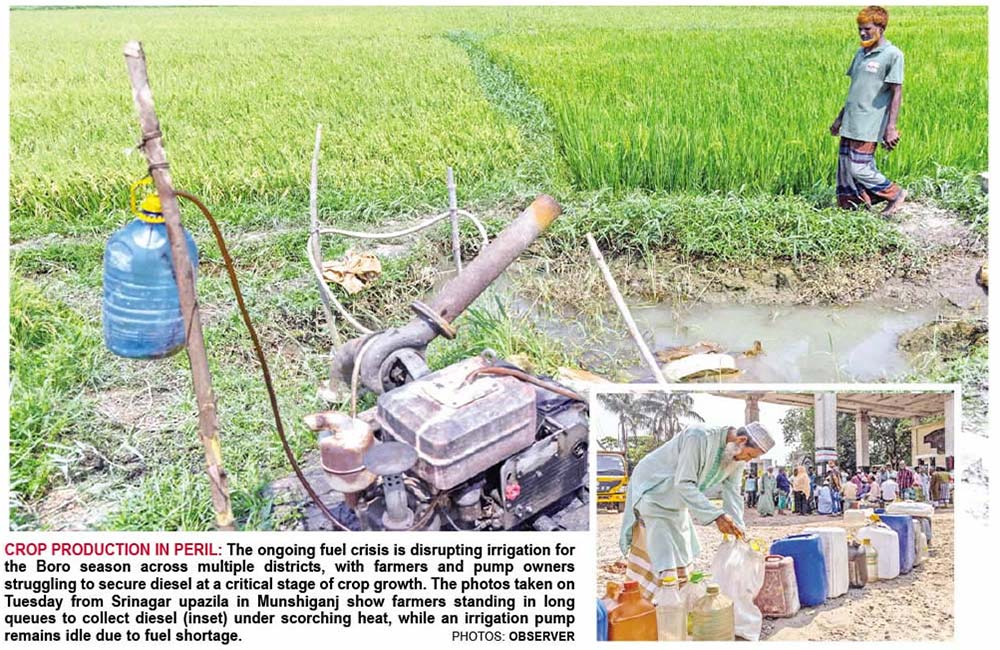 Soaring temperatures coupled with a fuel shortage have triggered widespread load-shedding across the country, crossing 2,000 megawatts of grid cuts on Tuesday evening.
Despite an installed generation capacity of nearly 29,000 megawatts, Bangladesh is unable to fully utilise its power plants due to fuel constraints, according to Power Grid Bangladesh data.
The Bangladesh Power Development Board (BPDB) is currently generating around 13,198 megawatts against a demand of about 15,200 megawatts.
Khulna, Sylhet, Chattogram and Mymensingh are among the worst affected, with many areas in these divisions experiencing five to six spells of load-shedding daily, just as students prepare for the ongoing Secondary School Certificate (SSC) examinations.
Over 2,000 MW load-shedding on Tuesday evening
BPDB data shows daily electricity demand has recently risen to between 13,500 and 15,000 megawatts, up from an average of around 12,000 megawatts in March. The widening gap has led to load-shedding of up to 1,000 megawatts on average.
A partial shutdown at a power plant operated by India's Adani Group has further reduced supply, with output dropping to around 755-760 megawatts from a potential 1,400 megawatts when both units are operational.
Amid intense heat and humidity, rural areas are bearing the brunt, with outages lasting an average of four to five hours daily.
Officials warn the situation could worsen if global fuel supply uncertainties persist, particularly as the peak summer and irrigation season approaches - traditionally the highest-demand period for electricity.
Six out of ten power plants in Khulna Division are either non-operational or operating at reduced capacity. In Sylhet, total demand stands at 477 megawatts, including 170 megawatts for BPDB consumers and 307 megawatts for rural users.
Mounting financial strain
The crisis is being intensified by rising fuel import costs. Officials estimate a deficit of around Tk 4,500 crore from LNG imports in a single month. The Ministry of Finance is reportedly considering energy price adjustments to ease subsidy pressure as import costs have nearly doubled in recent months.
At the same time, the power sector is facing mounting arrears. Outstanding dues owed by BPDB to domestic and foreign companies have reached about Tk 43,000 crore, including Tk 15,000 crore owed to private producers and Tk 2,500 crore in unpaid import-based electricity bills.
Risk of escalation
Energy experts warn the situation could deteriorate further without stable fuel supply. Gas-fired plants are operating well below capacity due to limited gas availability, while coal-fired plants face delays in fuel shipments.
A senior BPDB official said several coal plants, including the Matarbari Power Plant, are affected by fuel delivery delays, though shipments are expected within the next week.
Emergency measures
The government has introduced demand-management measures, including early closure of shops after peak hours, reduced office timings and restrictions on air conditioner use. Officials estimate these steps could save up to 1,500 megawatts.
Authorities are also prioritising gas supply during evening peak hours, with plans to increase generation by up to 2,000 megawatts in the coming weeks.
Private producers sound alarm
Private power producers have warned of a looming crisis if fuel supplies are not restored. The Bangladesh Independent Power Producers Association (BIPPA) said furnace oil stocks could run out by around 20 April, threatening up to 4,000 megawatts of generation capacity.
Operators say payment delays have prevented them from opening letters of credit for fuel imports, while rising global prices have further strained operations.
"We will require 8,000-10,000 metric tonnes of fuel per day to generate around 4,000MW of electricity from liquid fuel-based plants. If we operate at only 80 per cent capacity, most plants may be forced to shut down after 20 April 2026," said BIPPA President David Hasnat.
He added that outstanding payments include around Tk 600 crore for liquid fuel-based generation and Tk 400 crore for gas-based plants over the past seven months.
"Under normal circumstances, fuel import takes 35-40 days. But due to ongoing disruptions, delays could be longer. Without funds, we cannot even begin procurement," he said.
Regional impact
Power Grid Company data shows that in Greater Dhaka, Gazipur and Savar, around 45 per cent power disruption is being reported. In Sylhet, the figure stands at 28 per cent, while many rural areas are experiencing 8-10 hours of load-shedding daily.

Loading...
Loading...
Also read



Editor : Iqbal Sobhan Chowdhury
Published by the Editor on behalf of the Observer Ltd. from Globe Printers, 24/A, New Eskaton Road, Ramna, Dhaka.
Editorial, News and Commercial Offices : Aziz Bhaban (2nd floor), 93, Motijheel C/A, Dhaka-1000.
Phone: PABX- 41053001-06; Advertisement: 41053012; 01793317829, 01550707291, E-mail: [email protected], [email protected] Online: email: [email protected] 41053014; 01550707297 Advertisement: 01550707296
Published by the Editor on behalf of the Observer Ltd. from Globe Printers, 24/A, New Eskaton Road, Ramna, Dhaka.
Editorial, News and Commercial Offices : Aziz Bhaban (2nd floor), 93, Motijheel C/A, Dhaka-1000.
Phone: PABX- 41053001-06; Advertisement: 41053012; 01793317829, 01550707291, E-mail: [email protected], [email protected] Online: email: [email protected] 41053014; 01550707297 Advertisement: 01550707296


