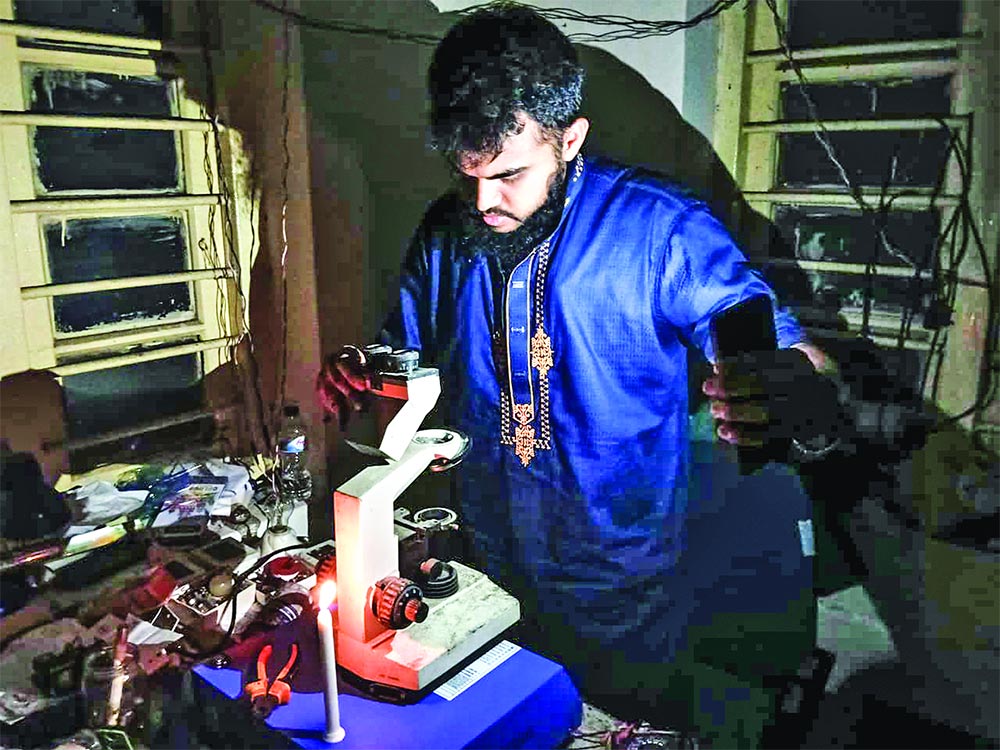
The Power Division has decided to divert electricity from urban centres to rural areas in a bid to reduce disparities in power supply between city and village consumers.
"We cannot allow urban residents to remain comfortable while rural people suffer. The spirit of the July Uprising calls for a discrimination-free Bangladesh. To eliminate this gap, we have decided to enforce load-shedding in cities if necessary, so that farmers in villages can get adequate electricity for irrigation," State Minister for Power, Energy and Mineral Resources Anindya Islam Amit told the Jatiya Sangsad on Thursday.
He said the government, after discussions with the Leader of the Opposition, has decided to begin an initial trial of 110 megawatts (MW) of load-shedding in Dhaka.
He also informed Parliament that the country's peak electricity demand on Wednesday stood at around 16,000MW, while generation reached 14,126MW, forcing authorities to shed 2,086MW of load.
However, officials acknowledge that the actual impact is higher. Large parts of Khulna, Mymensingh, Sylhet, Brahmanbaria, Savar, Gazipur and Narayanganj are reportedly experiencing 6 to 7 hours of load-shedding daily.
At a media briefing at the Power Division, Joint Secretary Umme Rehana said the country is currently facing a fuel shortage involving coal, gas and furnace oil, leaving no option but to impose load-shedding. She noted that power production is currently short by around 2,500MW against demand, which could rise to 3,000MW.
* 110MW load-shedding trial planned for Dhaka
* Around 2,000-3,000MW now national generation shortfall
* Several coal plants operating at half capacity
* Adani plant expected to resume full operations by April 26
* 7,000MT of diesel received from India via pipeline
She added that several coal-fired plants are operating at half capacity, including India's Adani power plant, Chattogram's SS Power and Patuakhali's RNPL. The Adani plant has reduced output due to technical issues, while others are facing coal shortages.
Encouragingly, she said the inoperative unit of India's Jharkhand-based Adani power plant is expected to resume operations by 26 April, while other coal-based plants are likely to increase output by early May. By then, coal-based generation is expected to reach 1,982MW.
State Minister Anindya Islam Amit said the government expects improved supply within the next seven days as major plants return to full production capacity.
He also acknowledged that despite higher installed capacity on paper, actual generation remains constrained due to fuel shortages and infrastructure limitations.
Irrigation priority amid heatwaveAmid the ongoing heatwave, the State Minister said the government has prioritised uninterrupted electricity for irrigation during the current harvest season, even as load-shedding continues in some areas.
He said the crisis is not short-term but the result of accumulated structural and supply-side issues. The government, he added, is consulting all stakeholders, including the opposition, to stabilise the electricity situation.
He further highlighted a gas supply gap, stating that daily demand is 3,800 million cubic feet, while domestic production is 1,616 million cubic feet and imports contribute 950 million cubic feet-leaving a shortfall of 1,164 million cubic feet.
"Even with financial capacity, it is not possible to increase gas imports immediately due to infrastructure constraints," he said, adding that expanding infrastructure is part of a 180-day action plan.
Fuel imports from India risingBangladesh received an additional 7,000 tonnes of diesel from India through the cross-border pipeline this month, taking April's total import through the system to 13,000 tonnes and the yearly total to 35,000 tonnes.
The fuel, transported under the India-Bangladesh Friendship Pipeline project, is received at the Parbatipur depot in Dinajpur before being distributed by state-owned companies-Padma, Meghna and Jamuna.
Authorities plan to import 25,000 tonnes of diesel from India in April, with earlier consignments of 8,000 tonnes and 5,000 tonnes already delivered.
Separately, Bangladesh Petroleum Corporation (BPC) sources said over one lakh tonnes of diesel and octane arrived at Chattogram Port last Tuesday via three tankers. Additionally, 25,000 metric tonnes of refined diesel have been imported from India's Numaligarh Refinery this month.
Global energy pressure and LNG importsOfficials said instability in the Middle East has disrupted global energy markets, pushing up fuel prices and increasing pressure on Bangladesh's import-dependent economy.
To ensure energy security, the government is importing liquefied natural gas (LNG) from multiple countries, including the USA, Australia, Angola, UAE, Kazakhstan and Oman through direct procurement.
So far, 20 LNG cargoes have been procured, with nine in April alone-six of which have already arrived. Another 11 cargoes are scheduled for May.
Renewable push and fuel stocksThe government has also expanded its focus on renewable energy. Currently, 1,445.07MW of electricity is generated from solar sources, with a target of 10,000MW by 2030.
Authorities said storage capacity has been increased to ensure at least three months of fuel reserves.
As of 22 April, fuel stock stood at 1,54,808 tonnes of diesel, 25,077 tonnes of octane, 19,201 tonnes of petrol, 53,135 tonnes of furnace oil and 17,484 tonnes of jet fuel.
To speed up procurement, the government has reduced the international tender period for fuel imports from 42 days to 10 days, aiming to improve supply responsiveness.





