



| HEADLINE |

|
13 Years Of Rana Plaza Tragedy
Survivors, families still cry, feel unlucky
Published : Saturday, 25 April, 2026 at 12:00 AM
Business Correspondent


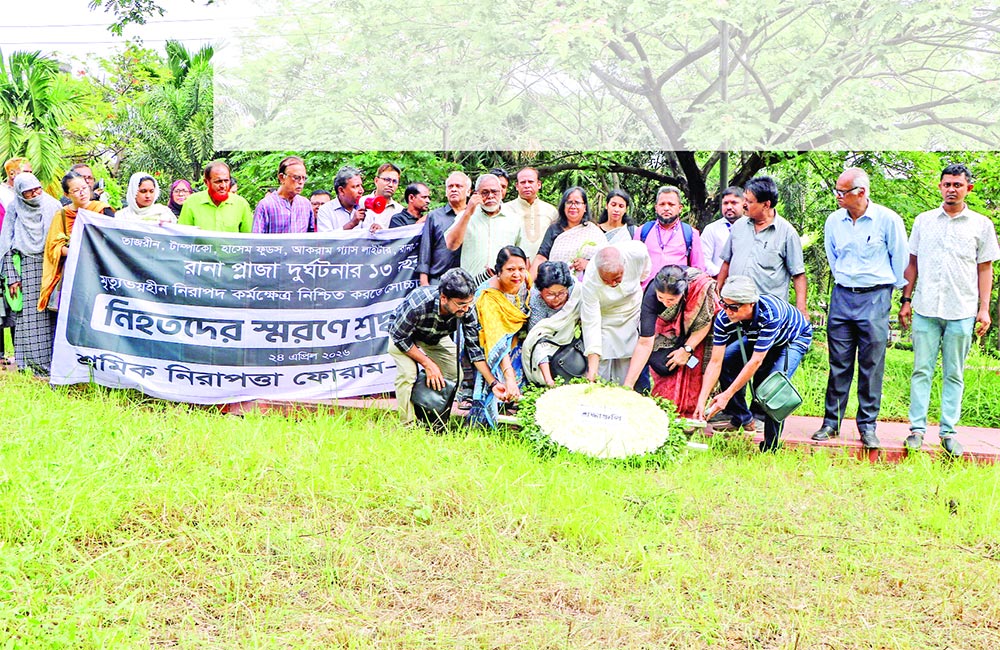 Thirteen years on, the shadows of the Rana Plaza tragedy still linger-long, heavy, and unrelenting. For the survivors and the families who lost their loved ones, time has not healed; it has only deepened the silence of unanswered questions. Even in the wake of the July Uprising, which many hoped would usher in justice and renewal, their grief remains largely unaddressed.
On Friday morning, labour organisations gathered in front of Rana Plaza with protest marches and human chains, marking the solemn anniversary. Flowers were placed at a temporary martyr's altar, a fragile tribute to lives lost too soon. Yet, for many grieving families and injured workers, commemoration alone felt hollow. Soon, their voices rose-raw and resolute-demanding justice, accountability, and the highest punishment for those responsible, including building owner Sohel Rana.
On that fateful day in 2013, at least 1,175 workers perished in what remains the deadliest industrial disaster in the country's history. Many more succumbed later to their injuries, while thousands survived with scars-both visible and unseen. The air had once been thick with dust, concrete, and desperate cries; rescue teams pulled from the rubble not just lifeless bodies, but shattered futures and broken hopes.
Today, the pain persists. As years pass, the questions grow heavier Will justice ever arrive Survivors continue to endure chronic illness, disability, and financial despair. Families struggle without their breadwinners, their lives reshaped by loss.
The nine-storey Rana Plaza once housed banks and shops on its lower floors, and five garment factories above-an uneasy structure that became a tomb. Each year since 2013, April 24 is observed as Rana Plaza Day, yet remembrance has not translated into resolution.
Legal proceedings have dragged on with agonising delay. A charge sheet was filed against 41 individuals, including Sohel Rana, and the trial began in 2016. What once seemed a case bound for swift justice has instead been ensnared in procedural setbacks, appeals, and inertia. Of the 594 listed witnesses, only 145 have testified. Even after the Appellate Division ordered the trial's completion within six months in January 2024, progress has remained stalled, trapped in a cycle of postponements and uncertainty.
Meanwhile, lives continue to unravel.
Khairul Mamun Mintu of the Bangladesh Garments and Sweaters Workers Trade Union Center called for immediate compensation, permanent rehabilitation, and exemplary punishment for all those responsible. His words echoed the anguish of many.
Bulbuli Akhter, once a worker on the eighth floor, now lives with permanent disability. "For 13 years, I have been living a life that is not truly human," she said quietly, her voice carrying years of struggle. Dependent on others even for daily meals, she still waits for dignity to return.
Masuda Begum, who worked on the seventh floor, survived but with severe injuries. Though she can walk again after prolonged treatment, her body remains frail, her life constrained. Living in a rented home, dependent on her child's income, she says the world's attention faded long ago. "After some initial help, no one looks after us anymore," she lamented.
Parul Begum, another survivor, spoke of a life defined by deprivation. Unable to afford her children's education or basic necessities, she urged the government to ensure proper treatment, rehabilitation, and compensation. She also called for a hospital or training centre to be built on the site-a place of healing rising from ruins.
The site itself mirrors this neglect. Once sealed off, it now lies overgrown, its fences gone, its memory fading beneath creeping vines. Yet, every April 24, it stirs again-briefly-through vigils, protests, and remembrance.
Labour leaders note that many accused, except Sohel Rana, continue their lives unburdened. Rafiqul Islam Sujan of the Bangladesh Garments and Industrial Workers Federation pointed out that, despite international labour standards, many victims have yet to receive adequate compensation.
Thirteen years later, Rana Plaza is no longer just a place-it is a wound. A wound that demands not only remembrance, but justice, dignity, and closure. Until then, the survivors and the bereaved will continue to live in the long shadow of that fallen building, still waiting for a justice that feels endlessly delayed.
Loading...
Loading...
Also read



Editor : Iqbal Sobhan Chowdhury
Published by the Editor on behalf of the Observer Ltd. from Globe Printers, 24/A, New Eskaton Road, Ramna, Dhaka.
Editorial, News and Commercial Offices : Aziz Bhaban (2nd floor), 93, Motijheel C/A, Dhaka-1000.
Phone: PABX- 41053001-06; Advertisement: 41053012; 01793317829, 01550707291, E-mail: [email protected], [email protected] Online: email: [email protected] 41053014; 01550707297 Advertisement: 01550707296
Published by the Editor on behalf of the Observer Ltd. from Globe Printers, 24/A, New Eskaton Road, Ramna, Dhaka.
Editorial, News and Commercial Offices : Aziz Bhaban (2nd floor), 93, Motijheel C/A, Dhaka-1000.
Phone: PABX- 41053001-06; Advertisement: 41053012; 01793317829, 01550707291, E-mail: [email protected], [email protected] Online: email: [email protected] 41053014; 01550707297 Advertisement: 01550707296


