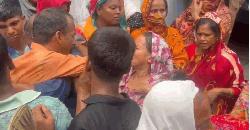
A discussion was held on Tuesday at the Rampura office of Nari Unnayan Shakti (NUS) demanding proper justice for violence against women and children, including rape.
The event, organized with underprivileged women from the Khilgaon area, was supported by Bangladesh Shishu Adhikar Forum, Young Women for Development Rights and Climate, and Forum for Culture and Human Development.
The keynote paper was presented by Dr. Afroja Parvin, Executive Director of Nari Unnayan Shakti and Chair of the session.
In her presentation, she stated that incidents of violence and rape against women and children in Bangladesh are increasing at an alarming rate, posing a serious threat to the country’s human rights situation. According to a report published in the New Age newspaper, data from Bangladesh Police Headquarters shows that approximately 7,068 rape cases were filed in 2025, compared to 5,570 in 2024, indicating a significant rise. A considerable proportion of the victims are children. According to Bangladesh Mahila Parishad, on average, four to five women and children fall victim to sexual violence every day.
A Dhaka Tribune report indicates: gang rape 179 incidents; attempted rape 188 incidents; suicide after rape 7 cases; and sexual harassment 169 incidents.
UNICEF has noted that a significant portion of violence against children in Bangladesh is perpetrated by individuals known to them. A report by Manusher Jonno Foundation states that many incidents in rural areas go unreported due to superstition, social pressure, and a culture of impunity.
Experts believe that impunity, social silence, superstition, and abuse of power are the four main drivers behind the rise in such crimes.
Referring to a recent horrific incident, she mentioned that in Faridganj, Chandpur, a four-year-old child was allegedly lured with biscuits and sexually abused by a local mosque muezzin. The child suffered severe physical and psychological trauma. Although the accused has been arrested, the incident has created widespread fear in the community.
Khairuzzaman Kamal, vice president of Bangladesh Shishu Adhikar Forum, stated that in Noakhali (Companiganj, Kabirhat, and Subarnachar), a madrasa head teacher deceived a teenage girl by claiming she was possessed by spirits and then sexually abused her in isolation. The victim and her family were later threatened and intimidated after filing a case, including threats of violence and arson. The family continues to live in fear and insecurity, and justice must be ensured.
Nusrat Sultana Afroz, Executive Chairperson of Young Women for Development Rights and Climate, said, “These incidents are a disgrace to our state and society. If we fail to ensure the safety of children, development loses all meaning. Due to the culture of impunity, such violence is increasing day by day.” Shaheda Wahab, President of Forum for Culture and Human Development, added, “Unless superstition and abuse of power are stopped, such crimes will continue.”
Abul Hossain, President of the Textile Garments Workers Federation, said, “Society must build resistance, and the government must strengthen administrative monitoring to ensure proper justice.” Selina Khatun, Publicity Secretary of SHILEAD, emphasized, “A zero-tolerance policy must be implemented against all forms of violence against women and children.” Tahura Khatun and Abul Kalam, representing underprivileged community stated, “Rehabilitation of victims is extremely important.”
Participants of the meeting strongly protested and demanded that violence against women and children be treated as a national emergency. They emphasized the need to stop the misuse of religious, social, or institutional identities to commit crimes, take strict action against fraudulent practices in the name of superstition and fake healing, ensure security for victims and their families, and end the culture of impunity.
The key demands raised at the meeting include: immediate arrest of the accused; speedy trial through special tribunals; ensuring maximum punishment; medical treatment, psychological support, and rehabilitation for victims; security for victims’ families; action against those involved in threats and attacks; and activation of local child protection committees.
The release further stated that ensuring the safety of women and children is a constitutional responsibility of the state. To prevent such incidents, the government, administration, civil society, and media must work in a coordinated manner.