



| HEADLINE |

|
Tariff relief comes with conditions, not comfort: US Ambassador


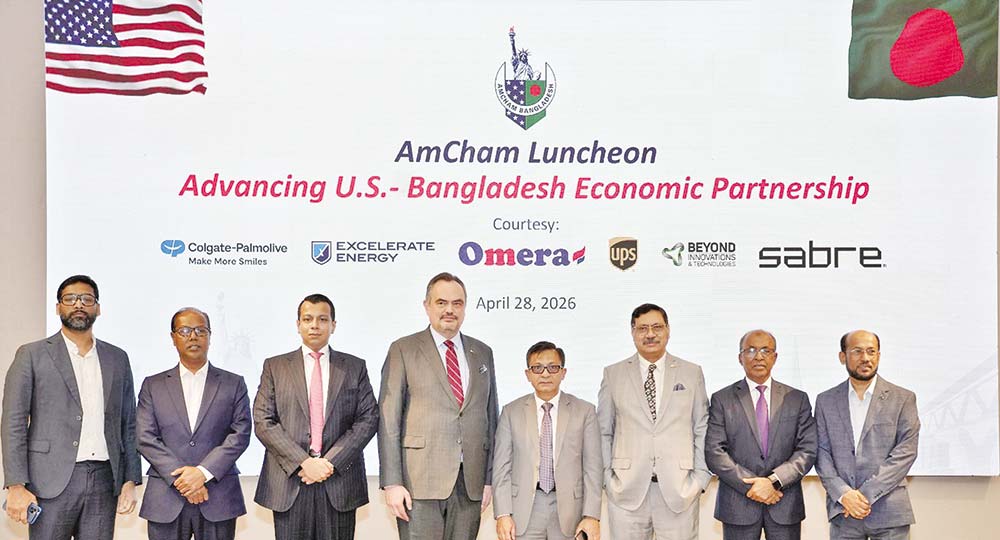 At an American Chamber of Commerce in Bangladesh (AmCham) seminar titled "Advancing US-Bangladesh Economic Partnership" at Sheraton Dhaka on Tuesday, the tone of US-Bangladesh economic engagement turned sharply conditional, balancing reform pressure, development caution, and business pragmatism.
"Tariff relief comes with conditions, not comfort," said US Ambassador to Bangladesh Brent T. Christensen, speaking as the keynote voice on Washington's trade posture. He anchored his remarks around the emerging Agreement on Reciprocal Trade (ART) and made it clear that Bangladesh's continued access to the US market would not come as an unconditional concession.
He stressed that tariff advantages must be matched with structural reforms in Bangladesh's trade and investment ecosystem.
According to him, priority areas include reducing non-tariff barriers, ensuring predictable contract enforcement, and improving regulatory transparency for foreign investors.
The Ambassador's message was firm but diplomatic: access to the US market will remain, but only within a rule-based environment that supports long-term investment confidence.
He also hinted that future investment flows from the US will increasingly depend on measurable policy consistency rather than goodwill-based engagement.
Christensen said, "The ART is an excellent agreement, which preserves Bangladesh's access to the critical U.S. market with competitive 19 per cent tariffs - down from 35 per cent without the agreement - while making changes in Bangladesh's tariffs and non-tariff trade barriers designed to encourage imports from the United States to balance our trade."
Following him, the Chief Guest, commerce minister Khandaker Abdul Muktadir presented Bangladesh's position with a more cautious developmental tone.
He acknowledged the importance of the US market for Bangladesh's export economy, particularly the ready-made garment sector, which continues to dominate external earnings. However, he highlighted the structural vulnerability that comes with such concentration and reiterated the government's intention to diversify into pharmaceuticals, agro-processing, leather, and ICT sectors. He underlined that Bangladesh is simultaneously managing the transition challenges of LDC graduation, which requires policy space, institutional strengthening, and time for industries to adjust. His remarks reflected a balancing act-recognising external expectations for reform while emphasising internal constraints that limit the speed of change.
He did not reject reform, but framed it as a phased necessity rather than an immediate overhaul like provisional licenses to run business to avoid lengthy process of getting licenses.
He also said to take urgent measures to resolve problems in the sea ports.
Syed Ershad Ahmed, President of AmCham Bangladesh in his welcome address described the engagement as a "practical partnership moment" rather than a policy confrontation.
According to him, investors are not driven by political narratives but by consistency, clarity, and predictability in the business environment. He stressed that US and Bangladeshi companies both require stable rules of engagement, transparent procedures, and reduced uncertainty in trade and investment processes.
He added that sudden policy shifts or regulatory unpredictability create hesitation in capital flow, even when market potential is strong. In simple terms, he positioned AmCham as a bridge between ambition and execution, saying that economic partnership only works when both sides speak in the language of stability rather than pressure.
Loading...
Loading...
Also read



Editor : Iqbal Sobhan Chowdhury
Published by the Editor on behalf of the Observer Ltd. from Globe Printers, 24/A, New Eskaton Road, Ramna, Dhaka.
Editorial, News and Commercial Offices : Aziz Bhaban (2nd floor), 93, Motijheel C/A, Dhaka-1000.
Phone: PABX- 41053001-06; Advertisement: 41053012; 01793317829, 01550707291, E-mail: [email protected], [email protected] Online: email: [email protected] 41053014; 01550707297 Advertisement: 01550707296
Published by the Editor on behalf of the Observer Ltd. from Globe Printers, 24/A, New Eskaton Road, Ramna, Dhaka.
Editorial, News and Commercial Offices : Aziz Bhaban (2nd floor), 93, Motijheel C/A, Dhaka-1000.
Phone: PABX- 41053001-06; Advertisement: 41053012; 01793317829, 01550707291, E-mail: [email protected], [email protected] Online: email: [email protected] 41053014; 01550707297 Advertisement: 01550707296


