Bangladesh Foreign Minister (FM) Dr Khalilur Rahman has warned that any disruption to global trade corridors, particularly key maritime routes such as the Strait of Hormuz, could trigger widespread economic consequences affecting both developed and developing nations.
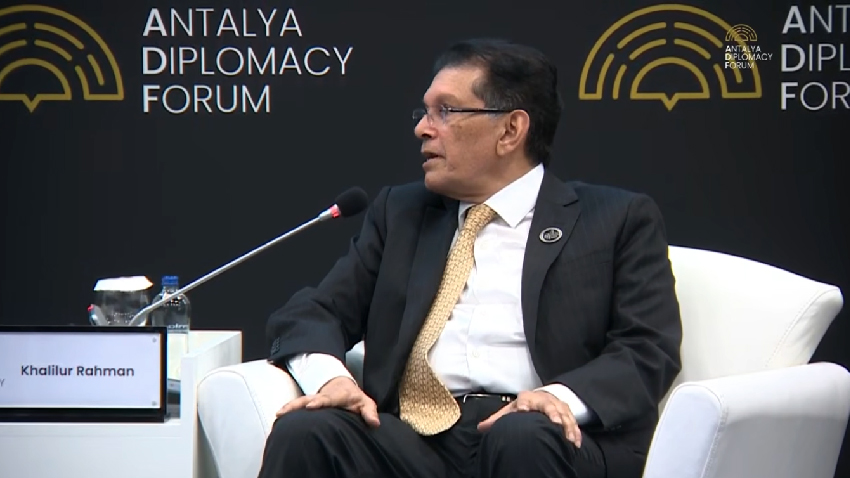
Speaking at ADF Talks during the Antalya Diplomacy Forum in Turkiye, the Foreign Minister stressed that uninterrupted navigation through vital sea lanes is essential for global stability.
He said the recent confirmation that the Strait of Hormuz would remain open had already calmed markets, pointing to the immediate impact on oil prices.
“It is critical that international commerce remains free and open,” he said. “If these channels are obstructed, global growth suffers and countries across the board face serious consequences.”
Dr Khalilur called for coordinated international efforts to contain the ongoing energy crisis, cautioning that prolonged supply disruptions could deliver severe shocks to vulnerable economies. Citing assessments by the International Energy Agency, he noted that the current crisis could potentially rival the scale of the oil shocks of the 1970s.
“If the impact mirrors that period, we are facing very difficult days ahead,” he said, adding that collective global action would be the only effective response to mounting pressures in energy markets.
Reflecting on past crises, the Foreign Minister recalled the hardships endured by developing countries during the 1980s following earlier oil shocks. He warned against repeating that experience, emphasizing the need for both peace and practical measures to limit economic fallout, particularly for nations with limited resilience.
As a net energy importer, Bangladesh remains exposed to fluctuations in oil, liquefied petroleum gas and fertiliser supplies, much of which pass through strategic maritime routes. Dr Khalilur said any prolonged disruption would have direct implications for agriculture, industry and household consumption, especially during peak sowing seasons when diesel and fertiliser demand rises.
He noted that the government is attempting to cushion the domestic impact through energy conservation initiatives, fuel rationing and adjustments to institutional schedules aimed at reducing consumption.
The Foreign Minister was attending the fifth edition of the Antalya Diplomacy Forum, held from April 17 to 19 under the auspices of Turkish President Recep Tayyip Erdoğan. This year’s theme, Mapping Tomorrow Managing Uncertainties, focused on navigating geopolitical tensions, shifting power dynamics and rising trade barriers in an increasingly unpredictable global environment.
On domestic matters, Dr Khalilur described Bangladesh’s February 2026 parliamentary elections as among the most peaceful in the country’s history. He said the decisive victory of the ruling BNP had placed significant responsibility on the government, which has since launched welfare initiatives including family cards for disadvantaged households and farmers’ cards to support the agricultural sector.
Outlining the country’s diplomatic priorities, he said Dhaka would pursue a Bangladesh First policy that safeguards national interests while maintaining balanced and constructive relations worldwide. “Bangladesh First does not mean Bangladesh alone,” he said, stressing that the approach is grounded in mutual respect for sovereignty and territorial integrity.
Regarding his candidacy for President of the United Nations General Assembly, Dr Khalilur said his long experience at the UN would enable him to take on the role immediately if elected. He pledged to represent all member states while prioritising the concerns of the Global South, smaller nations and vulnerable countries.
He also described the Antalya Diplomacy Forum as a valuable venue for dialogue, praising the depth of discussions and the scope for bilateral engagement.