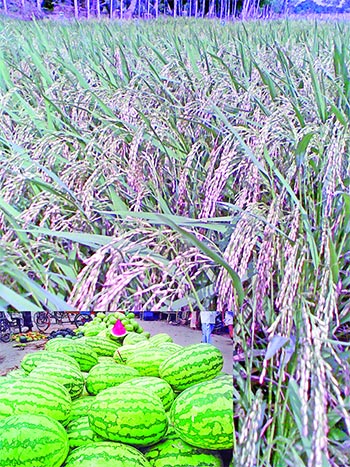
BARISHAL, Apr 3: Watermelon, winter vegetables, Boro paddy, oilseeds, pulses, onions and potatoes produced during the outgoing Rabi season have together contributed around Tk 1.5 lakh crore to the agriculture economy of the Barishal region at the field level, according to sector insiders.
Economists believe the value may rise to nearly Tk 2.5 lakh crore at the retail stage.
Field data suggest that after the strong contribution of winter crops-especially watermelon-Boro paddy is set to add a new dimension to the region's agricultural economy. As a result, Rabi crops this season are playing a significant role not only in Barishal but also in the wider southern region.
Dr Nazrul Islam Sikder, Regional Chief of the Department of Agricultural Extension (DAE) in Barishal, said the region already has a surplus of around 1.4 million tonnes of food grains. He added that Barishal is largely self-sufficient in Rabi and other crops, noting that nearly 70 percent of the country's watermelon is now produced in the region. The southern belt is also ahead in producing khesari, mung bean and chilli, he said, expressing optimism about a strong agricultural future.
In the just-concluding Rabi season, around 1.5 million tonnes of winter vegetables were produced on 75,000 hectares of land in Barishal. At an average field price of Tk 20 per kg, the estimated value stood at around Tk 3,000 crore. Although some vegetables sold at over Tk 30 per kg, others fetched less than Tk 10. Despite high production, market prices remained relatively higher than in previous years, yet farmers did not receive fair returns. Analysts say produce often changes hands three to four times before reaching consumers, pushing prices up four to five times.
Similarly, a record 3 million tonnes of watermelon were produced on nearly 71,000 hectares this season. At an average field price of Tk 50 per kg, the value at farm level exceeded Tk 15,000 crore. However, from traders to wholesalers and retailers, total transactions involving watermelon are estimated to have crossed Tk 50,000 crore.
Meanwhile, Boro paddy cultivation on nearly 400,000 hectares was completed by March 15, and harvesting is expected to begin after May 15. Farmers are working to achieve a target of about 1.8 million tonnes of Boro rice. The government has set procurement prices at Tk 36 per kg for paddy and Tk 49 per kg for rice, putting the official value of the expected output at around Tk 6,500 crore.
Taken together, watermelon, winter vegetables and Boro paddy alone are expected to contribute nearly Tk 60,000 crore to the region's agricultural economy this season. Economists at Barishal and Patuakhali universities say this will have a notable impact on the national economy as well.
However, rising production costs remain a concern. Disruptions in diesel supply and other challenges have increased input costs, while a 15 percent rise in retail prices has pushed Boro production costs to around Tk 1,250 per unit. Despite this, paddy prices remain low in local markets, even as rice prices are rising. Agricultural experts warn that failure to ensure fair prices could severely affect farmers and discourage future cultivation.
Another major concern is the lack of processing facilities. Although Bangladesh produces over 4 million tonnes of watermelon annually during winter, there is no significant ?????? to process the fruit into value-added products. Experts believe processed watermelon could be exported, boosting foreign exchange earnings.
For years, locals have demanded the establishment of an agro- and fisheries-based export processing zone (EPZ) in Barishal. Economists argue that such a facility could capitalise on local resources, including hilsa, guava, hog plum and watermelon, and bring positive socio-economic change to the region.
Despite bumper harvests this season, farmers have not seen a corresponding improvement in their livelihoods due to the dominance of middlemen. As a local saying goes, those who produce the crops often remain deprived, while profits are captured by intermediaries and traders-a reality that still holds true across Barishal and the broader southern region.





