



| HEADLINE |

|

Political backing, legal gaps deepen juvenile gang threat



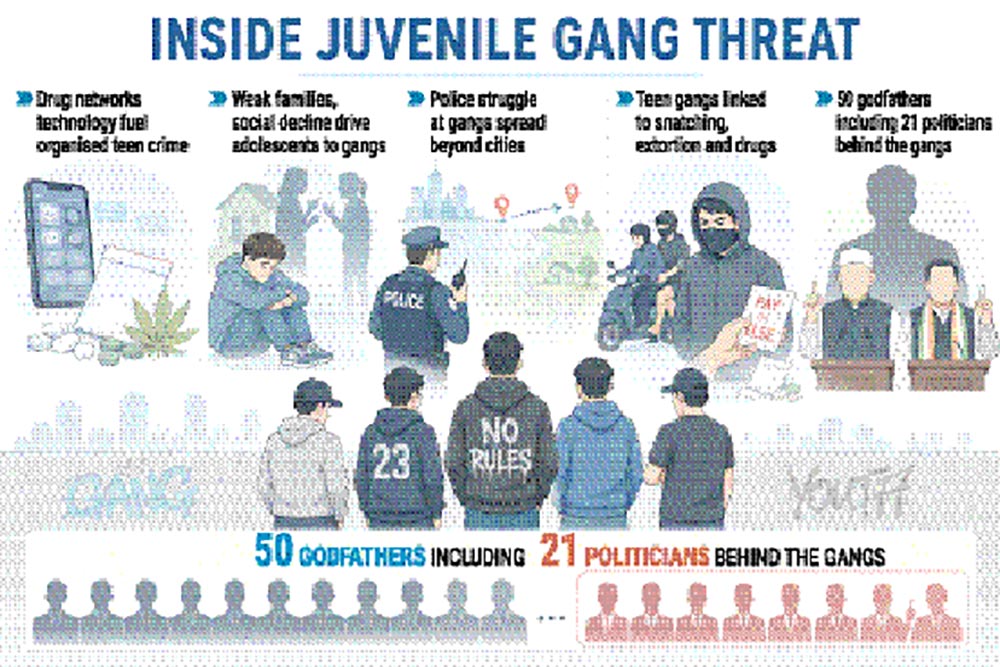 The persistence of juvenile gangs in Bangladesh is being driven not only by street-level violence but also by the "invisible hands" of political patrons, legal loopholes, drug networks and social breakdown.
Area-based juvenile gangs, often operating anonymously and under shifting identities, continue to pose a major challenge for law enforcement. Many allegedly operate under the protection of influential local figures, enabling members to act with impunity despite raids and arrests.
Information circulated by the Special Crime Management Branch of Police Headquarters identifies support networks linked to political actors behind such gangs in multiple areas, including around 50 alleged godfathers, among them Dhaka ward and metropolitan-level political leaders.
Teen gangs are involved in various crimes including snatching, extortion, drug trading, land grabbing, stalking, sexual harassment and illegal internet business.
A Dhaka Metropolitan Police (DMP) official, speaking on condition of anonymity, said the rise of juvenile gangs is driven by political patronage, local power struggles, access to weapons and the spread of narcotics. Law enforcement officials note that many accused secure bail soon after arrest and return to criminal activity, reinforcing a cycle of impunity.
DMP Additional Commissioner SN Nazrul Islam has called for stricter scrutiny in granting bail, including reviewing prior criminal records, while emphasising the role of families, educational institutions and society in steering adolescents away from crime.
Researchers and police link the rise in gang activity to technology, turf rivalries and control over the drug trade, with teenage crime becoming increasingly organised and violent. A senior police officer warned that repeated release of juvenile offenders has emboldened gangs and expanded their reach into rural areas.
Criminology expert Touhidul Haque said disadvantaged adolescents are being drawn into criminal networks and exploited by vested interests, arguing that existing legal measures are insufficient and require reform alongside action against those who patronise such groups. He also noted that juvenile correction centres often fail to rehabilitate offenders effectively.
Psychiatrists highlight drug dependency and lack of family intervention as key drivers, while narcotics officials point to large-scale drug inflows worsening the crisis. Analysts say juvenile development centres have had limited impact, fuelling debate over stronger legal reforms.
Community and political representatives stress the need for stronger local action. Some identify specific high-risk zones and call for dismantling criminal hubs and improving intelligence surveillance. Others allege that local businesses serve as centres for stolen goods and that influential figures continue to shelter juvenile gangs.
Stakeholders broadly link the growth of juvenile gangs to a combination of social, economic and institutional factors, including weak family supervision, failures in education, poverty, declining engagement in cultural and sports activities, legal loopholes and enforcement limitations. The influence of local power structures, peer rivalries and the glamorisation of violence further compound the problem.
Authorities have announced increased surveillance and enforcement measures, including large-scale CCTV installation and efforts to compile lists of active gangs and identify their sponsors. The issue has also been raised in parliament, with calls for more proactive policing.
Experts and community leaders advocate a coordinated strategy combining legal reform, social intervention and stronger accountability. They emphasise that prevention must begin within families and communities, supported by effective law enforcement and evidence-based policy measures, while ensuring that those who enable and exploit juvenile offenders are brought under the law.

Loading...
Loading...
Also read



Editor : Iqbal Sobhan Chowdhury
Published by the Editor on behalf of the Observer Ltd. from Globe Printers, 24/A, New Eskaton Road, Ramna, Dhaka.
Editorial, News and Commercial Offices : Aziz Bhaban (2nd floor), 93, Motijheel C/A, Dhaka-1000.
Phone: PABX- 41053001-06; Advertisement: 41053012; 01793317829, 01550707291, E-mail: [email protected], [email protected] Online: email: [email protected] 41053014; 01550707297 Advertisement: 01550707296
Published by the Editor on behalf of the Observer Ltd. from Globe Printers, 24/A, New Eskaton Road, Ramna, Dhaka.
Editorial, News and Commercial Offices : Aziz Bhaban (2nd floor), 93, Motijheel C/A, Dhaka-1000.
Phone: PABX- 41053001-06; Advertisement: 41053012; 01793317829, 01550707291, E-mail: [email protected], [email protected] Online: email: [email protected] 41053014; 01550707297 Advertisement: 01550707296


