



| HEADLINE |

|
Caught between crackdown, chaos
Dhaka's auto-rickshaw drivers seek rules, not raids


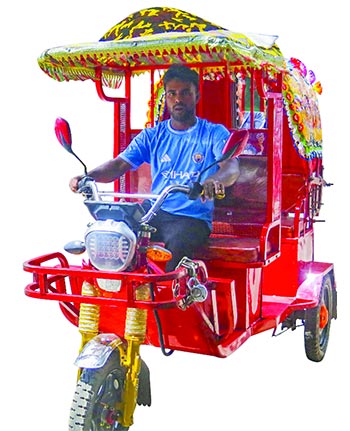 "We live hand to mouth. When our vehicles are seized, we have to spend money just to get them back," said Asad, an auto-rickshaw driver in Motijheel. "Sometimes it costs up to Tk 1,200. But nobody explains why the money is taken or where it goes. We spend hours moving from one office to another."
For drivers like Asad, an enforcement drive does not end with the seizure of a vehicle. It often marks the beginning of a costly and uncertain process involving dumping yards, paperwork, unofficial payments and lost working hours.
Across Dhaka, frustration is growing among auto-rickshaw drivers following recent crackdowns on unauthorized vehicles. Drivers allege that recovering seized auto-rickshaws now requires payments averaging around Tk 1,200 per vehicle, though the amount varies from case to case and lacks any clearly communicated structure.
Many drivers say they are not opposed to regulation. What they object to, they insist, is the absence of a transparent and unified system governing seizure, fines and release procedures.
The issue has once again highlighted a larger policy dilemma surrounding Dhaka's transport system - how to balance urban traffic management with the livelihoods of thousands of low-income drivers who depend on auto-rickshaws for survival.
A transport lifeline for thousands
In many neighbourhoods of the capital, battery-powered auto-rickshaws have become one of the most
accessible and affordable modes of transport, particularly for short-distance travel.
For commuters, they offer convenience in congested areas where buses are limited or unavailable. For drivers, they provide one of the few income opportunities requiring relatively low investment and limited formal qualifications.
Yet despite their growing presence on the streets, the sector continues to operate in a grey area between public demand and regulatory uncertainty.
Drivers claim that enforcement personnel often seize vehicles during operations without clearly explaining the legal grounds or subsequent procedures. The process of securing release frequently involves multiple offices, paperwork delays and unexpected expenses.
For daily wage earners, even a single day without a vehicle can mean losing the ability to provide for their families.
"We are not against regulation. We want clear rules," said Karim, a representative of drivers. "If there is a proper legal structure, everyone will know where and how vehicles can operate. But right now, there is no defined system, and that is where the problem begins."
Between enforcement and uncertainty
Authorities argue that the ongoing drives are necessary to restore discipline on the roads and reduce congestion caused by unauthorized vehicles.
Transport officials maintain that unregulated battery-powered rickshaws and auto-rickshaws cannot continue operating freely within an already strained urban transport network. According to officials, the drives are intended to improve public safety and bring order to the city's roads.
At the same time, policymakers themselves appear divided over the future of the sector.
A transport ministry official recently indicated that a final policy decision has yet to be taken on whether auto-rickshaws will face a complete ban or eventually be integrated into a regulated framework through coordination among city corporations, traffic authorities and the home ministry.
That uncertainty has deepened tensions on the streets.
Drivers say the absence of a formal licensing system leaves them vulnerable to inconsistent enforcement. Without designated routes, approved permits or standardised penalties, many feel trapped between public demand for their services and official drives against their vehicles.
Experts call for integration, not elimination
Urban transport experts argue that auto-rickshaws are no longer a temporary phenomenon but an established part of Dhaka's mobility system.
According to urban planners, simply removing small vehicles from the roads is unlikely to solve congestion in a city already struggling with inadequate public transport infrastructure.
"Simply banning small vehicles will not solve congestion," said one urban planner. "Instead, they should be regulated and incorporated into a broader transport system. Without long-term planning, pressure on the transport network will only increase."
Experts also stress the need for transparency in enforcement.
They argue that unclear seizure procedures and undefined payment systems create opportunities for irregularities while weakening public trust in regulatory agencies.
Without clear rules explaining why vehicles are seized, how fines are determined and where collected money goes, drivers remain vulnerable to confusion and possible abuse, they say.
Divided public opinion
The debate over auto-rickshaws has also divided city residents.
Some commuters view the vehicles as an essential transport option in areas poorly served by buses or other public transport. Others believe the growing number of auto-rickshaws contributes significantly to congestion, reckless driving and road safety risks.
Those favouring stricter enforcement argue that stronger regulation is necessary to restore order on Dhaka's roads and improve traffic discipline.
Yet even many supporters of tighter control acknowledge that the sector cannot simply disappear overnight without affecting thousands of livelihoods.
A policy vacuum on the streets
For now, Dhaka's auto-rickshaw sector remains caught in a policy vacuum.
On one side stand thousands of drivers struggling to earn a living in an uncertain regulatory environment. On the other are authorities attempting to manage worsening traffic congestion and urban disorder.
The conflict reflects a broader challenge facing the capital: how to create a transport system that is both organised and inclusive.
Driver groups continue to demand a comprehensive policy that includes licensing, designated routes, fixed fees and transparent penalties. They argue that regulation - not repeated crackdowns - is the only sustainable solution.
"We are ready to follow the law," one driver said. "But the law should not be used as a tool against us."
As enforcement drives continue across the capital, the pressure is now on policymakers to decide whether Dhaka's auto-rickshaws will remain targets of periodic crackdowns or become part of a regulated urban transport system designed to serve both commuters and drivers alike.
Loading...
Loading...
Also read



Editor : Iqbal Sobhan Chowdhury
Published by the Editor on behalf of the Observer Ltd. from Globe Printers, 24/A, New Eskaton Road, Ramna, Dhaka.
Editorial, News and Commercial Offices : Aziz Bhaban (2nd floor), 93, Motijheel C/A, Dhaka-1000.
Phone: PABX- 41053001-06; Advertisement: 41053012; 01793317829, 01550707291, E-mail: [email protected], [email protected] Online: email: [email protected] 41053014; 01550707297 Advertisement: 01550707296
Published by the Editor on behalf of the Observer Ltd. from Globe Printers, 24/A, New Eskaton Road, Ramna, Dhaka.
Editorial, News and Commercial Offices : Aziz Bhaban (2nd floor), 93, Motijheel C/A, Dhaka-1000.
Phone: PABX- 41053001-06; Advertisement: 41053012; 01793317829, 01550707291, E-mail: [email protected], [email protected] Online: email: [email protected] 41053014; 01550707297 Advertisement: 01550707296


