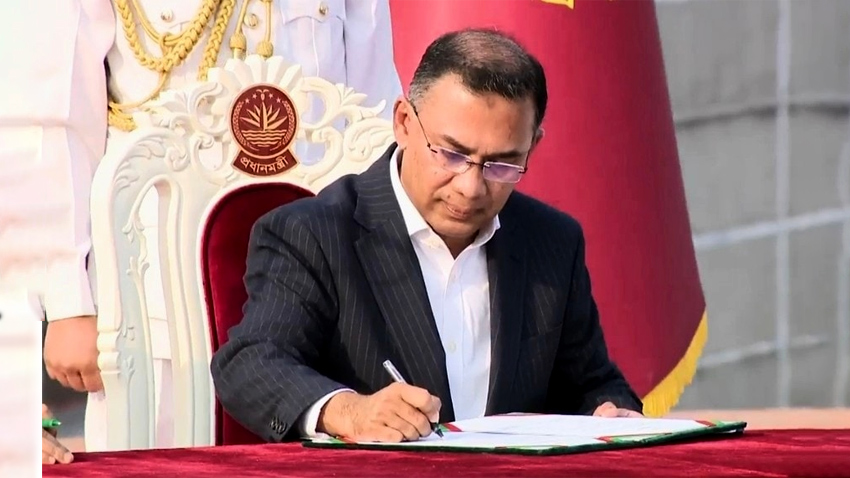
The corridors of power usually distance people--from citizens, from reality, and sometimes even from their own families. The busyness of governing a state, layers of security, and the rigidity of protocol gradually confine a head of government within an invisible wall. Yet, at certain moments in history, some leaders emerge who are able to break through that wall and enter the hearts of ordinary people through their conduct, humanity, and simplicity of life. The scenes that the people of Bangladesh have recently witnessed surrounding Prime Minister Tarique Rahman carry the indication of such a new political culture.
Recently, his act of personally driving from the Secretariat to the Bangladesh-China Friendship Conference Center in Agargaon to attend an event sparked widespread discussion on social media. Sitting beside him was his spouse, Dr. Zubaida Rahman. A Prime Minister sitting in the driver’s seat himself and traveling through traffic congestion with his wife is an entirely exceptional scene in the political culture of Bangladesh.
Even more remarkable was the fact that, on the way, he obeyed traffic signals, got stuck in traffic like ordinary citizens, and waved warmly to people around him. There was no arrogance of power, no artificial distance; rather, there was a natural human touch.
The significance of this scene deepens further when one recalls another incident. Near Karwan Bazar on the expressway, the Prime Minister reportedly stopped his convoy and instructed that an ambulance carrying a patient be given way first. The people of Bangladesh have witnessed many times how ordinary citizens, even ambulances carrying critically ill patients, were forced to wait for hours because of VIP movements. In that reality, when a Prime Minister halts his own security convoy and says, “Let the ambulance go first,” it is not merely an administrative instruction; it is, in effect, a symbol of a transformation in state thinking.
Tarique Rahman’s recent activities repeatedly make one thing clear--he seeks to view power not as a matter of privilege, but as a responsibility. Following the landslide victory in the 13th National Election, he became the first victorious head of government in Bangladesh’s history to personally visit opposition political leaders at their homes with flowers and invite them to work together for nation-building.
In South Asian politics, where elections often mean vengeance, division, and the destruction of opponents, Tarique Rahman’s conduct stands as a rare example of political courtesy and democratic maturity.
Not only in political behavior, but also in administrative decisions, he has conveyed a different message. Ending the long-debated culture of duty-free vehicle facilities and government plot allocations with a single declaration was a bold step. In a system long associated with privilege and special benefits tied to state power, this came as a major shock. Through this, he seemed to emphasize that state resources are not objects for the enjoyment of individuals or groups; rather, they are a trust belonging to the people.
Visible changes have also come in reducing expenses at the Prime Minister’s Office. Where the per-head cost of lunch was previously 800 taka, it has reportedly been reduced to only 150 taka, bringing it to a modest and realistic level. This is not merely about saving money; symbolically, it tells the public that even the highest officeholder of the state can practice restraint and simplicity.
The personal side of Tarique Rahman’s life has also touched people deeply. His sincerity and sense of responsibility toward his wife and daughter, Zaima Rahman, have created a positive impression among the public. The image of him walking in the rain in Sylhet, shielding his wife with one hand while holding an umbrella with the other, was not merely a family moment; it symbolized respect, love, and compassion. When a statesman openly demonstrates responsibility and affection toward his family, it sends a positive message to society as well--that caring for one’s family is not a weakness, but rather an expression of human strength.
In world politics, we have seen certain leaders gain distinct respect for their family values. Former U.S. President Barack Obama earned global admiration for his family-oriented lifestyle. Similar examples can be found in former Canadian Prime Minister Justin Trudeau and former British Prime Minister David Cameron. They demonstrated that a successful statesman can simultaneously be a caring father and a responsible husband. In the context of Bangladesh, the rise of Tarique Rahman appears to have newly joined that tradition.
Most importantly, simplicity rather than artificial extravagance is becoming increasingly visible in his way of life. Simple attire, arriving at the office before scheduled hours, and continuing to work even on holidays--all these remind people that leadership is not only about speeches; leadership is also about setting examples through behavior.
For a long time, the people of Bangladesh have hoped for a style of leadership where humanity would outweigh power. Tarique Rahman’s recent actions have reignited that hope. His every step--giving way to an ambulance, driving his own car, visiting opposition leaders, reducing state expenditures, and showing sincerity toward his family--together portray him as a different kind of political figure.
Popularity in politics may be temporary, but humanity leaves a lasting imprint on people’s hearts. Perhaps that is why ordinary people are now beginning to see Tarique Rahman not only as a Prime Minister, but also as a compassionate human being, a modern statesman, and a responsible guardian.
Therefore, alongside world leaders such as Obama, Trudeau, and Cameron, the name of Bangladesh’s Prime Minister Tarique Rahman is now also being mentionedâ€"not as a symbol of the arrogance of power, but as a symbol of humane leadership.
The writer is a journalist, columnist, and political analyst