



| HEADLINE |

|
Sufferings of Dhaka Medical patients beyond illness
Published : Friday, 15 May, 2026 at 12:00 AM
Tarana Jahid Sandhi


 Last Monday, I became genuinely frightened when my eyes suddenly swelled up. After attending classes all day, I decided in the evening that I needed to go to the hospital. Soon after, heavy rain and storms began. As a residential student of Ruqqayah Hall, Dhaka Medical was relatively close, so I chose to walk.
The roads were submerged in muddy water. In Dhaka, unfortunately, this is considered normal after rain. But when I reached the area in front of, it felt less like a street and more like crossing a sea. Water had swallowed almost the entire road.
Pedestrians were forced to walk through the middle of a dangerous three-way intersection because the footpaths had disappeared underwater. Large trucks sped recklessly through the flooded roads while people struggled to pass beside them. At any moment, an accident could have happened.
After somehow reaching the main gate of, I saw cars standing half-submerged inside the hospital premises. The entire area was flooded. Yet what disturbed me even more was what waited inside.
I bought a 10-taka emergency ticket and was instructed to go from Room 1 to Room 301. Previously, whenever I had visited the emergency department, I had only stayed on the ground floor for surgical consultations. The lower floor was already unpleasant enough. But what I witnessed on the upper floors left me nauseous and short of breath.
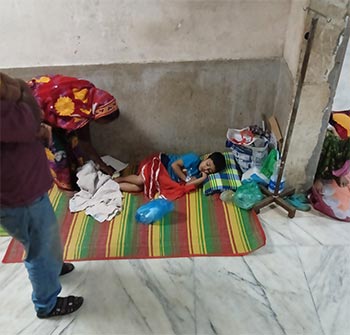 The third floor was covered in stagnant water. I had never before encountered such overwhelming filth and unbearable stench in a medical institution. Patients were receiving treatment on the floor beside dirty floodwater. The walls and corridors looked as though they had not been properly cleaned since the hospital was built. If the corridors were in such condition, I did not dare imagine the state of the washrooms.
Everywhere, there were cries of pain. Sick people lay helpless on floors soaked with dirty water. In one of my university classes, a teacher once told us: "If you ever go to Dhaka Medical, you will realize how privileged you are." That day, I finally understood what he meant.
I entered the hospital with swollen eyes. I left with nausea, breathlessness, and a crushing sense of despair. If a relatively healthy person can become physically sick merely by witnessing these conditions, what happens to the patients already fighting for their lives there? What happens to the poor, the helpless, the people who have nowhere else to go?
The tragedy does not begin inside the hospital. It starts from the streets outside. Flooded footpaths, broken drainage systems, unsafe roads, and complete urban neglect. In this country, when the sidewalks drown, people are forced to walk in the middle of speeding traffic. And when they finally reach a hospital, the healthcare environment threatens to make them even sicker.
A hospital should be a place of dignity, sanitation, and care. It should not resemble a disaster zone. Perhaps the cruelest reality of all is this: in Bangladesh, simply surviving with dignity increasingly feels like a luxury.
The writer is a student, Department of Political Science University of Dhaka
Loading...
Loading...
Also read



Editor : Iqbal Sobhan Chowdhury
Published by the Editor on behalf of the Observer Ltd. from Globe Printers, 24/A, New Eskaton Road, Ramna, Dhaka.
Editorial, News and Commercial Offices : Aziz Bhaban (2nd floor), 93, Motijheel C/A, Dhaka-1000.
Phone: PABX- 41053001-06; Advertisement: 41053012; 01793317829, 01550707291, E-mail: [email protected], [email protected] Online: email: [email protected] 41053014; 01550707297 Advertisement: 01550707296
Published by the Editor on behalf of the Observer Ltd. from Globe Printers, 24/A, New Eskaton Road, Ramna, Dhaka.
Editorial, News and Commercial Offices : Aziz Bhaban (2nd floor), 93, Motijheel C/A, Dhaka-1000.
Phone: PABX- 41053001-06; Advertisement: 41053012; 01793317829, 01550707291, E-mail: [email protected], [email protected] Online: email: [email protected] 41053014; 01550707297 Advertisement: 01550707296


