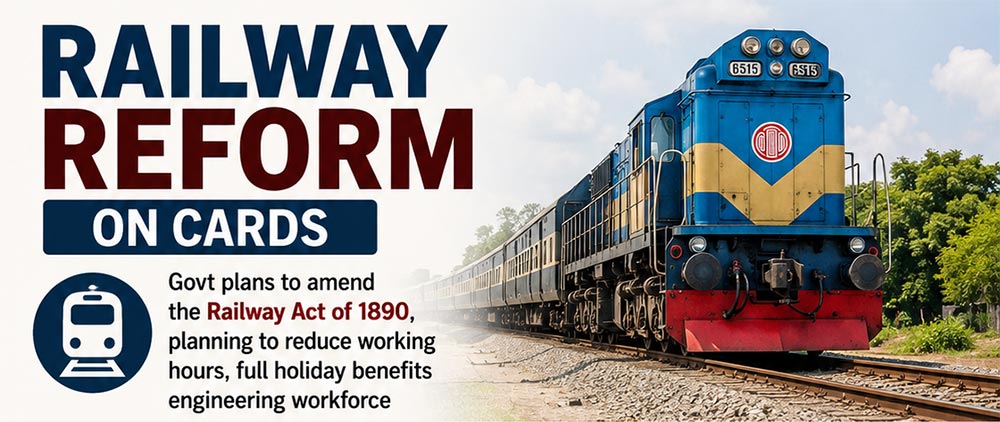
A major policy shift may finally be on the horizon for Bangladesh Railway's engineering workforce as a high-level government committee has recommended sweeping reforms to end what employees describe as 135 years of colonial-era labour discrimination.
The committee has proposed reducing working hours, introducing full holiday benefits and amending the Railway Act of 1890 - a law officials themselves described during discussions as outdated and incompatible with modern labour standards.
The recommendations came after months of review of a 12-point charter of demands submitted by field-level railway engineering employees, who have long complained of excessive duty hours, lack of leave facilities and unequal treatment compared to other government workers.
According to sources concerned, the recommendations were finalized at a meeting held at Rail Bhaban in the first week of May. The meeting was chaired by Md Asadul Haque, then Project Director and Joint Director General (Engineering) under the office of the Director General of Bangladesh Railway.
Officials involved in the process said the committee concluded that the existing Railway Act of 1890 no longer reflects operational realities, labour rights standards or technological advancement in railway management.
The issue gained momentum after engineering division employees submitted a memorandum containing 12 demands to the railway adviser in May last year. In the memorandum, workers alleged years of deprivation under a colonial work structure that still forces many field employees to remain on duty far beyond normal government working hours.
Following the submission, the Ministry of Railways directed authorities to examine the demands and submit recommendations.
Among the key demands was the introduction of two weekly holidays - Friday and Saturday - along with all government-declared gazetted holidays. Employees also demanded overtime facilities for staff required to work during emergencies or operational disruptions.
Workers further sought alignment of office schedules with the standard government timetable of 9am to 5pm, including lunch breaks. At present, many engineering field staff continue to work under operational schedules dating back to the British colonial era.
The employees also demanded proper grade changes during promotions from the post of wayman and employment opportunities for qualified children of railway workers who die while in service.
To examine the demands, Bangladesh Railway formed a nine-member committee headed by Joint Director General (Engineering) Md Asadul Haque. The committee reviewed railway laws, operational requirements and labour practices before preparing its report.
According to the report, the Railway Act of 1890 still permits railway employees in certain categories to work between 60 and 84 hours a week. The committee also noted that the law fails to clearly define "continuous workers," unlike modern railway systems in neighbouring countries including India.
The report observed that while railway technology and operations have undergone major transformation over the last century, labour conditions for many field-level employees have remained virtually unchanged.
"As a result, employees are struggling to maintain a balance between work and family life," officials familiar with the report said.
First, it proposed fixing duty hours for engineering department employees at eight hours a day and 48 hours a week. It also recommended amending the Railway Act of 1890 and related rules to align them with contemporary labour standards.
Second, the committee recommended ensuring that railway employees can enjoy gazetted and government holidays with their families. In cases where employees are required to work during emergencies, overtime benefits should be made mandatory through amendments to railway regulations.
Third, the committee proposed fixing duty hours for railway track repair and maintenance workers from 7am to 4pm, including breaks for prayers and lunch.
According to the report, the proposed schedule is operationally more practical because temperatures remain lower during morning hours, enabling workers to perform physically demanding tasks more efficiently and safely. The committee also noted that train movement remains comparatively lower during early daytime hours, reducing operational risks during track maintenance work.
The report warned that prolonged exposure to extreme afternoon heat places workers at serious risk of fatigue, dehydration and heat stroke, particularly during summer.
The committee further cited standards of the International Labour Organization (ILO) and Bangladesh Labour Law, both of which recognize eight-hour workdays as a fundamental labour right.
According to officials familiar with the process, the recommendations will now be reviewed by higher authorities at the Ministry of Railways before any final policy decision is taken.
If approved, the reforms would mark one of the most significant labour policy changes in Bangladesh Railway since the colonial era and could pave the way for wider workforce reforms across the railway sector.





