DASHMINA, PATUAKHALI, June 6: Continuous erosion by the Tentulia River is putting more than 2,000 families in four riverbank unions of Dashmina Upazila at serious risk, with homes, farmland and vital public infrastructure gradually disappearing into the river.
Locals say river erosion has become an annual crisis in the area, with hundreds of families already losing their homesteads over the years. The situation has now worsened, placing thousands more residents on the brink of displacement as the river continues to eat away at settlements along its banks.
A recent visit to the affected areas shows severe erosion in Banshbaria Union, including Banshbaria and Dhondonia villages; Dashmina Sadar Union, including Dashmina, Haji's Haat, Katakhali, Golkhali and Syedjafar; Rangopaldi Union, including Purba Auliapur, Auliapur, Charghuni and Patarchar; and Char Borhan Union, where entire settlements remain exposed to river pressure.
Residents say erosion intensifies during the monsoon season, particularly from Ashar to Ashwin, while river pressure also increases from Chaitra and Baisakh. During these periods, homesteads, cropland and local infrastructure are frequently lost, forcing families to relocate repeatedly.
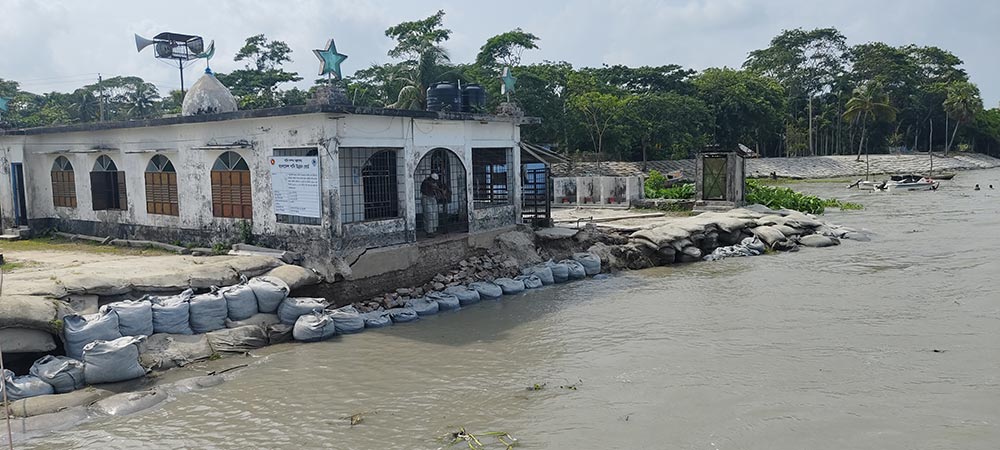
Among the worst affected areas is Haji's Hat launch ghat in Dashmina Sadar Union, where residents allege that the Water Development Board (WDB) carries out emergency protection works during the monsoon, mainly by dumping geo-bags along vulnerable points. However, locals say these temporary measures fail to withstand the strong river current, resulting in repeated damage and what they describe as wasteful public spending.
Local resident Anwar Hossain Khokon said his family has already lost a large portion of ancestral farmland to the Tetulia River. He added that parts of Haji's Hat market have also been eroded over time. "Even the front veranda of Baitul Fazl Jam-e-Mosque has gone into the river," he said, expressing concern over the ongoing destruction.
The erosion has also raised concerns over important public infrastructure, including mosques, schools, community clinics, embankments and roads. In several areas, protective embankments built by authorities are also under threat due to continuous river pressure.
Former Dashmina Upazila vice-chairman and BNP leader Fakhruzzaman Badal said the authorities mainly respond during the monsoon by dumping geo-bags, instead of taking long-term preventive measures during the dry season. He said such approaches are not effective and lead to wastage of public funds. According to him, durable block-based embankments constructed during the dry season could significantly reduce erosion risks in the region.
Imam of Baitul Fazl Jame Mosque at Haji's Hat launch ghat, Obaidullah, said the Water Development Board recently allocated around Tk 2.998 million for protecting the mosque and adjacent embankment. However, he claimed that unplanned execution of work has already resulted in partial damage to the mosque structure, including its veranda. He also said cracks have developed inside the mosque, raising concerns about its safety.
Another resident, Kabir from the embankment area near the launch ghat, said he is now living in a temporary shelter after losing his home to erosion. He said he is uncertain whether his makeshift house will survive the upcoming monsoon season.
"Everything has already been taken by the river. I don't know how long I can stay here," he said.
Locals across the four unions say at least 2,000 families are currently living under constant threat of displacement due to erosion by the Tentulia River. They also allege that although authorities take projects each year, these fail to produce lasting protection.
According to the Patuakhali WDB office, geo-bag dumping worth around Tk 60 lakh is currently underway in the Haji's Hat area to protect the mosque and nearby embankment.
Executive Engineer of Patuakhali WDB Md Rakib said the district faces widespread river erosion and the department prioritises protection of important structures such as mosques, schools and embankments. He said resources are limited and it is not possible to address all erosion points simultaneously.
He added that survey work is ongoing for a larger river management project, after which a more comprehensive plan will be taken. He also said that immediate protective works are being carried out to prevent further damage during the current monsoon season.





