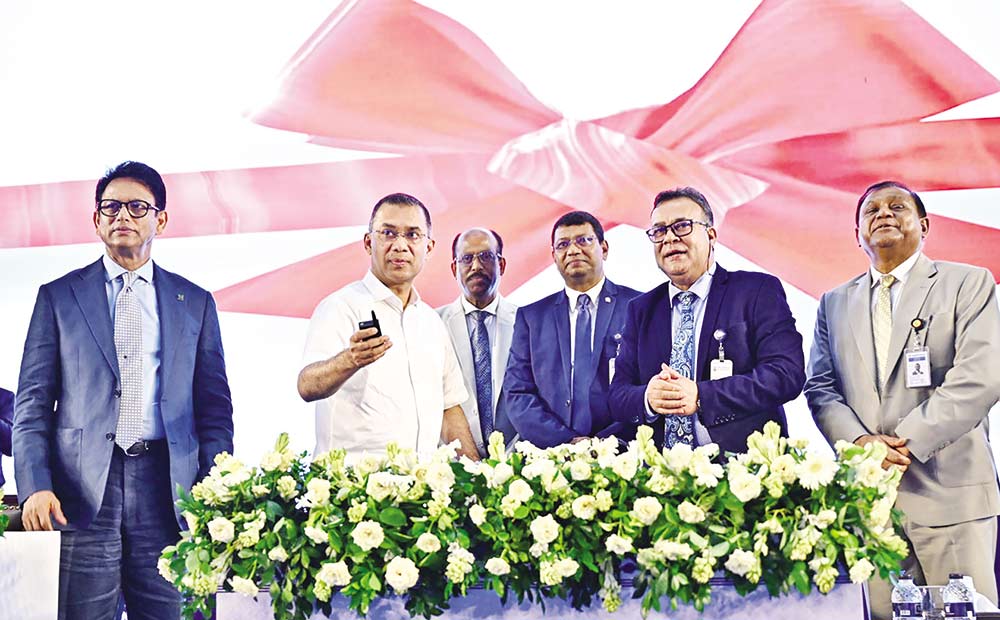
Prime Minister Tarique Rahman has said that in the era of the Fourth Industrial Revolution (4IR) and Artificial Intelligence (AI), it is no longer possible to remain competitive globally with a certificate-based education system alone. Therefore, there is no alternative to building a skill-based, technology-driven, and employment-oriented education system. He emphasised aligning education with real-life demands and employment opportunities.
The Prime Minister made these remarks while inaugurating the Teacher Training Programme on Skill-Based Education in the National University Curriculum as the chief guest at the Bangladesh-China Friendship Conference Center in the capital on Sunday (June 7).
National University Vice-Chancellor Professor Dr. ASM Amanullah chaired the event while Education Minister ANM Ehsanul Haque Milon and Prime Minister’s Adviser Dr. Mahdi Amin also addressed among others.
Tarique Rahman said that more than a decade and a half of authoritarian rule not only undermined the democratic rights of the people but also pushed the country's education system into deep crisis. Now, in a democratic Bangladesh, it is time to rebuild and move forward. To establish a knowledge-based state and society, there is no alternative to developing skilled human resources in education, research, science, and technology.
Tarique Rahman noted that the National University has the potential to play the most significant role in expanding higher education in the country. Currently, more than four million students are enrolled in over 2,000 affiliated colleges. He stressed the importance of transforming the National University into a center of modern, practical, and time-oriented education.
He stated that a modern curriculum cannot be complete without subjects such as Artificial Intelligence, Cybersecurity, Forensic Science, Programming, Digital Entrepreneurship Development, Digital Communication, Leadership, Presentation Skills, and Financial Literacy. He also emphasized equipping students with skills in emerging fields such as Genetic Engineering, Biotechnology, Quantum Computing, Nanotechnology, 3D Printing, and Fifth-Generation Wireless Technology.
The Prime Minister said that the government has already taken initiatives to make curricula from primary to higher education more practical, employment-oriented, and technology-driven. He added that curriculum reform is a continuous process in this era of research, innovation, and technological excellence.
Highlighting the issue of graduate unemployment, he said that many students remain jobless even after completing higher education due to a lack of practical and technological skills. To address this challenge, the government has undertaken initiatives to expand apprenticeships, internships, and industry-academia collaboration. Initially, these programs will be implemented through partnerships between universities in divisional cities and local industries and business establishments.





