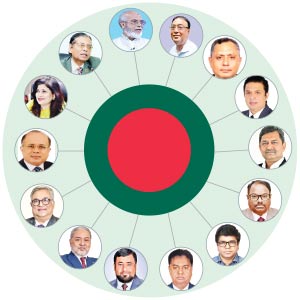
Economists, technology experts, business leaders and bankers speaking at The Daily Observer’s National Print Dialogue held last week delivered a sobering reminder that the new government has assumed office at a critical juncture�"defined by deep structural constraints, mounting economic pressures and unresolved fragilities that continue to test its reform agenda.
The dialogue, titled “From Ballot to Balance Sheet: The New Government, New Vision”, was conducted through written article & interviews.
The central question that anchored the entire discussion: can the current administration decisively confront corruption, widely regarded as the most persistent impediment to sustainable growth and institutional integrity?
Participants noted that while the government has introduced several widely welfare initiatives�"including the Family Card programme and monthly stipends for mosque imams�"serious concerns remain regarding fiscal sustainability and nationwide implementation capacity.
Concerns were raised that failure to extend these commitments equitably�"whether through stipend coverage for imams across all mosques or broader support for millions of low-income households�"could carry significant political and social consequences.
There was broad consensus that the government has inherited a fragile economy marked by persistent inflationary pressures, widening inequality and structural weaknesses in fiscal governance. Many participants argued that entrenched corruption and policy inefficiencies have intensified wealth concentration, deepening disparities across both urban and rural Bangladesh.
These domestic challenges, participants warned, are being compounded by external shocks, including global geopolitical tensions, supply chain disruptions and a weakening trade balance. Export performance and remittance inflows�"though vital economic lifelines�"are also facing growing headwinds.
Against this backdrop, the dialogue emphasised the urgent need for a coherent national strategy centred on stability, equity and structural reform. Participants called for a comprehensive recovery framework anchored in rebuilding institutional trust, restoring investors' confidence and strengthening protections for vulnerable groups. Good governance, financial discipline and inclusive growth were repeatedly highlighted as defining pillars of the emerging policy direction.
The discussions also underscored the importance of a strengthened partnership between the state and citizens in advancing democratic consolidation and economic resilience.
The central question on corruption, graft, irrigularities and abuse of power resonated throughout the session, with many participants reiterating that without credible progress in this area, broader reform efforts would remain constrained. Experts proposed a hybrid anti-corruption model combining ethical governance standards, innovative oversight mechanisms, and coordinated public�"private initiatives, alongside a broader cultural reform agenda. Participants suggested that these measures be institutionalised through a separate dedicated body to complement and strengthen the existing Anti-Corruption Commission (ACC).
The dialogue further reflected on public expectations surrounding Prime Minister Tarique Rahman’s return to the country after 17 years in exile. For many citizens, his return symbolised renewed hope for economic security, personal safety, functional governance and the restoration of democratic rights.
However, participants noted that rising political tensions have also given rise to new uncertainties. Questions were raised over whether the government can effectively maintain law and order, ensure public safety and stabilise a society still grappling with the legacy of political polarisation and institutional strain.
Ultimately, the dialogue concluded that balancing public expectations with economic reality will be the defining test of the new administration�"one that will determine not only the credibility of its reform agenda but also the trajectory of Bangladesh’s next phase of development.





