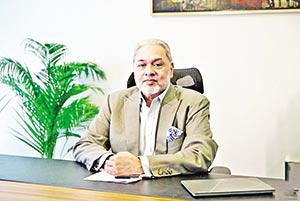
“Democracy does not end at the ballot box; its true victory begins when citizens defend it with honesty, sacrifice and responsibility,” declared senior banker Reazul Islam, Managing Director & CEO of AB Bank PLC, setting the tone for a charged National Print Dialogue that urged the new government to anchor its reform agenda in accountability, inclusion and institutional integrity.
Speaking at The Daily Observer’s National Print Dialogue titled From Ballot to Balance Sheet: New Government, New Vision, he warned that democratic gains risk dilution unless citizens and the state jointly uphold discipline and civic responsibility.
“A nation cannot enjoy the fruits of democracy if its people refuse to water its roots with discipline, unity and civic duty,” he said, framing democracy as both a right and a shared national duty.
Expressing optimism over the direction of the democratically elected government led by Prime Minister Tarique Rahman, he said its early vision�"focused on people at the bottom of the economic pyramid�"would only succeed if political actors and society worked in concert.
“This will be fruitful only if society and political actors join hands to enjoy the fruits of democracy which Bangladesh has long struggled to fully realise since independence,” he observed.
He stressed that democracy is “not merely the right to choose a government; it is the shared responsibility to build a nation worthy of that choice,” adding that accountability must become the defining currency of the new political order.
“Democracy is not a gift to be consumed�"it is a trust to be protected by every citizen, every day.”
Urging patience alongside vigilance, he noted: “We have to give the new government enough time to do the best for us,” while cautioning that progress would depend on implementation discipline rather than policy declarations alone.
Drawing on his 29 years of experience in banking and regulatory management, he warned that the new administration inherits a structurally fragile economy shaped by successive shocks�"from the Covid-19 pandemic to the upheavals of July�"August 2024.
He described the recent turmoil as economically devastating, with factories shuttered, supply chains disrupted and production in export manufacturing falling by as much as 50 per cent at its peak, costing the economy an estimated $150 million per day.
“The bad luck for the new government is that it has inherited a fragile economy, unfulfilled promises of the interim administration, and a trail of contentious last-minute decisions that could weigh on recovery,” he said.
Despite the challenges, he expressed cautious optimism, noting that early signals from the government suggested a rural-first approach, including social protection initiatives such as family cards.
“A good start creates hope; a disciplined continuation creates history,” he remarked, adding that the trajectory appeared broadly positive if sustained with consistency.
However, he cautioned that Bangladesh’s development model remains constrained by persistent inequality and weak implementation capacity. “No nation can prosper leaving its majority people behind,” he said, warning that policy success depends as much on governance architecture as on political intent.
Turning to financial sector reforms, he called for decisive action against loan defaulters and systemic banking vulnerabilities. “Bank looters must be brought to justice, and capital injection is necessary to revive distressed institutions�"not perpetuate problem banks,” he said, adding that a sound banking system is indispensable for national progress.
He also welcomed assurances from the central bank leadership regarding operational independence, describing non-interference from political or regulatory pressure as essential for restoring discipline in the financial sector.
At the same time, he urged the new government to prioritise inflation control, anti-corruption measures and broader wealth redistribution. He warned that Bangladesh’s wealth concentration has reached alarming levels, with the richest 10 per cent controlling 58 per cent of national wealth, while the poorest half hold just 4.7 per cent. The top 1 per cent alone, he noted, command nearly a quarter of all assets.
“If the new government wants to build an equitable society, it must start by narrowing the wealth gap,” he said, calling for tax system reform, wider tax participation and expanded access to credit for low-income groups.
Citing recent assessments by the World Bank and domestic think tanks, he highlighted stagnating real wages and rising living costs, which are deepening inequality in urban centres. He pointed to a rising urban expenditure Gini coefficient of 0.532, warning that major cities are becoming epicentres of economic disparity.
He further identified Bangladesh’s persistently low tax-to-GDP ratio�"below 7 per cent�"as a structural constraint on public investment in healthcare, education and social protection. “The tax system continues to favour an asset-owning elite, while the working majority remains exposed to global shocks and energy price volatility,” he said.
Calling for tax reform, he argued that the solution lies not in raising rates but in expanding the tax base. “The problem is not the tax rate�"it is participation. The system must be simple, transparent and fearless enough to encourage compliance,” he added.
Responding to questions on early policy performance, he declined to offer definitive judgment, saying it was too early for evaluation. However, he reiterated his optimism: “Every great nation, every great journey and every great reform begins with one courageous step in the right direction. That step has been taken.”
He concluded by expressing confidence that the new government’s vision�"if implemented with discipline and institutional integrity�"could help steer Bangladesh towards a more equitable future. “I remain hopeful that this journey will restore the promise of Sonar Bangla,” he said.
AB Bank PLC, the country’s first private commercial bank, marked its 44th founding anniversary on April 12, 2026, with all 104 branches and 64 sub-branches celebrating the occasion in a befitting manner across the nation.
After weathering a turbulent phase, the bank is now positioning itself for a strong resurgence, driven by a significant reduction in classified loans, robust cash recovery and an accelerated digital transformation drive.
The country’s oldest first-generation private commercial bank has also intensified deposit mobilisation efforts while strategically reshaping its investment portfolio.
Moving beyond excessive reliance on corporate banking, the bank is increasingly focusing on CMSMEs (cottage, micro, small and medium enterprises) and retail banking, signalling a decisive shift towards a broader, more resilient and inclusive growth model.





