



| HEADLINE |

|

Why Bangladesh newsrooms need an OSINT habit, not just a fact-check desk



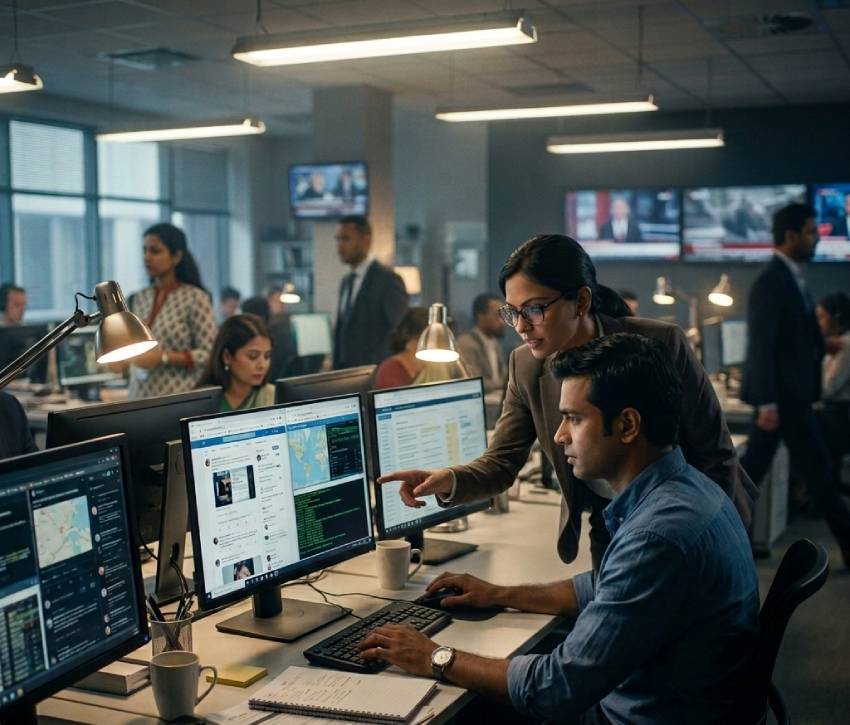
Symbolic Photo
Every major newsroom around the globe is now in the verification business to fight misinformation and reconstructing scenes to verify information.
Mainstream media like BBC built a 60-journalist unit named ‘BBC Verify’ in 2023 solely to fact-check video, counter disinformation and show audiences its evidence trail.
The New York Times is running a dedicated team named ‘Visual Investigations’ since 2017, combining digital forensics and traditional reporting. In plain English the team reconstructs crime scenes and conflict zones from cellphone footage and satellite images to verify data and information published in news.
CNN, The Washington Post and Reuters have followed with their own forensics and open-source units. This is not a buzzword, trend, or luxury, rather this is the need for an era where data passes in almost the speed of light.
Information now reaches the public before anyone in a newsroom has checked it, and audiences are increasingly unable, and do not have much time to verify, to tell real footage from fabricated footage on their own.
The verification practice is called Open-Source Intelligence, in short OSINT.
In plain English, OSINT is the practice of gathering and analysing information that is already publicly available on social media posts, satellite images, government records, leaked documents, YouTube videos, even shadows in a photograph. Then piecing them into a verified, defensible account of what actually happened.
It is not black magic, not hacking. It is not ‘espionage’. It is closer to old-fashioned shoe-leather reporting, except the “street” being walked is the internet, and the “eyewitnesses” are the millions of ordinary people filming events on their phones.
For Bangladeshi media, adopting an OSINT mindset is no longer optional and waste of time. It is becoming a rudimentary condition for publishing accurate and authentic news. This practice is equally applied for investigative reporters, as well as for us, the sub-editors who decide, often in minutes, whether a viral photo or video is safe to run under the paper’s name or portal.
A Short History: From wartime filing cabinets to Bellingcat
Interestingly, OSINT is older than the internet. During the WWII, the American Office of Strategic Services, the forerunner of CIA, ran a research branch that analyzed foreign newspapers, radio broadcasts, and even obituaries for collecting information about enemy capabilities.
The practice was intelligence gathering from publicly accessible sources. After the war, the discipline involved into a bureaucratic practice of librarians and archivists.
In 2009, young Iranians used social media to broadcast their protests to the world in near real time during Iran’s Green Revolution.
The outside observers realised that citizen-generated footages can be verified, geolocated, and used as a primary source of information.
The next major leap came from the British blogger Eliot Higgins in 2012. At that time Higgins was an unemployed office administrator. He began analysing YouTube videos of the Syrian civil war from his living room, under the pseudonym “Brown Moses.”
By cross-referencing weapons visible in the footage with satellite imagery and geography, he proved that the Syrian regime was using cluster munitions and chemical weapons, conclusions that mainstream reporters on the ground could not have reached alone.
In 2014, Higgins formalised this work into Bellingcat, a Netherlands-based collective of professional and volunteer investigators.
Bellingcat’s came in lime light within months of its founding, when it used open-source video, satellite images and social media posts to establish that a Russian Buk missile system had shot down Malaysia Airlines Flight MH17 over Ukraine that was later confirmed by an official international investigation.
Bellingcat went on to unmask the Russian agents behind the poisoning of Sergei Skripal and Alexei Navalny, using only publicly available flight records, leaked databases, and passport photos.
Bellingcat’s every step of its method was published. So, readers and rival investigators could check the workflow of the investigations. This transparency is now considered close to a scientific standard in newsrooms, and it directly inspired the large OSINT desks that BBC, the New York Times, Washington Post and others operate today.
How Mainstream Media Actually Uses OSINT
The 60-person BBC Verify brings scattered data analysis, disinformation monitoring, and fact-checking into an organized structured form. The team geolocates footages, analyses satellite imagery, checks metadata (the hidden data embedded in a photo or video file, such as when and where it was created) and cross-checks audio for signs of AI voice-cloning.
The team publishes its evidences alongside stories showing the audience how it knows something, not just what it knows.
The New York Times’ Visual Investigations team, combines traditional reporting with “open source reporting”. It geolocates a video to an exact street corner using landmarks and shadows, cross-referencing “before” and “after” satellite images to establish when a strike happened, and building minute-by-minute timelines from hundreds of scattered video clips.
In 2022, they reconstructed the killings of civilians in Bucha, Ukraine, using Google Street View imagery and metadata analysis to directly contradict Russian government claims about the timing of the killings.
The Washington Post’s Visual Forensics unit and Reuters run comparable operations, and both have collaborated with Bellingcat on cross-border investigations. CNN now runs a formal OSINT training academy for its own journalists, teaching reverse image search (tracing where else a photo has appeared online, and when), geolocation and open-source toolkit-building as baseline skills.
OSINT has two faces. It lets a desk-bound investigator do work that once required physical presence and acts as a filter against publishing fabricated content under the outlet’s name, the risk that has grown sharply with generative AI.
Why This Matters for Bangladesh
The information environment in Bangladesh has been under sustained strain since the July 2024 uprising, and it intensified through the campaign for the 13th parliamentary election held on February 12, 2026.
The period immediately around the February 2026 election was especially intense. On the single day before voting, three fact-checking organisations, Rumor Scanner, Dismislab and FactWatch, jointly documented 49 unique pieces of election disinformation in under 20 hours, including fabricated “news photocards” mimicking the visual style of established outlets falsely claiming candidates had withdrawn or that results were already decided.
For Bangladeshi editorial desks, the lesson is direct, the country’s evolving political and social climate means that speed, virality and partisanship are now baked into the information environment, and a newsroom that cannot independently verify what is landing in its inbox and its social feeds is at permanent risk of amplifying a fabrication, deliberately planted or not.
The Problem for Reporters and Sub Editors: Old Footage, Deepfakes and Rumour
In Bangladesh, fact checkers documented three recurring and common patterns that every reporter and sub-editor should be able to recognise on sight, even without sophisticated tools. These are the most rudimentary basics of utilizing OSINT in journalism.
Zombie Contents: In plain English, these are old footages recycled as breaking news. This is the single most common tactic documented around the 2026 election.
For example, a viral clip showed an election-day clash in Gopalganj. Fact checkers traced it to an August 2024 rally in Narayanganj.
The defence here is reverse image search. Taking a screenshot from the video or the photo itself and running it through a search engine’s image tools (Google Images, Bing, or specialist tools like TinEye) to see where and when it first appeared online. If the same clip surfaces in a report from a year earlier, it is not a breaking news.
Deepfakes: Deepfakes are AI generated image, video, or audio contents. Analysis of the July to September 2025 period found 71 AI-generated posts in circulation, the large majority of them videos, 57, and the rest were 14 images.
A fabricated image can be referred that shows students demanding the return of former prime minister Sheikh Hasina circulated in August 2025. It was entirely synthetic. The basics to identify a deepfake content is to look for unnatural blinking, mismatched lighting or shadows, blurred edges where a face meets hair or background, and audio that doesn’t quite sync with lip movement.
However, AI tools are improving quickly and becoming more natural looking. So, cross-checking against a second, independent source matters more than any single visual clue.
Fabricated “photocards” and impersonated outlets: Photocards are now a trend in social media to attract more user interactions to posts. During the national electionsin 2026, the creation of fake graphics designed to look exactly like a real outlet’s branded news card, like mimicking mainstream Bangladeshi media, was seen to fabricate instant credibility. Herer the defence is procedural, not technical. Any screenshot of “news” from another outlet should be verified directly on that outlet’s own website or verified social account before republishing or citing it.
Fact-Checkers Exist, So Why Do Newsrooms Still Need OSINT?
Bangladesh already has an established and functioning fact-checking ecosystem. Rumor Scanner, Dismislab, FactWatch, BoomBD, and AFP Fact Check Bangladesh to name a few. So, it is logical to ask why every reporter and sub-editor needs to acquire OSINT skills when specialist teams already do this job.
The answer is a division-of-labour, not a duplication of efforts.
Fact-checkers, by design, work after a claim has already gone viral. Their reports are fast and rigorous and are inherently reactive. Rumor Scanner’s fastest turnaround on election night was still measured in hours, not the seconds it takes for a sub-editor to decide whether to publish a breaking photograph.
A newsroom’s own desk is the only line of defence before a news is printed or goes online. The moment a wire photo, a viral clip or a tip-off first lands in the newsroom, someone on deadline has to decide whether it will be published or not. A fact-checker debunking an outlet’s story the next morning is reputational damage that basic verification, done in-house, could have prevented in the first place.
Bangladesh’s fact-checking organisations are committed but they are a handful of small teams checking a national information ecosystem that produced over 5,700 flagged claims in a single year.
It is unrealistic that they check everything crossing every a newsroom’s desk in real time, nor should reporters expect them to. Basic-to-moderate OSINT literacy like reverse image search, checking metadata, confirming a claim against a primary or official source, knowing how to geolocate a photo is what allows a reporter or sub-editor to filter the truth.
In May 2026, panels of senior editors at Bangladesh’s own Journalism Conference in May 2026 identified that modern investigative journalism needs financial forensics, data analysis, cybersecurity awareness, digital verification, and source protection that many newsrooms still inadequately support.
A newsroom in Bangladesh is right now navigating a volatile political transition and a surge of AI-generated fake contents. The basic layer of in-house scepticism and OSINT skills is no longer a specialist skill, rather, a must for both reporters and sub-editors.
Mainstream media like BBC built a 60-journalist unit named ‘BBC Verify’ in 2023 solely to fact-check video, counter disinformation and show audiences its evidence trail.
The New York Times is running a dedicated team named ‘Visual Investigations’ since 2017, combining digital forensics and traditional reporting. In plain English the team reconstructs crime scenes and conflict zones from cellphone footage and satellite images to verify data and information published in news.
CNN, The Washington Post and Reuters have followed with their own forensics and open-source units. This is not a buzzword, trend, or luxury, rather this is the need for an era where data passes in almost the speed of light.
Information now reaches the public before anyone in a newsroom has checked it, and audiences are increasingly unable, and do not have much time to verify, to tell real footage from fabricated footage on their own.
The verification practice is called Open-Source Intelligence, in short OSINT.
In plain English, OSINT is the practice of gathering and analysing information that is already publicly available on social media posts, satellite images, government records, leaked documents, YouTube videos, even shadows in a photograph. Then piecing them into a verified, defensible account of what actually happened.
It is not black magic, not hacking. It is not ‘espionage’. It is closer to old-fashioned shoe-leather reporting, except the “street” being walked is the internet, and the “eyewitnesses” are the millions of ordinary people filming events on their phones.
For Bangladeshi media, adopting an OSINT mindset is no longer optional and waste of time. It is becoming a rudimentary condition for publishing accurate and authentic news. This practice is equally applied for investigative reporters, as well as for us, the sub-editors who decide, often in minutes, whether a viral photo or video is safe to run under the paper’s name or portal.
A Short History: From wartime filing cabinets to Bellingcat
Interestingly, OSINT is older than the internet. During the WWII, the American Office of Strategic Services, the forerunner of CIA, ran a research branch that analyzed foreign newspapers, radio broadcasts, and even obituaries for collecting information about enemy capabilities.
The practice was intelligence gathering from publicly accessible sources. After the war, the discipline involved into a bureaucratic practice of librarians and archivists.
In 2009, young Iranians used social media to broadcast their protests to the world in near real time during Iran’s Green Revolution.
The outside observers realised that citizen-generated footages can be verified, geolocated, and used as a primary source of information.
The next major leap came from the British blogger Eliot Higgins in 2012. At that time Higgins was an unemployed office administrator. He began analysing YouTube videos of the Syrian civil war from his living room, under the pseudonym “Brown Moses.”
By cross-referencing weapons visible in the footage with satellite imagery and geography, he proved that the Syrian regime was using cluster munitions and chemical weapons, conclusions that mainstream reporters on the ground could not have reached alone.
In 2014, Higgins formalised this work into Bellingcat, a Netherlands-based collective of professional and volunteer investigators.
Bellingcat’s came in lime light within months of its founding, when it used open-source video, satellite images and social media posts to establish that a Russian Buk missile system had shot down Malaysia Airlines Flight MH17 over Ukraine that was later confirmed by an official international investigation.
Bellingcat went on to unmask the Russian agents behind the poisoning of Sergei Skripal and Alexei Navalny, using only publicly available flight records, leaked databases, and passport photos.
Bellingcat’s every step of its method was published. So, readers and rival investigators could check the workflow of the investigations. This transparency is now considered close to a scientific standard in newsrooms, and it directly inspired the large OSINT desks that BBC, the New York Times, Washington Post and others operate today.
How Mainstream Media Actually Uses OSINT
The 60-person BBC Verify brings scattered data analysis, disinformation monitoring, and fact-checking into an organized structured form. The team geolocates footages, analyses satellite imagery, checks metadata (the hidden data embedded in a photo or video file, such as when and where it was created) and cross-checks audio for signs of AI voice-cloning.
The team publishes its evidences alongside stories showing the audience how it knows something, not just what it knows.
The New York Times’ Visual Investigations team, combines traditional reporting with “open source reporting”. It geolocates a video to an exact street corner using landmarks and shadows, cross-referencing “before” and “after” satellite images to establish when a strike happened, and building minute-by-minute timelines from hundreds of scattered video clips.
In 2022, they reconstructed the killings of civilians in Bucha, Ukraine, using Google Street View imagery and metadata analysis to directly contradict Russian government claims about the timing of the killings.
The Washington Post’s Visual Forensics unit and Reuters run comparable operations, and both have collaborated with Bellingcat on cross-border investigations. CNN now runs a formal OSINT training academy for its own journalists, teaching reverse image search (tracing where else a photo has appeared online, and when), geolocation and open-source toolkit-building as baseline skills.
OSINT has two faces. It lets a desk-bound investigator do work that once required physical presence and acts as a filter against publishing fabricated content under the outlet’s name, the risk that has grown sharply with generative AI.
Why This Matters for Bangladesh
The information environment in Bangladesh has been under sustained strain since the July 2024 uprising, and it intensified through the campaign for the 13th parliamentary election held on February 12, 2026.
Rumor Scanner alone verified 310 separate misinformation cases in July 2025, rising to 320 in August and 329 in September, with well over half of all cases in each month tied to political content. Across the country’s fact-checking organisations combined, more than 5,700 fact-check reports were published in 2025 alone, roughly 30 percent more than the year before. Two out of every three of those fact-checks involved political content, and roughly one in ten used artificial intelligence to fabricate the deceptive material in the first place.
For Bangladeshi editorial desks, the lesson is direct, the country’s evolving political and social climate means that speed, virality and partisanship are now baked into the information environment, and a newsroom that cannot independently verify what is landing in its inbox and its social feeds is at permanent risk of amplifying a fabrication, deliberately planted or not.
The Problem for Reporters and Sub Editors: Old Footage, Deepfakes and Rumour
In Bangladesh, fact checkers documented three recurring and common patterns that every reporter and sub-editor should be able to recognise on sight, even without sophisticated tools. These are the most rudimentary basics of utilizing OSINT in journalism.
Zombie Contents: In plain English, these are old footages recycled as breaking news. This is the single most common tactic documented around the 2026 election.
For example, a viral clip showed an election-day clash in Gopalganj. Fact checkers traced it to an August 2024 rally in Narayanganj.
The defence here is reverse image search. Taking a screenshot from the video or the photo itself and running it through a search engine’s image tools (Google Images, Bing, or specialist tools like TinEye) to see where and when it first appeared online. If the same clip surfaces in a report from a year earlier, it is not a breaking news.
Deepfakes: Deepfakes are AI generated image, video, or audio contents. Analysis of the July to September 2025 period found 71 AI-generated posts in circulation, the large majority of them videos, 57, and the rest were 14 images.
A fabricated image can be referred that shows students demanding the return of former prime minister Sheikh Hasina circulated in August 2025. It was entirely synthetic. The basics to identify a deepfake content is to look for unnatural blinking, mismatched lighting or shadows, blurred edges where a face meets hair or background, and audio that doesn’t quite sync with lip movement.
However, AI tools are improving quickly and becoming more natural looking. So, cross-checking against a second, independent source matters more than any single visual clue.
Fabricated “photocards” and impersonated outlets: Photocards are now a trend in social media to attract more user interactions to posts. During the national electionsin 2026, the creation of fake graphics designed to look exactly like a real outlet’s branded news card, like mimicking mainstream Bangladeshi media, was seen to fabricate instant credibility. Herer the defence is procedural, not technical. Any screenshot of “news” from another outlet should be verified directly on that outlet’s own website or verified social account before republishing or citing it.
Fact-Checkers Exist, So Why Do Newsrooms Still Need OSINT?
Bangladesh already has an established and functioning fact-checking ecosystem. Rumor Scanner, Dismislab, FactWatch, BoomBD, and AFP Fact Check Bangladesh to name a few. So, it is logical to ask why every reporter and sub-editor needs to acquire OSINT skills when specialist teams already do this job.
The answer is a division-of-labour, not a duplication of efforts.
Fact-checkers, by design, work after a claim has already gone viral. Their reports are fast and rigorous and are inherently reactive. Rumor Scanner’s fastest turnaround on election night was still measured in hours, not the seconds it takes for a sub-editor to decide whether to publish a breaking photograph.
A newsroom’s own desk is the only line of defence before a news is printed or goes online. The moment a wire photo, a viral clip or a tip-off first lands in the newsroom, someone on deadline has to decide whether it will be published or not. A fact-checker debunking an outlet’s story the next morning is reputational damage that basic verification, done in-house, could have prevented in the first place.
Bangladesh’s fact-checking organisations are committed but they are a handful of small teams checking a national information ecosystem that produced over 5,700 flagged claims in a single year.
It is unrealistic that they check everything crossing every a newsroom’s desk in real time, nor should reporters expect them to. Basic-to-moderate OSINT literacy like reverse image search, checking metadata, confirming a claim against a primary or official source, knowing how to geolocate a photo is what allows a reporter or sub-editor to filter the truth.
In May 2026, panels of senior editors at Bangladesh’s own Journalism Conference in May 2026 identified that modern investigative journalism needs financial forensics, data analysis, cybersecurity awareness, digital verification, and source protection that many newsrooms still inadequately support.
A newsroom in Bangladesh is right now navigating a volatile political transition and a surge of AI-generated fake contents. The basic layer of in-house scepticism and OSINT skills is no longer a specialist skill, rather, a must for both reporters and sub-editors.

Loading...
Loading...
Also read







Editor : Iqbal Sobhan Chowdhury
Published by the Editor on behalf of the Observer Ltd. from Globe Printers, 24/A, New Eskaton Road, Ramna, Dhaka.
Editorial, News and Commercial Offices : Aziz Bhaban (2nd floor), 93, Motijheel C/A, Dhaka-1000.
Phone: PABX- 41053001-06; Advertisement: 41053012; 01793317829, 01550707291, E-mail: [email protected], [email protected] Online: email: [email protected] 41053014; 01550707297 Advertisement: 01550707296
Published by the Editor on behalf of the Observer Ltd. from Globe Printers, 24/A, New Eskaton Road, Ramna, Dhaka.
Editorial, News and Commercial Offices : Aziz Bhaban (2nd floor), 93, Motijheel C/A, Dhaka-1000.
Phone: PABX- 41053001-06; Advertisement: 41053012; 01793317829, 01550707291, E-mail: [email protected], [email protected] Online: email: [email protected] 41053014; 01550707297 Advertisement: 01550707296


