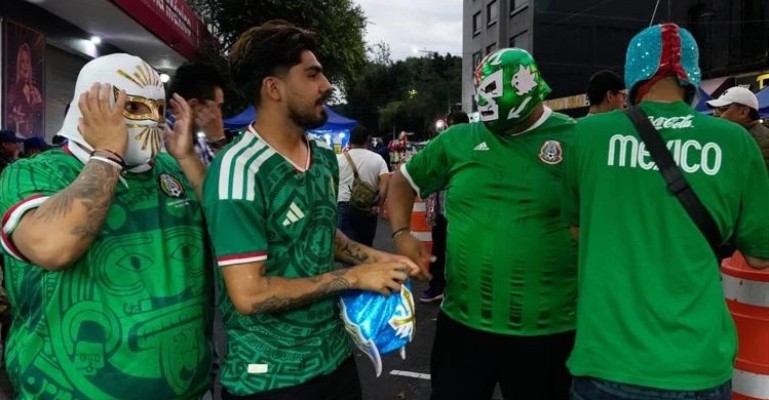
Alongside football, Mexico's famous lucha libre wrestling has become one of the biggest attractions for World Cup visitors, with colourful masked wrestlers filling the streets and arenas as fans from around the world embrace one of the country's most celebrated traditions.=
Masked wrestlers can be seen everywhere during the tournament, from stadium surroundings and busy streets to restaurants and bars. Many football fans are taking a break from World Cup action to experience the high-energy wrestling shows that have long been a key part of Mexican culture.
While Spain played Uruguay in Guadalajara, thousands of spectators packed the iconic Arena México, known as the home of lucha libre, to watch a headline bout featuring Místico and Máscara Dorada against The Beast Mortos and Sammy Guevara.
"It was simply fantastic, we enjoyed it immensely," said Andy Winston from Manchester, who has travelled with his family to all three World Cup host countries, Canada, the United States and Mexico, while supporting England.
"You can't come to Mexico and not come to watch lucha libre. It's a great tradition, a classic," he said.
Fans wearing football jerseys from England, Japan, South Korea, Brazil, Colombia, Spain and Mexico filled the arena, cheering loudly throughout the event.
"It was a wonderful night, much better than I imagined," said Brazil's Henrique Nunes dos Santos. "You connect with the spectacle in a way that makes it all seem real. There's a gigantic energy."
Lucha libre dates back to the early 20th century and combines American wrestling, Greco-Roman wrestling, acrobatic moves and theatrical performances. Over the years, it has developed into a unique form of entertainment and was recognised as part of Mexico City's cultural heritage in 2018.
"Lucha libre is in our roots. For almost 93 years, it has been part of us Mexicans and has also become a calling card for Mexicans," said Julio César Rivera, spokesperson for the World Wrestling Council.
The matches usually feature a battle between the "técnicos," or heroes, and the "rudos," the villains. The wrestlers are known for their colourful masks, which often represent superheroes, animals or other symbolic figures.
The masks are much more than costumes. They represent the wrestler's identity, heritage and character, and performers rarely reveal their real names in order to preserve the mystery.
Thirty-year-old wrestler Star Black said he fell in love with lucha libre while helping his grandparents sell wrestling masks as a child.
"I started to fall in love with the masks, the capes, the aerial maneuvers and the moves of lucha libre, and one day I decided to train," he said.
The World Cup has further boosted interest in the sport. Many international visitors are staying in Mexico because of lower accommodation costs before travelling to matches in the United States and Canada, said José Ángel Garfias Frías, a lucha libre researcher at the National Autonomous University of Mexico.
"Lucha libre was already popular, but now with the World Cup, the arenas are much more crowded, and we see many tourists there wearing their national team jerseys," Garfias said.
Outside stadiums, wrestling masks are almost as common as national flags, with street vendors selling both. Although FIFA security rules prohibit masks inside stadiums, some fans have still been seen wearing them.
Lucha libre and football have long shared a close connection in Mexico. Argentine footballer Gabriel Pereyra famously celebrated goals for Mexican club Cruz Azul by wearing Místico's wrestling mask, while legendary wrestler América Salvaje based his ring identity on Club América's colours.
"Lucha libre is Mexico. It's part of our identity. And it's as popular as soccer," said Claudio Díaz, one of many masked supporters celebrating Mexico's advancement to the knockout stage.
For wrestler Dragón Legendario, lucha libre reflects Mexican society even more than football.
"I feel that soccer doesn't represent us Mexicans as much; lucha libre represents us way more," he said. "People from all walks of life come here, from grandmothers to businessmen to women who run small restaurants. It has all kinds of fans."