
Every nation’s history holds certain moments that are not merely events, they become the very foundation of that nation’s existence. For Bangladesh, 1971 is exactly such a moment, one that cannot be compared to anything else in the world. It was not a fight over which government would rule; rather, it was a fight for a nation’s very existence, for the right to language, culture and identity, a fight in which three million people gave their lives for one simple truth: that Bangladeshi people deserved a homeland of their own. Few precedents exist in world history for a new state being born through so much bloodshed in such a short period of time. That is why trying to place 1971 alongside any other movement is, from the outset, a flawed proposition, because 1971 stands beyond comparison. 1971 is our root.
But roots alone do not keep a tree alive; they have to be protected, again and again. The mass uprising of July and August 2024 is exactly that story of protection. When a fascist regime had turned every institution of the state into its obedient tool, when voting rights had been stripped away, and when dissent meant the threat of enforced disappearances, killings, or false cases, the common people took to the streets once more. Students and teachers from schools, colleges, universities and madrasas, rickshaw-pullers, day-labourers, housewives, even fathers with babies - everyone stood together with a single demand: Give the country back to its people. This uprising cannot be denied, because it proved that the people of Bangladesh still have not learned to bow before injustice. Against the combined pressures of foreign domination and homegrown fascism, this awakening became the last wall standing in defence of the nation’s dignity and sovereignty.
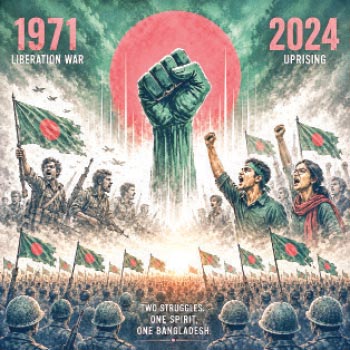
But here a question arises that needs to be discussed openly: Who wants to pit 2024 against 1971? Why is there a persistent effort, across various media outlets and social media platforms, to turn these two movements into rivals? Looking for the answer reveals a deliberately constructed narrative. For those who turned the spirit of 1971 into their political capital and used it to cling to power for years, the 2024 uprising is an uncomfortable and bitter truth because it proved that even power accumulated in the name of the “Spirit of 1971” is something the people of this country no longer accept. So their strategy is to make 2024 controversial, to frame it as a rival to 1971, and to manufacture a false conflict that confuses people and casts doubt on the aspirations of the masses. This scheme has a single goal: to weaken the nation’s new awakening so that the old fascist structure of exploitation, obedient to its foreign masters, can rise again.
But the truth is this: 1971 and 2024 were never opposing forces; rather, they complement each other. 1971 was the story of a nation’s birth, the moment when the people of Bangladesh first won a homeland of their own. 2024 is the promise that teaches that same nation how to live with its head held high while preserving its sovereignty and own identity.
One gave birth, while the other taught the nation how to grow and how to protect that sovereignty through constant vigilance. Both movements share one thing in common: the defeat of the forces that stood against the hopes and aspirations of ordinary people, and the victory of those very people. In 1971, colonial exploitation and discrimination were defeated. In 2024, authoritarian dictatorship and the obedient servants of foreign masters were defeated. In both, the same force - the just aspirations of ordinary people - prevailed.
So what comes next? The inspiration of that July and August cannot remain just a memory, it has to become part of the nation’s everyday consciousness. Because fascism never truly ends in one stroke, it continually tries to return in new forms - sometimes behind a mask of rumour and propaganda, sometimes under the banner of minority rights, sometimes in the name of development, and sometimes by invoking old legacies such as the “Chetona of 1971” as an excuse. If the nation forgets the lessons of 2024, some form of authoritarianism will inevitably find its way back. To live with dignity and to stand against any future fascist attempt, this nation must carry both the sacrifice of 1971 and the resistance of 2024 equally close to its heart. Together, these two chapters make up the complete history of Bangladesh and to understand one while dismissing the other is, in truth, to deny one’s own roots.
The writer is Head of Photography, The Daily Observer





