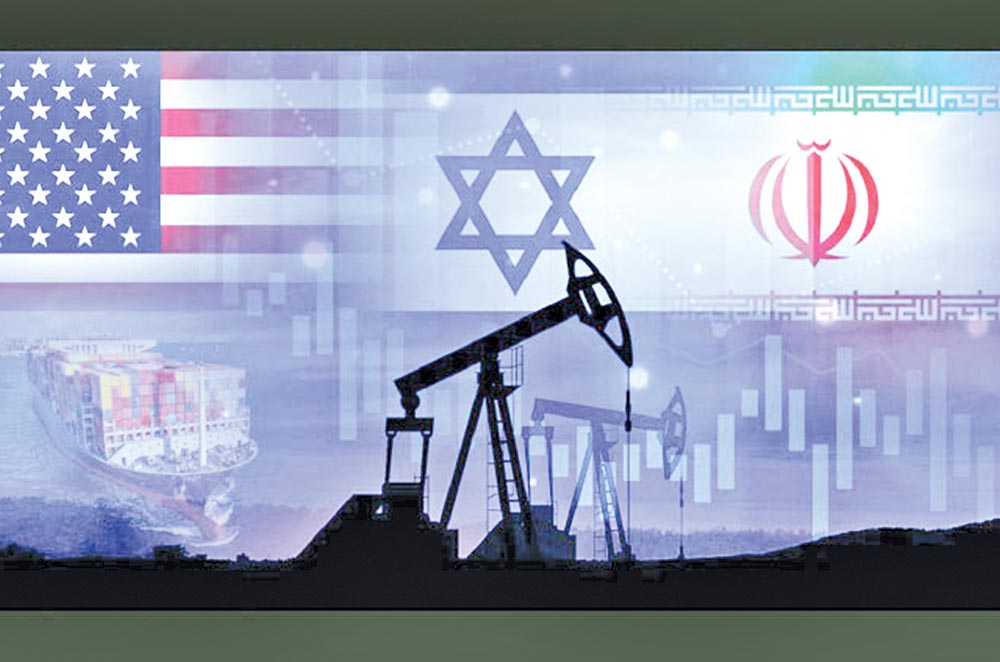
The United States and Iran again exchanged military strikes even as their mutually agreed cease-fire came into force last week. But now the two countries are back in talks to resume that fragile ceasefire.
Washington claimed that it was retaliating for Iran’s supposed attack on a commercial ship in the Hormuz Straits. And Iranian officials point out that while Israel has continued its deadly, destructive, violation of the Islamabad Agreement, safe ship movements cannot be guaranteed.
For Sri Lankans nervously watching world oil price levels slowly stabilising, this latest flare-up adds to the current trauma, especially for those pauperised social layers hit with food insecurity. And if (lower) middle-income Sri Lanka thus suffers, readers can easily imagine the scale of global social trauma for the billions of far poorer, already starving, stunted, homeless, people on the planet around us �" in Africa, pockets of South Asia and Latin America.
Within hours of the signing of the Iran-USA MoU on June 17, world oil market prices began to drop below the US$ 100/barrel mark, even before the agreement was to come into effect on June 18. Now, after the latest clashes and Israel’s persistence with its genocidal wars in Palestine and Lebanon, oil prices are edging up again.
Tehran keeps insisting on the full observance of the Memorandum Of Understanding (MoU) by all sides in order that conditions in the Gulf region stabilise to enable shipping. In the historic MoU, an all-round ceasefire was the bottomline for Tehran, while for Washington and other capitals across the world, including Colombo, the urgent need was the freeing up of crude and processed fuel shipments through the Hormuz Straits.
Equally importantly for those poor nations exporting to West Asia, like this country, (Sri Lanka and Iran, Yemen, Oman, Bahrein, have been trading for millennia), an end to war in the Gulf will enable resumption of trade and migrant worker livelihoods.
But the sudden bombing of Iran by the US signals a return to uncertainty. One analyst called the MoU a ‘mirage’.
The Islamabad Memorandum of Understanding (MoU) between the United States and Iran was electronically signed and officially released on June 17, 2026, and went into immediate effect on June 18.
Tehran keeps pointing out that the MOU, in its very first clause, agrees to: “..an immediate and permanent cessation of military operations on all fronts (including Lebanon), with a mutual guarantee of Lebanon’s sovereignty…”.
Red lines: Everyone acknowledges that this first Clause meets Iran’s oft-insisted “red lines” pertaining to Lebanon. Long before the MoU was being pushed through by a West flummoxed by Iran’s sheer gritty resistance, Iran had been militarily retaliating wherever possibly (its targets obviously carefully selected for impact) whenever Israel struck at Lebanon.
But within hours of signing and much boasts about “peace” achievement by the White House, Israel was continuing its full-scale offensive in Lebanon, having already conquered and physically flattened a sixth of Lebanon’s territory. Israel is continuing its bombing of Beirut and other Lebanese cities �" targeting mostly neighbourhoods of Iran’s close politico-military ally, the Hezbollah Shia Social Movement.
Tehran, however, has never specified Hezbollah (or any other Shia community) in relation to its policy toward Lebanon. Rather, Tehran, has correctly, firmly expressed its full solidarity with Lebanon as a regional sister country (as it does with all Arab and Muslim nations in West Asia and worldwide).
The West, led by superpower USA and colonial protégé Israel, launched their latest hot war against Iran on February 28. Since then, till now, the Western military machine has inexorably proceeded dealing death and destruction on West Asia, principally on Iran, but also �" in terms of the socio-economic impact of the oil crisis �" across the region and, across the rest of the world.
Whether through the US-Israeli strike forces or, the continuous facilitation of strike units deployments by all NATO allies and, regional monarchy allies, or, the continuous military replenishments and financing of protégé state Israel, the multiple wars in West Asia are the accomplishment of this Western power bloc. Built on the huge wealth and politico-cultural influence legacy of centuries of European colonisation of much of the planet, this Western power bloc is, by far, the world’s richest, militarily most powerful, geopolitical bloc.
Is the Washington-Brussels combine fully serious about standing down all its military operations �" mobilised across the planet from Diego Garcia and Cyprus bases and all NATO facilities and local allies �" against Iran? The answer to that question is already largely known from the many decades of Western-directed and backed war of colonisation in West Asia since London and Washington set up the state of Israel in 1948. What is going on in West Asia, are the consistent political and military actions by that same Western ‘power bloc’.
Whether a Democratic or Republican presidency or Congress, whether a Labour or Conservative UK government, whether similarly right-wing or left-wing governments in other NATO member states or in the European Parliament, the Western power bloc has been fully unified for at least a whole century in its dealing with West Asia.
Balfour: Indeed, most critics of that infamous policy ‘Letter’ by UK Foreign Secretary Lord Arthur Balfour, issued to the top business-led community leadership of Jews in Europe in 1917, point to that Letter as the first categorical statement of imperial-colonial intentions of the West toward West Asia. Critics see the ‘Balfour Declaration’ as the declared implanting of a long term geopolitical presence in West Asia, going beyond the colonial political withdrawal from colonies and territories that had already begun to happen.
It is noteworthy that the very year that the UK demonstrated its “democratic” spirit by withdrawing colonial control of the whole South Asian Subcontinent, was the year in which, the UK, in alliance with the US and France and, using the West’s then dominance of an incipient United Nations, established an European Jewish state of Israel in Palestine. That ‘state’ wholly comprises European migrant settlers who were allowed �" with British colonial military backing and diplomatic connivance �" to settle on the Palestinian lands after forcibly (including massive armed, lethal, violence) expelling the indigenous Arab inhabitants.
That Euro-colonial intent, in the face of a general colonial planetary withdrawal, to dominate and retain control of strategically key pockets of territory across the planet, is explicitly stated in the Balfour Declaration. And the colonial powers have done precisely that, even up to the present.
The West needs Israel as a colony-proxy immediately adjoining both the Suez Canal and also the West Asian oil and natural gas fields. The West is also happy to keep most of the un-elected Arab monarchies locked into its petro-dollar embrace with most of the billions invested in the West while NATO (mainly American) military bases and outposts are located in those kingdoms and emirates.
The US alone has some 20 plus bases and outposts in the Gulf area.
Axis of Resistance: In terms of its larger, general, foreign policy, Tehran includes the Hezbollah Movement in the ‘Axis of Resistance’ regional geopolitical coalition. The ‘Axis of Resistance’ resists the Western forcible intrusion into West Asia, including the fully West-sponsored forcible colonisation of Palestine by an European Jewish ‘state of Israel’.
The Axis also includes Hamas and several other Palestinian nationalist militia (in the West Bank, Gaza, refugee camps in neighbouring states and in the diaspora), the many Shia social movements and militias across the region, and also other Arab anti-colonial movements.
Thus, the geopolitical line-up on both sides of the Islamabad MoU is clear. On one side, Iran and its allies want the West off their backs as much as possible, ending all military devastation and politico-economic siege, whether in Palestine, Lebanon, Syria and or Iran.
On the Western side, it is clear that while the Western power bloc wants to free up the Hormuz blockade, it is not serious about the Israeli front. Since the West has underwritten all Israel’s colonising and region-dominating wars since 1948, it is difficult to see the Washington-Brussels combine doing differently now.
This is the hard geopolitical fact that is being exposed now under this partial implementation of the Islamabad MoU.
The very fact that the West yet underwrites the Gaza genocide, West Bank ethnic cleansing as well as Israel’s conquest and ethnic cleansing of southern Lebanon, clearly indicates the West’s reluctance to weaken its proxy Israel colony’s current hold on the eastern (Levantine) littoral of the Mediterranean Sea. The ideal for the West would be an open Hormuz, alongside a genocidally dominant Israel. But if Israel is allowed to persist with its wars, the global economy could be further destabilised when oil shipments are again blocked by more war over the Hormuz.
Is Tehran, despite all the inhuman pounding it is getting, ready to continue its grip on the Hormuz Strait? That seems to be the only way the West can be forced to relax its genocidal-colonial grip on the Levant by reducing its sponsorship of its desperate Israeli protégé.
The writer is a senior journalist in Sri Lanka





