



| HEADLINE |

|

Will LatAm retain World Cup 26?
Published : Friday, 3 July, 2026 at 12:00 AM
Khalid Ferdous


 As the history of World Cup football says, every tournament has its own story. Sometimes Europe dominates, sometimes Latin America triumphs with its artistic and rhythmic football. The picture emerging at the beginning of the knockout phase of the 2026 World Cup has brought a new question to the fore�"will the golden trophy of the World Cup return to Latin America this time too?
 Football is not just a game of statistics; it is the art of using confidence, tradition, rhythm and the moment. Yet statistics provide important clues about future prospects. Of the six Latin American teams that participated in the Round of 32 in this World Cup, five made it to the next stage. This success rate is higher than that of Europe in terms of participation. This is not a mere coincidence; rather, it is a reflection of the depth and competitive ability of Latin American football.
Germany, one of the superpowers of world football, is also facing a new reality this time. They have been defeated by Latin American opponents in two consecutive matches. Latin America's consistent success against teams once known as symbols of European power signals signals a shift in the balance of power in world football.
Meanwhile, Brazil and Paraguay have already secured their places in the Round of 16. Brazil in particular is gradually returning to its usual rhythm. Vinicius Junior's pace, Mateusz Cunha's attacking prowess and the team's overall balance have made Brazil one of the title contenders again. On the other hand, the current world champion Argentina is still one of the most mature teams in the world in terms of experience, strategy and mental toughness. Lionel Messi's leadership and influence are still a big challenge for the opponent. The football magician is already the top scorer with a hat-trick.
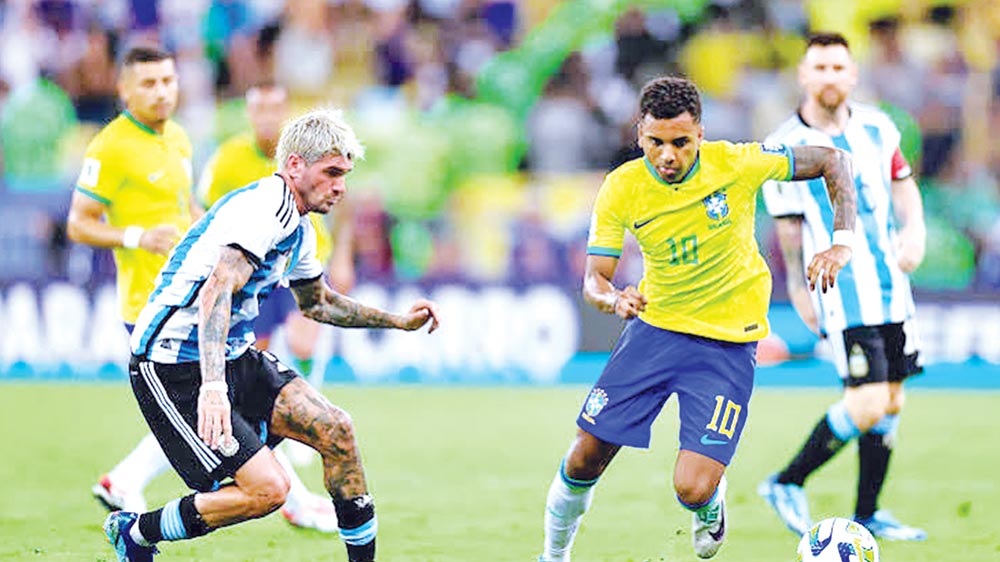 History also speaks in favor of Latin America. In 1986, Argentina became the world champion on Mexican soil with the magical skills of Diego Maradona. Brazil won the title in the 1994 World Cup held in the United States. This year's World Cup is co-hosted by the United States, Mexico and Canada. The reality is that none of the three host countries are considered the main contenders for the title. As a result, history once again indicates new possibilities for Latin America on North American soil.
Another important aspect is the familiarity of the field. Lionel Messi has been playing club football in the United States for a long time. His familiarity with the weather, stadiums, and audience culture there can create a psychological advantage for Argentina. On the other hand, Brazil has also completed its reconstruction as a confident team with a new generation of talented footballers.
Some say that this time the cup will go to Europe. Because France is playing very well. Kylian Mbappe and Ousmane Dembele are playing exceptionally. Almost every player on their team is in rhythm. Of all the World Cup games that have been played on the field, France is the most advanced in all aspects. Spain has also played well and has strengthened its claim to the title. However, Germany and the Netherlands, the main contenders for the title, have already exited the World Cup. Therefore, the World Cup is never limited to the equation of possibilities. A mistake, a brilliant goal or an inspiring performance can change all the calculations in an instant.
So it cannot be said for sure that the trophy will go to Latin America right now. But this much can be said�"Latin America has the brightest prospects in the 2026 World Cup, judging by current performance, history, confidence and footballing power. Whether the trophy will ultimately go to Argentina or Brazil�"only time will tell. However, there is little chance of denying the reality that the winds of world football are now blowing towards Latin America.
The writer is a teacher and Assistant Proctor, National University
Loading...
Loading...
Also read



Editor : Iqbal Sobhan Chowdhury
Published by the Editor on behalf of the Observer Ltd. from Globe Printers, 24/A, New Eskaton Road, Ramna, Dhaka.
Editorial, News and Commercial Offices : Aziz Bhaban (2nd floor), 93, Motijheel C/A, Dhaka-1000.
Phone: PABX- 41053001-06; Advertisement: 41053012; 01793317829, 01550707291, E-mail: [email protected], [email protected] Online: email: [email protected] 41053014; 01550707297 Advertisement: 01550707296
Published by the Editor on behalf of the Observer Ltd. from Globe Printers, 24/A, New Eskaton Road, Ramna, Dhaka.
Editorial, News and Commercial Offices : Aziz Bhaban (2nd floor), 93, Motijheel C/A, Dhaka-1000.
Phone: PABX- 41053001-06; Advertisement: 41053012; 01793317829, 01550707291, E-mail: [email protected], [email protected] Online: email: [email protected] 41053014; 01550707297 Advertisement: 01550707296


