





| HEADLINE |

|
Is Tarique Rahman emerging as a statesman?


Recent political developments have sparked debate in Bangladesh over the leadership style of Tarique Rahman, with supporters arguing that his decisions, personal lifestyle and engagement with state institutions reflect the qualities of a statesman.
Supporters point to what they describe as his emphasis on patriotism, fiscal discipline and close connection with ordinary citizens.

Supporters point to what they describe as his emphasis on patriotism, fiscal discipline and close connection with ordinary citizens.
They also cite his family background, noting that, he is the son of former President Ziaur Rahman and former Prime Minister Begum Khaleda Zia, prominent figures in Bangladesh's political history.
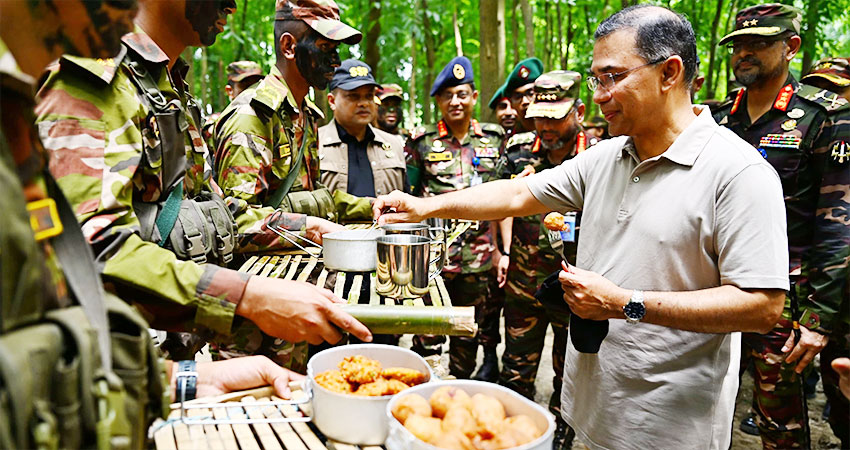
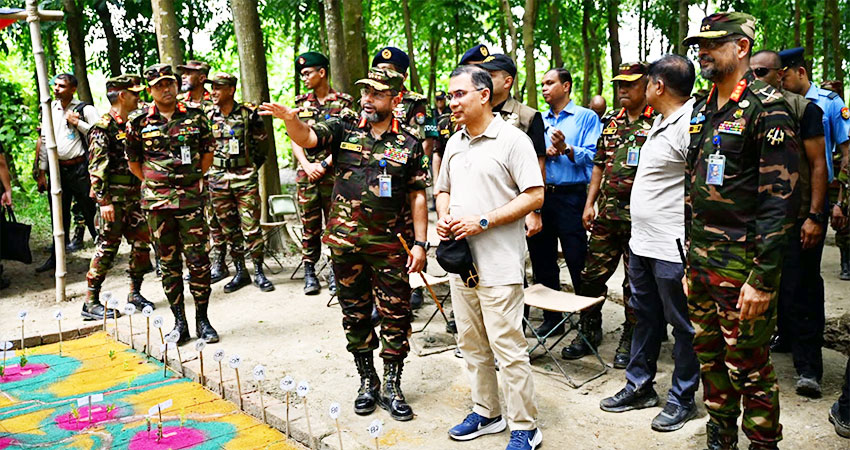
A recent visit to Bangladesh Army summer exercise has drawn particular attention. Tarique Rahman visited a training area under the Army's 9th Infantry Division in Singair, Manikganj, on Tuesday (July 7) where he observed operational drills, interacted with soldiers and toured field positions.
Supporters described the visit as unusually informal, saying he spoke directly with troops, entered military bunkers, and shared a simple meal and tea with officers and soldiers.
The visit has been portrayed by his supporters as a demonstration of his respect for the armed forces and a leadership style that emphasizes accessibility over ceremony.
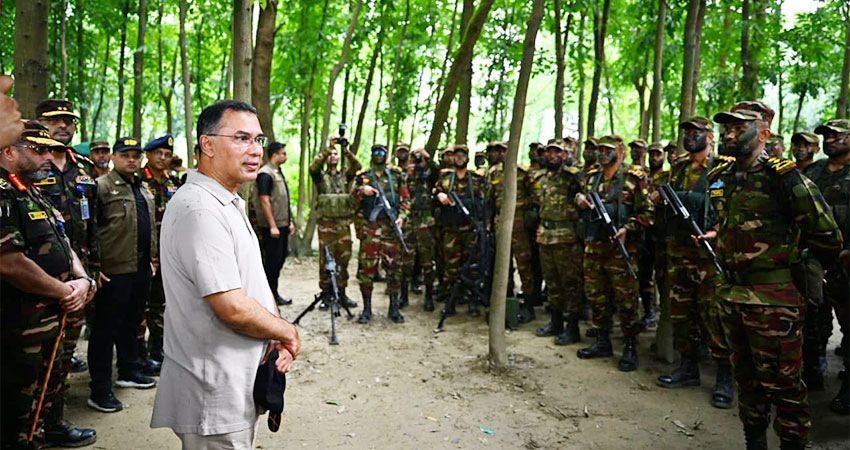
Without any elaborate ceremony or protocol, the Prime Minister walked across the vast training grounds on foot. He listened attentively to a commander's operational briefing and closely observed a meticulously executed raid exercise. The most striking moment came when the Prime Minister personally approached ordinary soldiers concealed beneath foliage in camouflage positions. Placing a hand on their shoulders, he spoke with them about their welfare and battlefield tactics, encouraging the troops who stand ready to defend the nation's sovereignty.
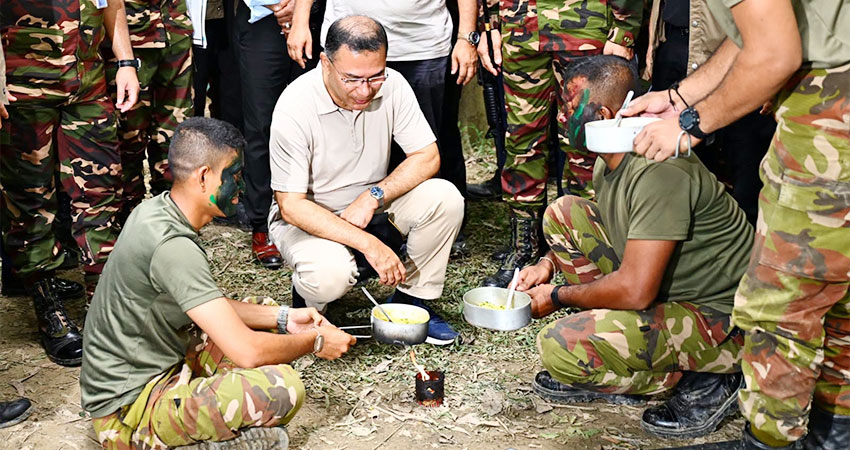
The most remarkable aspect of the visit was his genuine warmth and humility. Instead of a grand or ceremonial event, the Prime Minister entered a dark military bunker, where he sat on the ground with officers and soldiers participating in the exercise, engaging them in informal conversation. He also shared the simple field meal prepared for troops under wartime conditions and joined them for a cup of tea.
Witnessing the country's head of government eating alongside them in their own bunker from the same food prepared for the troops moved many soldiers emotionally. According to the account, the moment symbolized more than a shared meal---it reflected the deep bond between the son of a former Army Chief and the soldiers who now serve as the successors to his father's legacy. It was also presented as a reflection of the public's enduring confidence in the Bangladesh Army.
Supporters argue that Tarique Rahman has demonstrated simplicity not only in the field but also in the way he governs. They claim that while the previous administration spent between Tk 300 million and Tk 550 million annually on hospitality for officials and staff at the Prime Minister's Office, including Tk 302,297,335 in the 2018-19 fiscal year--his administration has embraced fiscal restraint.
They say hospitality expenses at his office totaled only Tk 1.169 million last June, that spending on Eid events at Jamuna has been significantly reduced, and that the traditional post-budget state banquet for the 2026-27 fiscal year was cancelled, saving the government approximately Tk 5 million in a single night.
Calling on citizens to embrace austerity, he has sought to lead by example. Rather than relying on an official government vehicle, the Prime Minister reportedly uses his own Toyota for official travel, covering fuel costs and the driver's salary from his personal funds. To reduce traffic congestion and public inconvenience in Dhaka, he is said to have reduced his motorcade from 14 vehicles to just four and abolished the long-standing practice of deploying hundreds of police officers along roadsides during official movements.
For travel outside Dhaka, he has reportedly chosen to use an ordinary red bus bearing the slogan 'Bangladesh First.' To reduce costs and save ministers' time, Cabinet meetings have also been moved from the Prime Minister's Office to the Secretariat.
He has reportedly declared that lawmakers from his party will not receive tax-free vehicle import privileges, reduced government officials' vehicle purchases and monthly fuel allocations by 30 per cent, suspended all government-funded overseas training, seminars, and large-scale events, and described preventing the waste of electricity, gas, and water in government offices as a moral and religious responsibility.
The combination of personally observing realistic military exercises, sharing meals with ordinary soldiers in field bunkers and promoting integrity and fiscal discipline in governance represents a leadership style not previously seen in Bangladesh. It argues that, inspired by the honesty of his father, the late President Ziaur Rahman, and the steadfast patriotism of his mother, former Prime Minister Begum Khaleda Zia, Tarique Rahman is leading Bangladesh toward a new era.
By breaking away from luxury, excessive protocol and political elitism and by connecting with both the people and the armed forces, Tarique Rahman is, in the view of his supporters and some political commentators, emerging as a successful statesman whose name will one day be remembered as a defining figure in Bangladesh's history.
Supporters described the visit as unusually informal, saying he spoke directly with troops, entered military bunkers, and shared a simple meal and tea with officers and soldiers.
The visit has been portrayed by his supporters as a demonstration of his respect for the armed forces and a leadership style that emphasizes accessibility over ceremony.
Without any elaborate ceremony or protocol, the Prime Minister walked across the vast training grounds on foot. He listened attentively to a commander's operational briefing and closely observed a meticulously executed raid exercise. The most striking moment came when the Prime Minister personally approached ordinary soldiers concealed beneath foliage in camouflage positions. Placing a hand on their shoulders, he spoke with them about their welfare and battlefield tactics, encouraging the troops who stand ready to defend the nation's sovereignty.
The most remarkable aspect of the visit was his genuine warmth and humility. Instead of a grand or ceremonial event, the Prime Minister entered a dark military bunker, where he sat on the ground with officers and soldiers participating in the exercise, engaging them in informal conversation. He also shared the simple field meal prepared for troops under wartime conditions and joined them for a cup of tea.
Witnessing the country's head of government eating alongside them in their own bunker from the same food prepared for the troops moved many soldiers emotionally. According to the account, the moment symbolized more than a shared meal---it reflected the deep bond between the son of a former Army Chief and the soldiers who now serve as the successors to his father's legacy. It was also presented as a reflection of the public's enduring confidence in the Bangladesh Army.
Supporters argue that Tarique Rahman has demonstrated simplicity not only in the field but also in the way he governs. They claim that while the previous administration spent between Tk 300 million and Tk 550 million annually on hospitality for officials and staff at the Prime Minister's Office, including Tk 302,297,335 in the 2018-19 fiscal year--his administration has embraced fiscal restraint.
They say hospitality expenses at his office totaled only Tk 1.169 million last June, that spending on Eid events at Jamuna has been significantly reduced, and that the traditional post-budget state banquet for the 2026-27 fiscal year was cancelled, saving the government approximately Tk 5 million in a single night.
Calling on citizens to embrace austerity, he has sought to lead by example. Rather than relying on an official government vehicle, the Prime Minister reportedly uses his own Toyota for official travel, covering fuel costs and the driver's salary from his personal funds. To reduce traffic congestion and public inconvenience in Dhaka, he is said to have reduced his motorcade from 14 vehicles to just four and abolished the long-standing practice of deploying hundreds of police officers along roadsides during official movements.
For travel outside Dhaka, he has reportedly chosen to use an ordinary red bus bearing the slogan 'Bangladesh First.' To reduce costs and save ministers' time, Cabinet meetings have also been moved from the Prime Minister's Office to the Secretariat.
He has reportedly declared that lawmakers from his party will not receive tax-free vehicle import privileges, reduced government officials' vehicle purchases and monthly fuel allocations by 30 per cent, suspended all government-funded overseas training, seminars, and large-scale events, and described preventing the waste of electricity, gas, and water in government offices as a moral and religious responsibility.
The combination of personally observing realistic military exercises, sharing meals with ordinary soldiers in field bunkers and promoting integrity and fiscal discipline in governance represents a leadership style not previously seen in Bangladesh. It argues that, inspired by the honesty of his father, the late President Ziaur Rahman, and the steadfast patriotism of his mother, former Prime Minister Begum Khaleda Zia, Tarique Rahman is leading Bangladesh toward a new era.
By breaking away from luxury, excessive protocol and political elitism and by connecting with both the people and the armed forces, Tarique Rahman is, in the view of his supporters and some political commentators, emerging as a successful statesman whose name will one day be remembered as a defining figure in Bangladesh's history.
Loading...
Loading...
Also read



Editor : Iqbal Sobhan Chowdhury
Published by the Editor on behalf of the Observer Ltd. from Globe Printers, 24/A, New Eskaton Road, Ramna, Dhaka.
Editorial, News and Commercial Offices : Aziz Bhaban (2nd floor), 93, Motijheel C/A, Dhaka-1000.
Phone: PABX- 41053001-06; Online: 41053014; 01550707296 Advertisement: 41053012; 01550707291
E-mail: [email protected] [email protected]
Published by the Editor on behalf of the Observer Ltd. from Globe Printers, 24/A, New Eskaton Road, Ramna, Dhaka.
Editorial, News and Commercial Offices : Aziz Bhaban (2nd floor), 93, Motijheel C/A, Dhaka-1000.
Phone: PABX- 41053001-06; Online: 41053014; 01550707296 Advertisement: 41053012; 01550707291
E-mail: [email protected] [email protected]


