



| HEADLINE |

|
When Technology Isn't Enough
Why VAR still cannot end football's arguments


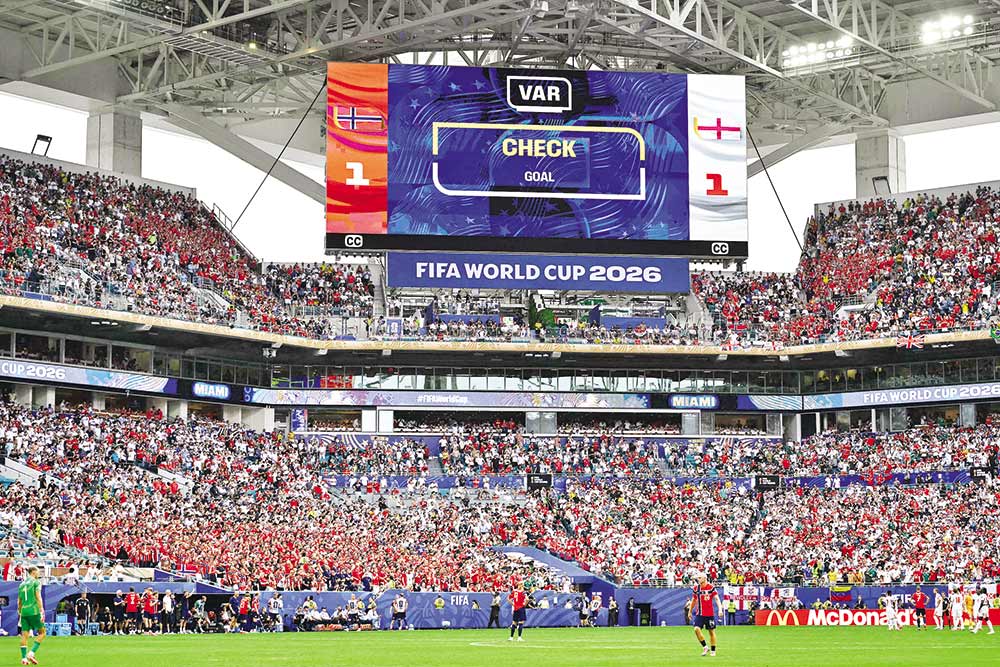 When FIFA introduced the Video Assistant Referee (VAR), the promise was simple: reduce mistakes, increase fairness and restore confidence in refereeing.
Several years later, World Cup 2026 has shown that technology can correct errors-but it cannot eliminate football's oldest tradition: argument.
Throughout this tournament, VAR has overturned goals, confirmed penalties, detected offside offences and reviewed red-card incidents with remarkable precision. In many cases, it has prevented clear and obvious mistakes that once changed the outcome of major matches.
Yet controversy has not disappeared.
Instead, it has evolved.
Supporters no longer argue about whether an incident was seen. They argue about whether it was interpreted correctly.
The difference is crucial.
Football's Laws contain numerous situations that still depend on human judgement. Was the contact enough for a penalty? Did the defender deliberately handle the ball? Was the challenge reckless or simply mistimed? VAR can replay the incident from every angle, but it cannot replace interpretation.
That reality has been evident throughout the knockout stage.
Several reviews involving penalties, red cards and physical challenges have divided fans, former players and television pundits. One decision is described as "correct" by one group and "too harsh" by another. Technology provides evidence, but not universal agreement.
Another challenge is time.
Modern football values rhythm and emotion. Extended VAR reviews interrupt both. Celebrations are delayed, momentum changes and players often wait several minutes before learning whether a goal actually counts.
Supporters inside stadiums frequently experience even greater confusion because they cannot immediately hear the discussions taking place inside the VAR room.
There is also the psychological factor.
Referees now know that every major decision will be examined repeatedly. That additional layer of scrutiny has undoubtedly improved accuracy, but it has also increased pressure. Every whistle carries the possibility of public debate long after the final whistle.
Even so, statistics consistently show that VAR has increased the percentage of correct decisions in elite competitions. From an officiating perspective, it has been a success.
The problem is that football is not judged only by statistics.
It is judged by emotion.
Every supporter sees the game through the colours of their own team. A correct decision that benefits one side can still feel unfair to the other. No technology can remove that emotional reality.
Perhaps that explains why football remains unique.
Unlike sports where technology produces clear, objective outcomes, football continues to leave room for interpretation, discussion and disagreement.
VAR has made the game fairer.
It has not made it less emotional. And as long as football remains the world's most passionately debated sport, technology alone will never end the arguments.
Loading...
Loading...
Also read



Editor : Iqbal Sobhan Chowdhury
Published by the Editor on behalf of the Observer Ltd. from Globe Printers, 24/A, New Eskaton Road, Ramna, Dhaka.
Editorial, News and Commercial Offices : Aziz Bhaban (2nd floor), 93, Motijheel C/A, Dhaka-1000.
Phone: PABX- 41053001-06; Advertisement: 41053012; 01793317829, 01550707291, E-mail: [email protected], [email protected] Online: email: [email protected] 41053014; 01550707297 Advertisement: 01550707296
Published by the Editor on behalf of the Observer Ltd. from Globe Printers, 24/A, New Eskaton Road, Ramna, Dhaka.
Editorial, News and Commercial Offices : Aziz Bhaban (2nd floor), 93, Motijheel C/A, Dhaka-1000.
Phone: PABX- 41053001-06; Advertisement: 41053012; 01793317829, 01550707291, E-mail: [email protected], [email protected] Online: email: [email protected] 41053014; 01550707297 Advertisement: 01550707296


