



| HEADLINE |

|
Floods, labour shortage threaten Bagmara jute harvest
Published : Saturday, 18 July, 2026 at 12:00 AM
Our Correspondent


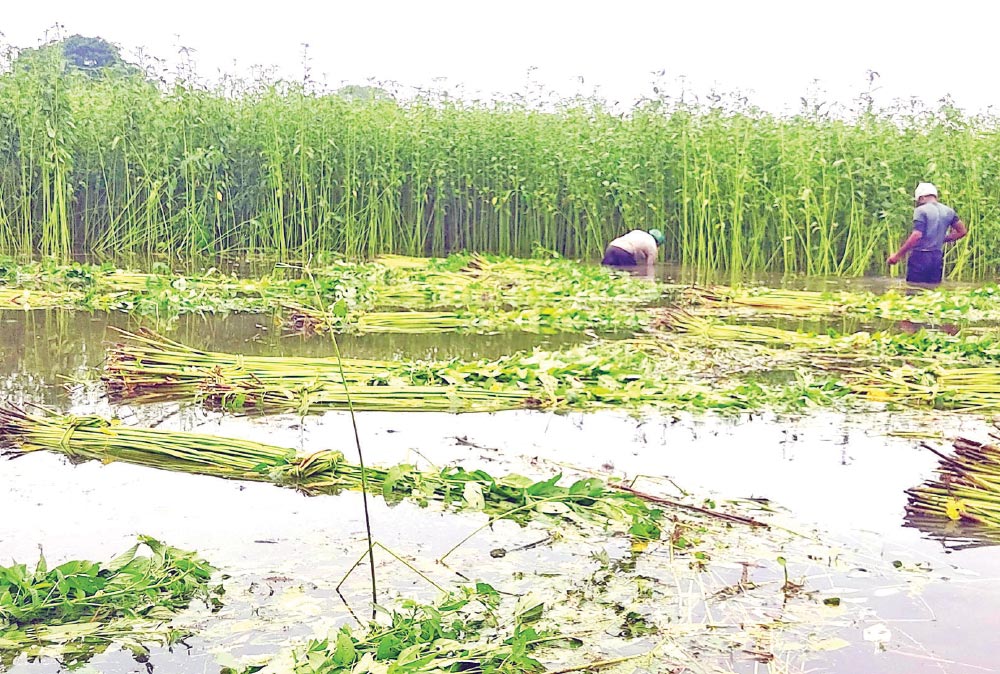 BAGMARA, RAJSHAHI, July 17: Thousands of hectares of jute fields in Rajshahi's Bagmara Upazila are at risk of being submerged as floodwaters continue to rise, while an acute shortage of farm labour has left many growers unable to harvest the crop in time.
Abdul Majid Sardar, a farmer from Konabaria Village, is among those facing heavy losses.
Earlier this season, he incurred losses of more than Tk 350,000 after cultivating onions on four and a half bighas of land. He sold his cattle and took loans from an NGO to recover part of the losses before planting an improved variety of jute on the same land in the hope of rebuilding his livelihood.
Now, unexpected flooding threatens to destroy that crop as well.
"I can't find workers to harvest the jute even after offering double the usual wage," Majid said. "If the crop goes under water, I don't know how I'll recover. I have already sold all my cattle."
Heavy rainfall and flash floods from upstream have caused the Atrai River to overflow, breaching embankments and inundating vast areas of Bagmara. Farmers across the upazila have been forced to harvest immature jute to minimise losses.
Many growers say labourers are demanding as much as Tk 1,000 a day, yet workers remain scarce.
Kerandi Molla, a farmer from Sripatipara Village, said he cultivated jute on three bighas of land expecting to earn a profit of Tk 15,000 to Tk 20,000 per bigha.
"As the floodwater keeps rising, I'm afraid the entire crop will be submerged," he said.
According to the Local Government Engineering Department (LGED), Bagmara has 816 small and large bridges and culverts. More than 100 of them have had their drainage channels blocked due to fish farming enclosures or illegal construction, obstructing the natural flow of floodwater.
Officials of the Bangladesh Water Development Board (WB) said the blocked culverts, combined with continuous rainfall and inflows from upstream, have slowed the drainage of floodwater, worsening water-logging in agricultural fields.
Bagmara Upazila Agriculture Officer Dr Abdur Razzak said the cultivation target for the upazila was 1,510 hectares this season. However, farmers planted jute on a larger area than planned, growing both the Indian variety Tossa GRO-524 and the local variety Masteo-9897.
According to the Rajshahi Department of Agricultural Extension, the district set a jute cultivation target of 17,355 hectares this year. The target includes 4,950 hectares in Bagha, 3,150 in Charghat, 875 in Godagari, 1,510 in Bagmara, 3,220 in Puthia, 1,500 in Durgapur, three in Tanore, 2,090 in Paba, 50 in Mohanpur and seven hectares in the Rajshahi metropolitan area.
Loading...
Loading...
Also read



Editor : Iqbal Sobhan Chowdhury
Published by the Editor on behalf of the Observer Ltd. from Globe Printers, 24/A, New Eskaton Road, Ramna, Dhaka.
Editorial, News and Commercial Offices : Aziz Bhaban (2nd floor), 93, Motijheel C/A, Dhaka-1000.
Phone: PABX- 41053001-06; Advertisement: 41053012; 01793317829, 01550707291, E-mail: [email protected], [email protected] Online: email: [email protected] 41053014; 01550707297 Advertisement: 01550707296
Published by the Editor on behalf of the Observer Ltd. from Globe Printers, 24/A, New Eskaton Road, Ramna, Dhaka.
Editorial, News and Commercial Offices : Aziz Bhaban (2nd floor), 93, Motijheel C/A, Dhaka-1000.
Phone: PABX- 41053001-06; Advertisement: 41053012; 01793317829, 01550707291, E-mail: [email protected], [email protected] Online: email: [email protected] 41053014; 01550707297 Advertisement: 01550707296


