



| HEADLINE |

|
US expands Iran offensive, killing 8, as bridges, airports, railways bombed
Iran Guards hit US bases across Gulf, vows continued attacks until strikes around south, Hormuz stop


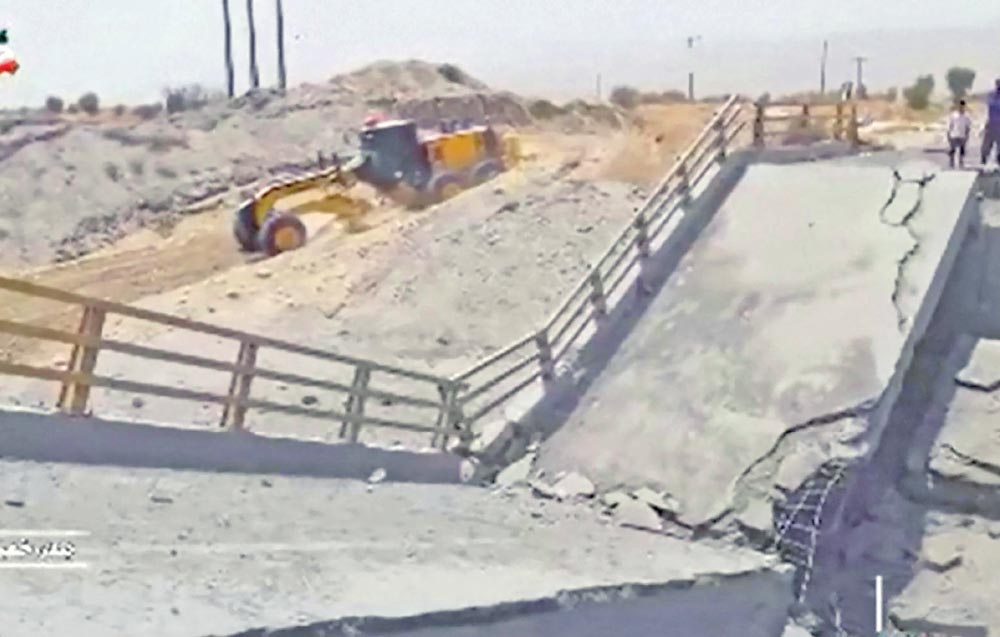 DUBAI, July 17: The United States and Iran exchanged some of the most significant attacks of the renewed conflict overnight, widening the war to include critical civilian and military infrastructure across the region. The latest strikes targeted airports, railway facilities, bridges, power and water plants, and military installations, raising fears of a broader regional conflict and further disruption to global energy supplies.
Iranian state media reported that overnight US strikes on infrastructure in southern and western Iran killed eight people and wounded 20 others. According to the official IRNA news agency, several provinces came under attack, with six bridges in the southern province of Hormozgan among the targets.
State television said US strikes hit two bridges in Hormozgan province, killing three people and injuring nine. Other attacks reportedly targeted Iranshahr airport in southeastern Iran, where several explosions were heard and at least one US projectile struck the facility. The Bandar Abbas railway junction was also hit, injuring two people, while another strike wounded one person in the western port city of Bushehr.
Iranian media also reported additional casualties elsewhere, including attacks in Bandar Khamir, where bridges and transport infrastructure were reportedly struck. Reuters said it could not independently verify the reports.
The US military's Central Command confirmed it had targeted what it described as "military logistics infrastructure," marking the first time in more than a week that infrastructure had been explicitly included among its stated targets.
Iran responded by expanding its own military operations against US interests and allied Gulf states that host American forces.
Kuwait announced that an Iranian attack damaged one of its power generation and water desalination plants, causing a fire, disrupting several production units and impairing electricity generation. The Ministry of Electricity, Water and Renewable Energy urged residents to conserve electricity during what it described as an exceptional period while emergency crews worked to contain the fire and restore operations.
Iranian state television said the strikes targeted US military deployment sites and logistical support centres in Kuwait, describing the attacks as retaliation for what it called US aggression against Iran.
Elsewhere in the Gulf, Bahrain said its air defence systems intercepted and destroyed several Iranian aerial attacks.
Residents in the capital, Manama, reported hearing multiple explosions after warning sirens sounded overnight.
Qatar's defence ministry also said its forces intercepted a missile attack. Explosions were heard across Doha, and the country's interior ministry later reported that a child was injured by falling debris from an intercepted missile.
Iran's Islamic Revolutionary Guard Corps (IRGC) said it had also launched ballistic missiles and drones at US military aircraft stationed in Jordan. In a statement, the Guards claimed they destroyed several US refuelling aircraft and fighter jets while damaging others, although no independent confirmation was immediately available.
Jordan's military rejected those claims, saying its air defence systems intercepted three Iranian missiles that entered Jordanian airspace on Friday morning, with no casualties or damage reported.
The IRGC further announced strikes against two US radar installations in Oman, saying its forces destroyed maritime surveillance radar at the Salamah Rocks and an American air surveillance radar in the Ghanam area.
Meanwhile, Majid Mousavi, commander of the IRGC Aerospace Force, vowed Iran would continue attacks until the United States halted strikes on Iran's southern coastline and the Strait of Hormuz.
"Tehran and the south are one and indivisible as Iran," Mousavi said in a social media post, adding that "effective and targeted strikes from across Iran against the enemy will continue" until attacks on Iran's southern coast cease.
The conflict also intensified at sea in the strategically vital Strait of Hormuz, where renewed fighting has further disrupted global energy supplies.
The United States said US Marines boarded a tanker as part of operations enforcing Washington's blockade of Iranian ports. The military released photographs showing Marines descending from helicopters onto a vessel, while another ship was reported to have been struck by a projectile.�" AGENCIES
Loading...
Loading...
Also read



Editor : Iqbal Sobhan Chowdhury
Published by the Editor on behalf of the Observer Ltd. from Globe Printers, 24/A, New Eskaton Road, Ramna, Dhaka.
Editorial, News and Commercial Offices : Aziz Bhaban (2nd floor), 93, Motijheel C/A, Dhaka-1000.
Phone: PABX- 41053001-06; Advertisement: 41053012; 01793317829, 01550707291, E-mail: [email protected], [email protected] Online: email: [email protected] 41053014; 01550707297 Advertisement: 01550707296
Published by the Editor on behalf of the Observer Ltd. from Globe Printers, 24/A, New Eskaton Road, Ramna, Dhaka.
Editorial, News and Commercial Offices : Aziz Bhaban (2nd floor), 93, Motijheel C/A, Dhaka-1000.
Phone: PABX- 41053001-06; Advertisement: 41053012; 01793317829, 01550707291, E-mail: [email protected], [email protected] Online: email: [email protected] 41053014; 01550707297 Advertisement: 01550707296


