



| HEADLINE |

|

Solar energy role vital, but limitations remain
Published : Sunday, 19 July, 2026 at 12:00 AM


In 2008, Bangladesh set a target of generating five per cent of its electricity from renewable sources by 2015 but failed to achieve it. Later, it sets a target of generating 10 per cent by 2020 and subsequently failed again. Despite these ambitious goals, the country's reported installed renewable power generation has reached barely 3.5 per cent. This is because our fiscal regime has continued to incentivise fossil fuels. Although the ruling Bangladesh Nationalist Party (BNP), in its election manifesto, promised 20 per cent renewable electricity by 2030, it later revised the plan to generate between 30 per cent and 50 per cent of the country's electricity from renewable sources by 2050. Against this backdrop, Minister for Power, Energy and Mineral Resources Iqbal Hasan Mahmood, in an exclusive interview with Shahnaj Begum of the Daily Observer, focused on the opportunities, challenges and policy reforms needed to accelerate the country's renewable energy transition and address energy security issues. We are sharing the interview with our readers.
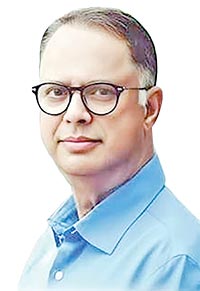
Observer: The regional comparison makes Bangladesh’s challenge sharper. India already generates more than 30 per cent of its electricity from renewable, in particular Solar Energy. Sri Lanka stands at above 22 per cent. Pakistan generates nearly 7 per cent. Bangladesh remains below 4 per cent. Under such circumstances, how do you describe the government's plan to achieve 30 per cent by 2030 and 50 per cent of electricity from renewable sources by 2050?
Setting a clear target is important because it provides direction for policymakers, investors, and other stakeholders. While achieving 10,000 MW from renewable by 2030 will be challenging, I would not say it is impossible. The previous governments failed because their main problem was the absence of a detailed roadmap as their motive was not to implement it, but to plunder the sector.
“The major challenges now are implementation capacity of the agencies. Policies alone do not deliver project, institutions must have the ability to execute them efficiently as the government works under a system. Decisions taken in previous years have left the current administration facing a difficult situation. This time, we are experiencing a collapsed or ruined system”
Observer: What are the biggest challenges here?
Minister: Obviously, land is the first challenge. Utility-scale solar projects require large areas, and Bangladesh is one of the world’s most densely populated countries. However, we are thinking of installing solar panels on all public entities and planning to make changes to engage the private sector with lucrative incentives. It is certain that not all of the targeted 10,000 MW must come from land-based projects. At the same time, we are considering the potential for floating solar.
Under this plan, import duties, regulatory duties, and advance taxes on solar panels, inverters, and key components have been waived until 2031. Battery storage systems have also received tariff relief.
Kaptai Lake alone covers about 6,000 square kilometres. Even if a small portion of its surface were used for floating solar installations, the generation potential would be significant. At the same time, with the Rooppur Nuclear Power Plant, we are going to add 2,400 MW of clean energy from next year, so the total amount would stand within the next five years at approximately 9,000 to 10,000 MW.
Observer: This is your second term in the country's power and energy sector. Earlier, you served as the State Minister, but now you are in full charge of the ministry. What challenges are you facing in this role?
Minister: The major challenges here now are the implementation capacity of the agencies. Policies alone do not deliver projects; institutions must have the ability to execute them efficiently. The government has to work under a system. Decisions taken in previous years have left the current administration facing a difficult situation. This time, I am experiencing a collapsed or ruined system.
Observer: Can Bangladesh eventually become fully dependent on solar power?
Minister: Solar can play a much larger role in Bangladesh’s energy mix, but we must recognise its limitations. Solar generation is intermittent and depends on sunlight. As a result, it cannot currently replace all other energy sources. The long-term solution lies in energy storage. Battery technologies are becoming more affordable, but large-scale deployment remains expensive. The viability of a predominantly solar-powered energy system will depend heavily on future advances in storage technology.
Observer: What is your government’s plan to address the nagging energy crisis?
Minister: Our election manifesto made raising domestic gas production a top priority. After taking office, the BNP-led government revised the model PSC contract. The government was also working to strengthen state-run exploration company Bapex.
You see, the country had suffered heavy losses from over-reliance on imported energy while keeping domestic resources underground. We have launched a bidding round for 26 offshore oil and gas blocks in the Bay of Bengal, although neighbouring countries have advanced gas exploration in offshore areas following maritime boundary settlements, Bangladesh has made any progress except taking up the issue politically by the then Awami League government.
Observer: What role can the private sector play here?
Minister: The government cannot achieve energy and power sectors target alone. We are thinking to engage private sector in distribution and transmission sector.
Observer: What about environmental concerns related to solar panels at the end of their life cycle?
Minister: This is an important issue that often receives insufficient attention. We will not ignore it, we want to address it in proper manner for the sustainability of a project.
Observer: How do you address the current mounting financial pressure in the power sector due to capacity payments and other billing issues with the private sector?
Minister: The government is grappling with mounting financial pressure in the power sector due to capacity payments, unfavourable contracts with private power producers and past irregularities by the Awami League-led government. Capacity payments were introduced by guaranteeing returns to investors to attract private investment, making projects bankable and enabling rapid expansion of power generation capacity. However, many of the agreements were structured in a way that primarily protected investors’ interests, offering little flexibility for the government.
Now we are bearing the burden of those decisions. But efforts are underway to review the capacity charge mechanism. But power sector has accumulated outstanding dues of around Tk 56,000 crore, largely due to heavy reliance on costly private generation while state-owned plants remained underutilised due to poor maintenance.
Observer: How would you describe your nearly five months in the Ministry of Power, Energy and Mineral Resources?
Minister: This sector is the backbone of the country’s economy. To address the challenges, we need immediate, short-term, and long-term plans. That also takes time to become visible. After taking charge, we have been observing geopolitical tensions in the Middle East and instability in the Strait of Hormuz, which have created "force majeure" situations in some supply contracts with Qatar and Saudi Arabia, forcing Bangladesh to seek alternative energy sources.
Despite global disruptions, the government has managed to maintain stable fuel supply. We are trying to ensure fuel supply across the country.
Loading...
Loading...
Also read



Editor : Iqbal Sobhan Chowdhury
Published by the Editor on behalf of the Observer Ltd. from Globe Printers, 24/A, New Eskaton Road, Ramna, Dhaka.
Editorial, News and Commercial Offices : Aziz Bhaban (2nd floor), 93, Motijheel C/A, Dhaka-1000.
Phone: PABX- 41053001-06; Advertisement: 41053012; 01793317829, 01550707291, E-mail: [email protected], [email protected] Online: email: [email protected] 41053014; 01550707297 Advertisement: 01550707296
Published by the Editor on behalf of the Observer Ltd. from Globe Printers, 24/A, New Eskaton Road, Ramna, Dhaka.
Editorial, News and Commercial Offices : Aziz Bhaban (2nd floor), 93, Motijheel C/A, Dhaka-1000.
Phone: PABX- 41053001-06; Advertisement: 41053012; 01793317829, 01550707291, E-mail: [email protected], [email protected] Online: email: [email protected] 41053014; 01550707297 Advertisement: 01550707296


