



| HEADLINE |

|
No respite from gas crisis
Published : Monday, 27 July, 2026 at 12:00 AM
Special Correspondent


 Local and international technical teams are working round the clock to repair damage at Excelerate Energy's Floating Storage and Re-gasification Unit (FSRU) in Moheshkhali following a fire that has triggered one of the country's worst gas supply disruptions, Petrobangla said on Saturday.
The fire at the FSRU on July 21 damaged one of the terminal's two boilers, forcing the suspension of operations and sharply reducing gas supply nationwide.
International experts from the United Kingdom and the United Arab Emirates have been working alongside local engineers since Thursday to restore the terminal's operations as quickly as possible.
In a brief statement issued after four days of disruption, Petrobangla said the teams were working and expressed hope that repairs would be completed "as soon as possible".
However, the state-owned corporation did not disclose the cause of the technical fault, the extent of the damage, or provide any timeline for resuming operations.
"Any updates on the matter will be shared later," the statement said, apologising to consumers for the temporary disruption and assuring them that technical teams were working continuously to restore normal operations.
Meanwhile, Titas Gas Transmission and Distribution PLC warned that low gas pressure would continue across Dhaka and adjoining districts until the situation improves.
According to Petrobangla, gas-fired electricity generation has already fallen by around 1,500 megawatts due to the disruption, raising concerns over widespread power outages.
An official said the ongoing gas crisis, triggered by the fire at the floating storage and regasification unit in Cox's Bazar, was unlikely to ease anytime soon.
The accident has reduced the country's total gas supply to below 2,150 million cubic feet per day (mmcfd), down from an average of around 2,700 mmcfd maintained over the past year, against a national daily demand of nearly 3,800 mmcfd.
The shortage has severely disrupted households, CNG filling stations, power plants, industries and commercial establishments across the country.
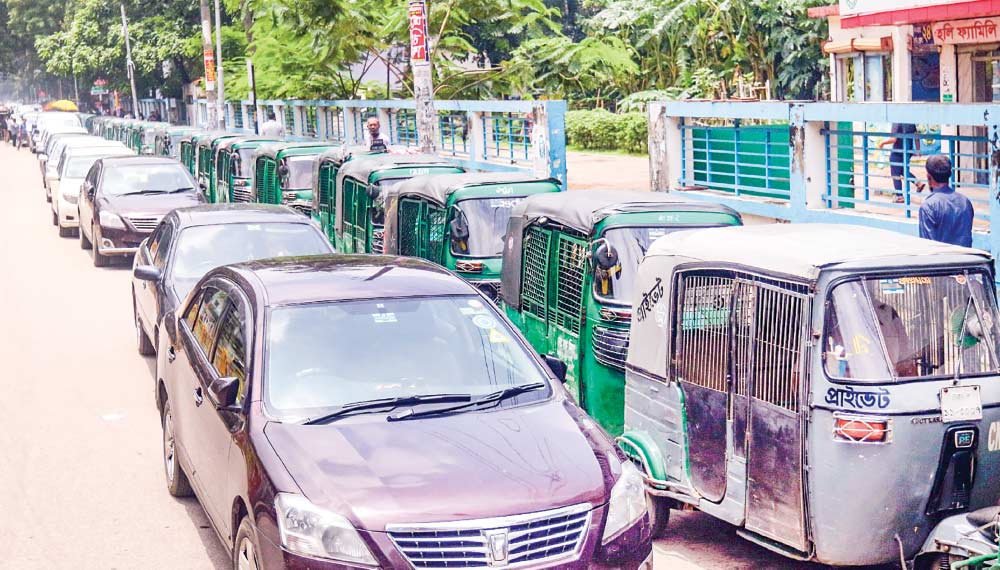
Long queues of vehicles have formed at CNG filling stations across the capital, while low gas pressure has slowed industrial production and left many households without cooking gas.
Residents of Mohammadpur, Kalabagan, Kafrul, Kazipara, West Tejturi Bazar, Mirpur, Rampura and Badda said their gas stoves had remained unlit or barely usable for days.
Many low-income families have resorted to building temporary clay stoves and using firewood for cooking, while others have switched to electric cookers or LPG cylinders, significantly increasing their household expenses.
Frustrated residents in several neighbourhoods, including Mohammadpur, have staged demonstrations and expressed their anger on social media over the prolonged cooking gas crisis.
The disruption has also taken a heavy toll on industry.
Many factories have switched to diesel to keep operations running, substantially increasing production costs. Electricity generated using gas costs around Tk 14-15 per unit, compared with nearly Tk 34 when diesel is used.
Despite the higher costs, diesel-powered boilers are unable to provide the required output, leaving some machinery idle and pushing up production costs that are ultimately reflected in product prices.
The gas crisis has crippled knitwear factories, making production planning almost impossible due to uncertainty over gas supply, said Fazlee Shamim Ehsan, executive president of the Bangladesh Knitwear Manufacturers and Exporters Association.
Low gas pressure leaves fabric trapped inside processing machines, which must continue operating to avoid damage, resulting in higher electricity bills.
"But workers' wages and utility bills must be paid, come what may. Industries are gradually becoming sick," he said.
The crisis has further intensified pressure on exporters already struggling with weak orders. Production delays are forcing some manufacturers to use costly air freight to meet delivery schedules, he added.
The shortage is disrupting production across the textile and garment value chain, with many factories reporting that operating costs have risen by around 20 per cent after switching to diesel.
Shams Mahmud, managing director of Shasha Denims, said his factory requires gas pressure of 8 pounds per square inch (PSI) but is receiving only 2-3 PSI, forcing production slowdowns while also damaging machinery.
Erratic gas pressure is also causing heavy losses in dyeing operations, where interrupted production can ruin entire batches of fabric.
"But buyers are unwilling to absorb the additional expense," said Mahmud, also a former president of the Dhaka Chamber of Commerce and Industry.
Loading...
Loading...
Also read



Editor : Iqbal Sobhan Chowdhury
Published by the Editor on behalf of the Observer Ltd. from Globe Printers, 24/A, New Eskaton Road, Ramna, Dhaka.
Editorial, News and Commercial Offices : Aziz Bhaban (2nd floor), 93, Motijheel C/A, Dhaka-1000.
Phone: PABX- 41053001-06; Advertisement: 41053012; 01793317829, 01550707291, E-mail: [email protected], [email protected] Online: email: [email protected] 41053014; 01550707297 Advertisement: 01550707296
Published by the Editor on behalf of the Observer Ltd. from Globe Printers, 24/A, New Eskaton Road, Ramna, Dhaka.
Editorial, News and Commercial Offices : Aziz Bhaban (2nd floor), 93, Motijheel C/A, Dhaka-1000.
Phone: PABX- 41053001-06; Advertisement: 41053012; 01793317829, 01550707291, E-mail: [email protected], [email protected] Online: email: [email protected] 41053014; 01550707297 Advertisement: 01550707296


