



| HEADLINE |

|
BD among most vulnerable to heat deaths
Published : Tuesday, 28 July, 2026 at 12:00 AM
Special Correspondent


 Bangladesh is among the countries most vulnerable to rising heat-related deaths by 2050 as poor nations face the greatest burden from climate-driven temperature increases and limited access to cooling, according to a report released on Monday.
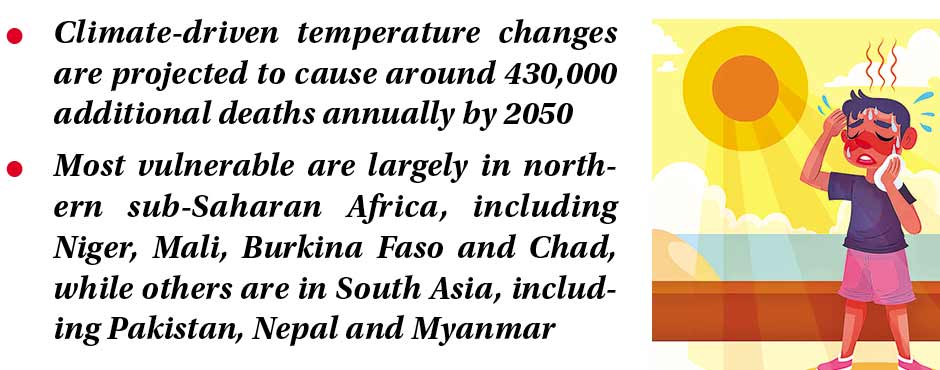
The Climate Impact Lab report warns that climate-driven temperature changes are projected to cause around 430,000 additional deaths annually by 2050, with poor countries expected to suffer 10 times more fatalities than richer nations because they lack the resources needed to power cooling systems.
The report identifies regions in 18 countries, home to 676 million people, that are trapped in a deadly combination of extreme heat and limited access to cooling. It estimates that about 377,000 people in these areas could die each year by 2050 as temperatures rise while energy consumption remains too low to support adequate cooling.
According to the report, access to electricity alone is not enough to reduce the risk of heat-related deaths. What matters is the ability to use sufficient electricity to power cooling technologies such as air conditioners.
Highlighting Bangladesh, Ashwin Rode, Director of Scientific Research at the Energy Policy Institute at the University of Chicago and a fellow at the Climate Impact Lab, said the country demonstrates the difference between electricity access and electricity use.
"Nearly the whole country already has power access, yet people in the hardest-hit regions are not using much more of it, even as heat deaths there are projected to climb. Having a connection is not the same as increasing how much power gets used. That gap is what this report points to," he said.
Michael Greenstone, co-founder of the Climate Impact Lab and the Milton Friedman Distinguished Service Professor in Economics at the University of Chicago, said air conditioning saves lives and climate change is likely to increase its use in today's wealthier countries.
"Our research finds, however, that in too many countries around the world people will not be able to respond in the same way. The result is one of climate's great cruelties-lots of death in the very countries that have contributed the least to climate change," he said.
The report says many middle-income countries are expected to see their economies grow and their energy markets develop enough to support greater electricity consumption for cooling. As a result, electricity used for cooling is projected to grow seven times faster in middle-income countries than in low-income countries.
By contrast, the projected increase in electricity use per person in low-income countries would be so small that it would only be enough to power a single LED bulb for four months.
The countries identified as being most vulnerable are largely in northern sub-Saharan Africa, including Niger, Mali, Burkina Faso and Chad, while others are in South Asia, including Bangladesh, Pakistan, Nepal and Myanmar.
The report says improving energy access, strengthening electricity markets, expanding heat early warning systems, improving healthcare access and introducing targeted social programmes will be essential to reducing future heat-related deaths. It adds that the Climate Impact Lab is developing data-driven adaptation strategies to help governments and communities respond more effectively to growing climate risks.
Loading...
Loading...
Also read



Editor : Iqbal Sobhan Chowdhury
Published by the Editor on behalf of the Observer Ltd. from Globe Printers, 24/A, New Eskaton Road, Ramna, Dhaka.
Editorial, News and Commercial Offices : Aziz Bhaban (2nd floor), 93, Motijheel C/A, Dhaka-1000.
Phone: PABX- 41053001-06; Advertisement: 41053012; 01793317829, 01550707291, E-mail: [email protected], [email protected] Online: email: [email protected] 41053014; 01550707297 Advertisement: 01550707296
Published by the Editor on behalf of the Observer Ltd. from Globe Printers, 24/A, New Eskaton Road, Ramna, Dhaka.
Editorial, News and Commercial Offices : Aziz Bhaban (2nd floor), 93, Motijheel C/A, Dhaka-1000.
Phone: PABX- 41053001-06; Advertisement: 41053012; 01793317829, 01550707291, E-mail: [email protected], [email protected] Online: email: [email protected] 41053014; 01550707297 Advertisement: 01550707296


