



| HEADLINE |

|
Farmers in Cox’s Bazar battle back after floods
10,778 to receive seed support as 4,211 hectares of cropland damaged
Published : Friday, 31 July, 2026 at 12:00 AM
AH Salim Ullah


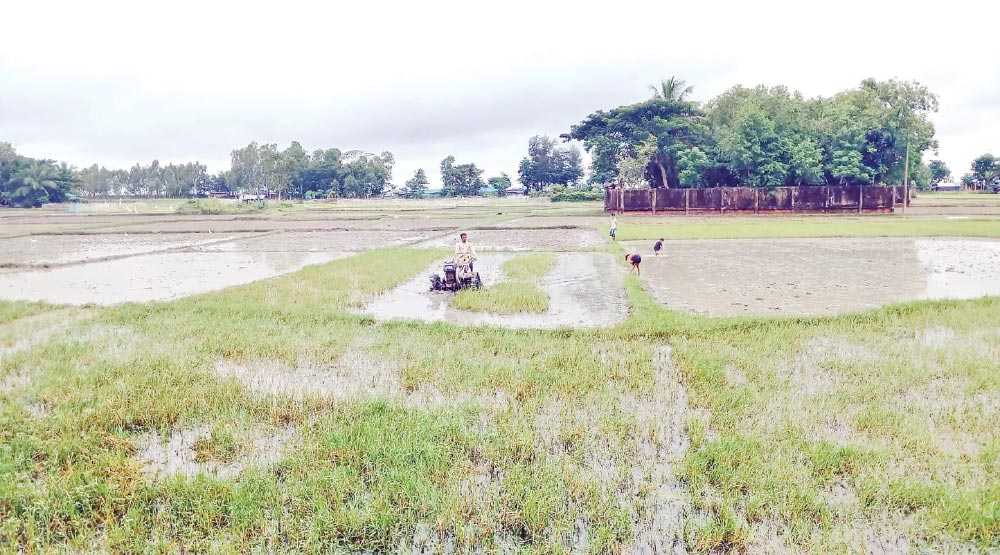 COX'S BAZAR, July 30: Farmers across Cox's Bazar have begun rebuilding their livelihoods after nine consecutive days of heavy rain and flooding that caused widespread damage to crops, forcing many to restart cultivation from scratch.
Floodwaters submerged transplanted Aus paddy, Aman seedbeds, summer vegetables and betel leaf gardens, leaving thousands of farmers struggling to recover. To support rehabilitation efforts, the government has launched an incentive programme under which 10,778 farmers will each receive 5kg of paddy seed. Vegetable seeds will also be distributed, while community-based seedbeds will be established to supply seedlings to farmers unable to raise their own.
According to the Department of Agricultural Extension (DAE), preparations are underway to resume cultivation on flood-affected land, with an initial plan to bring 78 hectares back under production.
DAE data show that floods triggered by persistent rainfall damaged crops on 4,211 hectares across the district, including Aus paddy, Aman seedbeds, betel leaf gardens and a variety of vegetables.
The worst-hit upazila was Chakaria, where crops on 1,661 hectares were damaged. It was followed by Kutubdia (1,120 hectares), Pekua (500), Ramu (340), Maheshkhali (237), Teknaf (140), Cox's Bazar Sadar (88), Eidgaon (75) and Ukhiya (50).
The department estimates that 43,210 farmers in the district were affected by the floods. Of them, 13,852 are from Chakaria, 7,020 from Pekua, 6,415 from Kutubdia, 4,875 from Ramu, 4,320 from Maheshkhali, 3,120 from Teknaf, 1,304 from Eidgaon, 1,166 from Cox's Bazar Sadar and 1,138 from Ukhiya.
A visit to several parts of the district on Monday found farmers preparing fresh Aman seedbeds after floodwaters receded. Many were busy ploughing fields, collecting seeds and raising new seedlings in an effort to recover their losses before the planting season ends.
Ali Hossain, a farmer from Morichya in Ukhiya, said the flood destroyed his Aman seedbed and submerged his vegetable fields.
"I am now preparing a new seedbed to start cultivation again," he said.
Another farmer from the area, Abdul Jalil, said the flood washed away his entire seedbed.
"I urgently need seeds to restart cultivation. Government support will help us recover at least part of the losses," he said.
Deputy Director of the Cox's Bazar DAE Dr Bimal Kumar Pramanik said a detailed assessment of agricultural losses had already been sent to the relevant ministry.
"As an initial measure, 10,778 farmers are being provided with 5kg of paddy seed each. Vegetable seeds will also be distributed in phases," he said.
He added that community seedbeds would be established for farmers who are unable to prepare seedbeds on their own, enabling them to collect seedlings and resume Aman cultivation.
"About 43,000 farmers in Cox's Bazar have been affected directly or indirectly by this year's floods. Our priority is to help them return to production as quickly as possible through incentives and other support programmes," he said.
Loading...
Loading...
Also read



Editor : Iqbal Sobhan Chowdhury
Published by the Editor on behalf of the Observer Ltd. from Globe Printers, 24/A, New Eskaton Road, Ramna, Dhaka.
Editorial, News and Commercial Offices : Aziz Bhaban (2nd floor), 93, Motijheel C/A, Dhaka-1000.
Phone: PABX- 41053001-06; Advertisement: 41053012; 01793317829, 01550707291, E-mail: [email protected], [email protected] Online: email: [email protected] 41053014; 01550707297 Advertisement: 01550707296
Published by the Editor on behalf of the Observer Ltd. from Globe Printers, 24/A, New Eskaton Road, Ramna, Dhaka.
Editorial, News and Commercial Offices : Aziz Bhaban (2nd floor), 93, Motijheel C/A, Dhaka-1000.
Phone: PABX- 41053001-06; Advertisement: 41053012; 01793317829, 01550707291, E-mail: [email protected], [email protected] Online: email: [email protected] 41053014; 01550707297 Advertisement: 01550707296


