



| HEADLINE |

|

Female Doms is a must for the Autopsy of deceased Women



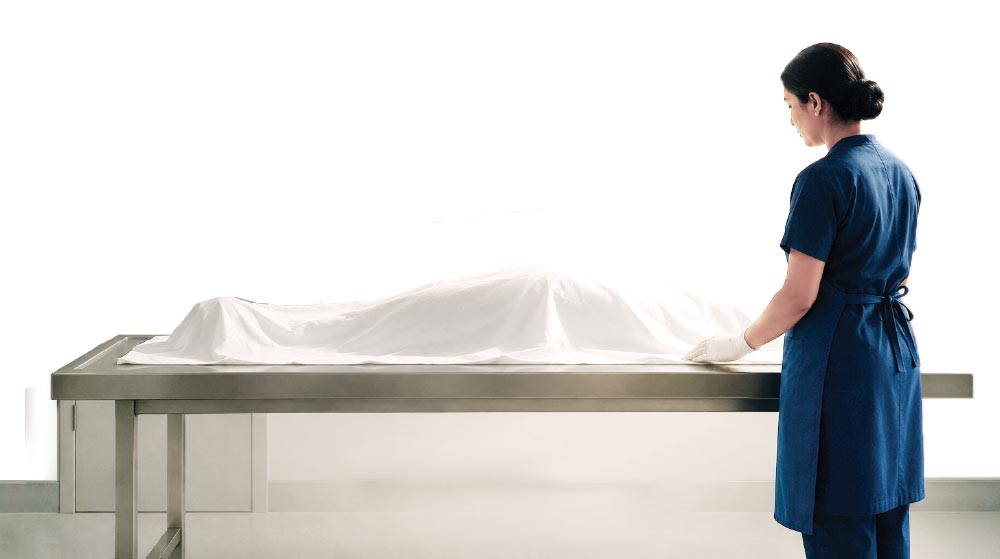 There is a quiet irony in a nation that celebrates women's achievements in life, yet leaves their dignity unguarded in death. Bangladesh proudly counts its female parliamentarians, garment workers and grassroots entrepreneurs among the symbols of its progress. Yet behind the closed doors of its mortuaries, one institutional failure has endured for decades: the near absence of female morgue attendants or doms, to assist in the post-mortem examination of women's bodies. Long overlooked, that uncomfortable reality has at last found its way into the courtroom.
 On 19 July, the High Court bench comprising Justice Fahmida Quader and Justice Md Asif Hasan issued a rule asking why the government should not appoint female doms at every post-mortem facility in the country. The order followed a public interest litigation filed by a Supreme Court lawyer against the Secretary of the Ministry of Health and the Director General of the Directorate General of Health Services. Although the petition concerns an administrative practice, it ultimately asks a far deeper question that is does a woman's right to dignity end with her last breath?
The petition answers in the negative. Drawing upon Articles 27 and 31 of the Constitution, it argues that the guarantees of equality before the law and legal protection do not expire at death. Human dignity, it contends, survives the individual. That principle has long been recognised by international human rights law and echoed in decisions of the Indian Supreme Court. More importantly, no law in Bangladesh prohibits the appointment of female morgue staff. Their absence is therefore not the result of legislative restriction but of administrative neglect.
The issue is neither abstract nor merely legal. Bangladesh's predominantly Muslim society, together with its Hindu, Christian and Buddhist communities, attaches profound religious and cultural importance to preserving the modesty of women after death. Wherever possible, women are expected to prepare the bodies of deceased women. The absence of female attendants therefore deepens the anguish of bereaved families. Recognising these sensitivities, countries such as Saudi Arabia, Iran and Malaysia, parts of Pakistan, and Indian states including Kerala and Uttar Pradesh have introduced female forensic or mortuary staff. Bangladesh, despite its commitment to gender equality in many other sectors, remains an exception.
The petition also confronts an even darker reality. It recalls the 2025 Mymensingh Medical College Hospital case in which morgue attendant Abu Saeed was arrested for sexually violating the body of a young woman awaiting post-mortem examination. It also cites the 2020 Shaheed Suhrawardy Medical College Hospital case, where CID DNA analysis linked Munna Bhagat to the abuse of multiple female corpses. As a reminder that no country is immune to such crimes, the petition refers to Kenneth Douglas, the Ohio morgue attendant who admitted abusing about one hundred female corpses over a sixteen-year period. The lesson is not that female doms alone can eliminate such crimes, but that their appointment, together with CCTV surveillance, dual-attendant procedures and regular institutional audits, would significantly strengthen safeguards against abuse.
Yet this debate extends well beyond security. It is also about opportunity. Establishing a trained cadre of female doms would create skilled employment within Bangladesh's under-resourced public health system while helping to professionalise an occupation that has long existed in the shadows. Recruiting women for medical college hospitals, district facilities and forensic departments would strengthen the healthcare workforce and transform a socially stigmatised role into a recognised paramedical profession supported by formal training, fair remuneration and career progression. Similar programmes in several Indian states have already demonstrated that such reforms are both practical and sustainable.
Women's empowerment cannot be confined to visible positions of prestige while ignoring the overlooked corners of public service. Forensic medicine and mortuary science are no less essential than the courtroom, the classroom or the operating theatre. Countries including the United Kingdom, Australia and Canada have long normalised women's participation in these professions without compromising investigative standards. Bangladesh should aspire to the same.
The High Court's intervention therefore presents an opportunity that reaches beyond a single writ petition. The appointment of female doms should be accompanied by broader reforms, including recognising necrophilia as a distinct criminal offence, introducing mandatory CCTV monitoring of mortuaries, requiring dual-attendant protocols during post-mortem examinations and implementing a nationwide recruitment and training programme.
A society's respect for women should not end where life does. The dignity promised by the Constitution is not measured only by how the living are treated, but also by how the dead are honoured. If Bangladesh is serious about protecting women's rights, that commitment must extend beyond the hospital ward to the mortuary table, where dignity, though silent, deserves the same protection as life itself.

Loading...
Loading...




Editor : Iqbal Sobhan Chowdhury
Published by the Editor on behalf of the Observer Ltd. from Globe Printers, 24/A, New Eskaton Road, Ramna, Dhaka.
Editorial, News and Commercial Offices : Aziz Bhaban (2nd floor), 93, Motijheel C/A, Dhaka-1000.
Phone: PABX- 41053001-06; Advertisement: 41053012; 01793317829, 01550707291, E-mail: [email protected], [email protected] Online: email: [email protected] 41053014; 01550707297 Advertisement: 01550707296
Published by the Editor on behalf of the Observer Ltd. from Globe Printers, 24/A, New Eskaton Road, Ramna, Dhaka.
Editorial, News and Commercial Offices : Aziz Bhaban (2nd floor), 93, Motijheel C/A, Dhaka-1000.
Phone: PABX- 41053001-06; Advertisement: 41053012; 01793317829, 01550707291, E-mail: [email protected], [email protected] Online: email: [email protected] 41053014; 01550707297 Advertisement: 01550707296


