



| HEADLINE |

|

He Earns, She Makes Earning Possible
Unpaid Labour and the Gender Gap in Matrimonial Property Rights
Published : Saturday, 26 September, 2026 at 12:00 AM
Alisha Pradhan


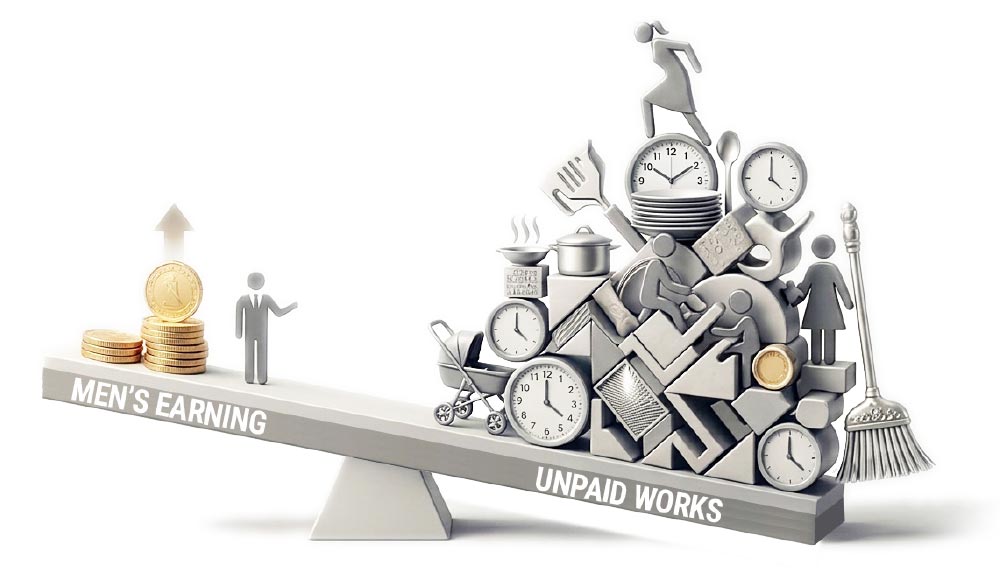 We have mastered the theatre of empowerment in Bangladesh. We put women’s face on billboards, corporate panels, Women’s Day Botox offer, and call it progress. Yet inside the home, the real CEO, the mother, the wife works 16 hours without a salary, ownership or exit power.
We celebrate women publicly but leave them financially vulnerable privately. In Bangladesh, women’s empowerment has often remained skin deep because beneath it lies a persistent reality, financial dependence still keeps many women subdued.
Let's debunk “Islam stops us from sharing with wives or daughters.” Go deeper. Islam does the opposite. Islam gave women an independent financial personality 1,400 years before the West. Quran 4:7 says women have an obligatory share of what parents and close relatives leave; Quran 4:32 recognises women’s share in what they earn. Her Mahr is hers. Her inheritance is hers. Her income is hers. No husband has a right over it. And the man’s duty? Quran 4:34 and 2:233 establish the obligation to maintain, protect and provide for food, clothing, housingand even nursing fees.
More importantly, Bangladesh does not run on Sharia law. Article 27 of the Constitution guarantees equality before law, while Article 28(2) ensures women equal rights with men in all spheres of state and public life. Bangladesh also operates through Westminster traditions, common law, civil statutes and the Family Courts Act 2023. Yet BBS officially valued unpaid household work at “Tk 6.7 lakh crore, 18.9% of GDP in 2021, with women contributing 85%”. The state must act through civil law rather than allowing misinterpreted religion to become a convenient subterfuge.
So, why do we let men buy women what they desire�"a sari, a bag, a Botox voucher�"and mistake that for value? “Value is when the account is in her name. The deed is in her name. If we genuinely want a healthier society, marriage must evolve from a charity model into a partnership model, as many Western and European legal systems have done. The principle is simple: when a mother has economic agency within her household, children learn that she is not merely a dependent; she is a stakeholder.
Divorce Is Expensive for Her, Free for Him. Change the Math. My proposals for change include:
Community of Acquests After Six Years: All wealth, property, savings and business equity accumulated “after marriage” should be deemed joint property. After 6�"10 years of marriage, a 50�"50 division should apply upon divorce or death. This reflects the European model�"France, Sweden and Germany.
Before Five Years, No Children: The first five years should not be a race to motherhood. Delaying children can help Bangladeshi women build careers, savings and financial independence before unpaid care work reshapes their lives.
The Inflation Deficit: Reclaiming Mahr’s Value: Modern currency depreciation systematically erodes the real-world value of decades-old, deferred Mahr, rendering traditional safeguards toothless. To combat this injustice, courts must invoke the Hanafi jurisprudence of Imam Abu Yusuf. This legal precedent mandates adjusting debts to reflect purchasing power at the divorce date, restoring economic equity and modernizing Islamic contract enforcement.
Why This Matters?
It creates financial accountability. When a man knows that half the property and business wealth accumulated during marriage is jointly owned, financial decisions acquire moral consequences. It protects women from the soft abuse of spouse and in-laws. The Domestic Violence Act, 2010 provides a right to reside, but not ownership. We must move from residence to ownership.
Deeds, Not Disquisitions: The Path to Real Emancipation
True emancipation rejects the hollow currency of empowerment seminars and tokenistic pageantry; it demands structural equity. The remedy lies in translating UN Women’s framework into realitythrough a Law Commission-drafted Matrimonial Property (Recognition and Equal Sharing) Act, rigorously vetted by the Ministries of Law and Women’s Affairs. This mandate would introduce an optional Uniform Family Code, defaulting for all unions post-2028, while weaponizing the Kabin Nama to enforce mandatory joint-property ownership and independent maternal banking.
We do not need another thousand speeches; we need a singular Act that firmly places the power, the bill, and the deed in her name.
The author is the Founder of HerNet Foundation and a global advocate on Women empowerment, Youth, and SDGs

Loading...
Loading...



Editor : Iqbal Sobhan Chowdhury
Published by the Editor on behalf of the Observer Ltd. from Globe Printers, 24/A, New Eskaton Road, Ramna, Dhaka.
Editorial, News and Commercial Offices : Aziz Bhaban (2nd floor), 93, Motijheel C/A, Dhaka-1000.
Phone: PABX- 41053001-06; Advertisement: 41053012; 01793317829, 01550707291, E-mail: [email protected], [email protected] Online: email: [email protected] 41053014; 01550707297 Advertisement: 01550707296
Published by the Editor on behalf of the Observer Ltd. from Globe Printers, 24/A, New Eskaton Road, Ramna, Dhaka.
Editorial, News and Commercial Offices : Aziz Bhaban (2nd floor), 93, Motijheel C/A, Dhaka-1000.
Phone: PABX- 41053001-06; Advertisement: 41053012; 01793317829, 01550707291, E-mail: [email protected], [email protected] Online: email: [email protected] 41053014; 01550707297 Advertisement: 01550707296


