



| HEADLINE |

|

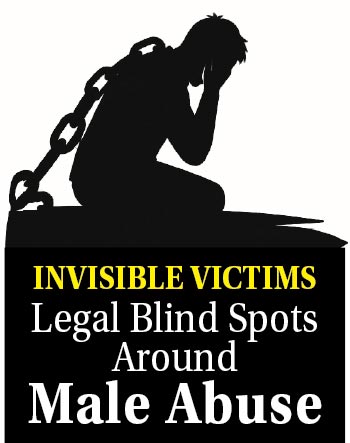
Invisible Victims
Legal Blind Spots Around Male Abuse
Published : Saturday, 3 October, 2026 at 12:00 AM
Irin Jahan Mim


 Bangladesh’s laws have taken decades to develop safeguards for women and children, and rightly so, given the many documented examples of gender based violence in the country. Yet a quieter question remains largely ignored: what happens to a man when he is abused, but the law was never designed to protect him?
The main problem is structural. Men are largely absent from laws such as the Penal Code of 1860, the Nari o Shishu Nirjatan Daman Ain 2000, the Domestic Violence (Prevention and Protection) Act 2010 and various laws dealing with dowry and acid crimes. This is not necessarily a blind spot, but a product of the time, purpose and language in which these laws were drafted. As a result, men, at least within the words of the law, often remain outside its zone of protection.
The gap is most visible in domestic violence. Section 3 of the Domestic Violence (Prevention and Protection) Act 2010 defines domestic violence in relation to the abuse of a woman or a child. Under that definition, a man physically or psychologically abused by his wife has little to point to, not because the abuse is untrue, but because the law does not contemplate him as a possible victim. Rape is similarly defined under Section 375 of the Penal Code, where the legal character of the same act depends partly on the sex of the person against whom it is committed.
Common threads can also be found in anecdotal accounts appearing in Bangladeshi legal commentary and news reports: men labelled “disabled” or otherwise discredited by former spouses to explain a divorce; men accused of dowry or abuse whose complaints receive little attention when a spouse’s infidelity comes to light; and men assaulted in institutional settings, such as dormitories or workplaces, whose cases are never pursued.
Survey based research has pointed to similar patterns, with significant numbers of men reporting some form of harassment, usually psychological rather than physical. Many also report witnessing others being harassed, while a strong majority feel that women now have better avenues of legal recourse than men. Such studies often involve small, self selected samples and therefore cannot be treated as nationally representative or conclusive. Yet the consistency across different sources suggests that this is a recurring experience rather than a marginal grievance.
The counter argument, however, should not be overlooked. Describing the issue as “male oppression” can obscure the broader structural reality of patriarchy. In aggregate, men in Bangladesh continue to hold greater advantages in areas such as income, institutional power and, in many respects, access to education. From this perspective, the answer may not be a mirror image of existing women’s rights legislation, but a gender neutral legal framework that protects any person from abuse.
The debate, therefore, need not be reduced to whether men require a separate law or whether existing protections should remain exclusively gendered. Women can experience multiple forms of abuse simultaneously, while individual men can also suffer genuine abuse that falls beyond the reach of current legal provisions.
The practical steps are not particularly complicated. The definition of domestic violence could be expanded to cover any person, rather than only women and children. Male victims, including male children, could be recognised more clearly by introducing a gender neutral definition of rape into the law. Male victims of sexual violence also remain largely under represented in the existing legal framework, which relies on provisions such as Section 377. Effective safeguards against deliberately false complaints should also be considered, while ensuring that such measures do not discourage genuine victims from seeking justice. Alongside legal reform, social and institutional support is needed to encourage men to report abuse without fear of stigma, which keeps many cases silent and unreported.
Filling those gaps by defining “victim” in gender neutral terms, rather than creating competing and separate legal silos, may provide a more durable solution. Whether policymakers choose that path is ultimately a question of policy. But the gap itself is not imaginary, and under the law as it currently stands, it remains largely unaddressed.
The author is an advocate

Loading...
Loading...
Also read



Editor : Iqbal Sobhan Chowdhury
Published by the Editor on behalf of the Observer Ltd. from Globe Printers, 24/A, New Eskaton Road, Ramna, Dhaka.
Editorial, News and Commercial Offices : Aziz Bhaban (2nd floor), 93, Motijheel C/A, Dhaka-1000.
Phone: PABX- 41053001-06; Advertisement: 41053012; 01793317829, 01550707291, E-mail: [email protected], [email protected] Online: email: [email protected] 41053014; 01550707297 Advertisement: 01550707296
Published by the Editor on behalf of the Observer Ltd. from Globe Printers, 24/A, New Eskaton Road, Ramna, Dhaka.
Editorial, News and Commercial Offices : Aziz Bhaban (2nd floor), 93, Motijheel C/A, Dhaka-1000.
Phone: PABX- 41053001-06; Advertisement: 41053012; 01793317829, 01550707291, E-mail: [email protected], [email protected] Online: email: [email protected] 41053014; 01550707297 Advertisement: 01550707296


