



| HEADLINE |

|
Suvendu promises responsibility of Taslima Nasreen
Published : Sunday, 2 August, 2026 at 5:04 PM
Observer Online Report


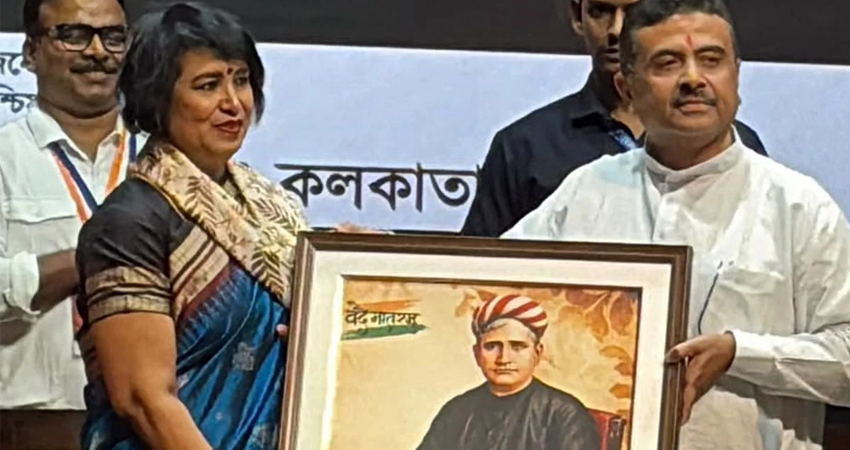
Collected Photo
Suvendu Adhikari has announced that he will take full responsibility for the exiled and controversial writer Taslima Nasreen following her return to Kolkata after 19 years.
As reported in sangbadpratidin, the statement came out on Saturday, August 1 during a reception organized at Rabindra Sadan in Kolkata.
Chief Minister welcomed Taslima Nasreen at the event, organized by the Secular Mission, and said, “The culture of fear or threats has ended in a secure West Bengal. You can come to Bengal as many times as you like. As Chief Minister, it is my duty to provide you with security. Democracy, the Constitution, fundamental rights, and freedom of speech are safe in Bengal under the new government.”
Suvendu gifted a special memento and portrait of literary legend Bankim Chandra Chattopadhyay to Taslima Nasreen.
Meanwhile, the Special Branch of Kolkata Police established a strict, three-tier security perimeter around the venue due to the controversial writer's participation.
Visitors were prohibited from carrying umbrellas, bags, and water bottles inside the hall. A special escort vehicle was also arranged for her movement.
Earlier on Friday, July 31 morning, Taslima arrived at Kolkata's Netaji Subhash Chandra Bose International Airport from Delhi.
Previously, in 2007, parts of Kolkata erupted in violent protests over the publication of Taslima's novel Dwikhandito.
Widespread tension spread across Muslim-majority areas, forcing the administration to deploy the army as the situation escalated.
Buddhadeb Bhattacharjee was the Chief Minister at that time. The former Left Front government banned the controversial book and asked the writer to leave Kolkata overnight.
Although political power shifted in the state in 2011, the Trinamool Congress government maintained this "unwritten ban" on Taslima.
Finally, after a long period, following political and administrative shifts in state governance, Taslima returned to the state.
Earlier in the late 1980s, Taslima Nasreen's newspaper columns and subsequent novels angered conservative sections of society in Bangladesh due to their themes regarding women's oppression and criticisms of Islam.
Following the publication of her controversial novel Lajja in 1993, religious organizations demanded her execution. In 1994, after a case was filed against her for hurting religious sentiments, she remained in hiding for nearly two months before being forced to leave Bangladesh.
The then BNP government revoked her Bangladeshi passport.
Although she attempted to return home at various times, no government granted her permission.
She subsequently moved to Europe before coming to reside in Kolkata, from where she was eventually driven out.
-SA
Loading...
Loading...
Also read






Editor : Iqbal Sobhan Chowdhury
Published by the Editor on behalf of the Observer Ltd. from Globe Printers, 24/A, New Eskaton Road, Ramna, Dhaka.
Editorial, News and Commercial Offices : Aziz Bhaban (2nd floor), 93, Motijheel C/A, Dhaka-1000.
Phone: PABX- 41053001-06; Advertisement: 41053012; 01793317829, 01550707291, E-mail: [email protected], [email protected] Online: email: [email protected] 41053014; 01550707297 Advertisement: 01550707296
Published by the Editor on behalf of the Observer Ltd. from Globe Printers, 24/A, New Eskaton Road, Ramna, Dhaka.
Editorial, News and Commercial Offices : Aziz Bhaban (2nd floor), 93, Motijheel C/A, Dhaka-1000.
Phone: PABX- 41053001-06; Advertisement: 41053012; 01793317829, 01550707291, E-mail: [email protected], [email protected] Online: email: [email protected] 41053014; 01550707297 Advertisement: 01550707296


