



| HEADLINE |

|
WASA pledges clean-up, profit, better services: MD Aminul Islam
Published : Thursday, 6 August, 2026 at 12:00 AM
Mohosinul Karim


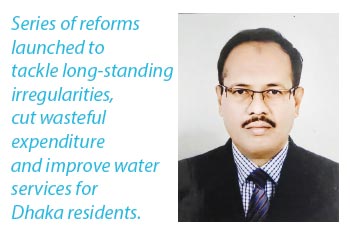 Newly appointed Dhaka Water Supply and Sewerage Authority (Dhaka WASA) Managing Director Md Aminul Islam says restoring transparency, rooting out graft, improving operational efficiency and putting the utility back on a sound financial footing are his immediate priorities.
The former government secretary, appointed on a contractual basis, has launched a series of reforms to tackle long-standing irregularities, cut wasteful expenditure and improve water services for Dhaka residents.
In an exclusive interview with the Daily Observer at Dhaka WASA headquarters in Karwan Bazar, he spoke about corruption investigations, the Dasherkandi Sewage Treatment Plant, water quality, financial reforms and future development plans.
DO: What have you found regarding corruption and irregularities during previous administrations?
Md. Aminul Islam: Dhaka WASA had every opportunity to become a profitable and efficient public utility service provider through proper management and good governance. Unfortunately, over the years the organisation gradually declined because the interests of the government and the people were not properly protected.
The Anti-Corruption Commission (ACC) is currently investigating allegations of corruption and irregularities involving previous managements. Since the ACC is a statutory body, we are extending full cooperation by providing all necessary documents and information. The ACC is probing independently, while we are carrying out our own institutional reforms. Appropriate action will be taken based on the findings of the investigation.
DO: The Dasherkandi Sewage Treatment Plant remained idle for a long time despite huge investment. What is the current status?
Md. Aminul Islam: The ACC is also investigating various aspects of this project.
The Dasherkandi Sewage Treatment Plant was implemented at a cost of around Tk 3,482 crore with support from the Government of Bangladesh, Dhaka WASA and financing from the Export-Import Bank of China. Although it was designed to significantly improve wastewater management in Dhaka, it remained largely non-operational because the required sewerage collection and transmission network was not completed.
Following the directives of Prime Minister Tarique Rahman, we have now initiated work to construct the necessary transmission lines so that the plant can become fully operational. We hope to complete the work as soon as possible.
DO: Some researchers have claimed that cancer-causing elements were found in Dhaka WASA water. How do you respond?
Md. Aminul Islam: Dhaka WASA regularly tests water quality in its own laboratory in accordance with international standards. Based on our routine testing, there is no evidence that such harmful elements or carcinogens exist in the water supplied by WASA. At the source level, our water is safe.
However, researchers from Sher-e-Bangla Agricultural University have made certain claims. We are treating the matter seriously and have already formed an investigation committee. Necessary measures will be taken after the committee completes its examination.
DO: Residents of some areas still complain about poor water quality.
Md. Aminul Islam: We have identified supply-related problems in parts of Mirpur, Monipur and Kafrul. These issues are mainly associated with the distribution network rather than the source water itself.
We are working to resolve these problems, but the authority cannot do it alone. Cooperation from local residents is essential. In some cases, influential individuals have created obstacles to maintenance and repair work. We are engaging with local stakeholders to overcome these challenges and improve the system.
DO: Dhaka WASA has reportedly incurred losses from selling its bottled drinking water brand, Shanti. What are your plans?
Md. Aminul Islam: Shanti is a high-quality bottled water product that meets strict quality standards. We believe it has strong commercial potential.
Our objective is to make the brand profitable by increasing production and expanding its supply, particularly to government institutions. Two committees have already been formed to develop a sustainable business strategy.
One major reason behind the financial losses has been the practice of distributing Shanti water free of charge at various programmes. We are reviewing this policy.
DO: What is the current water supply situation in Dhaka?
Md. Aminul Islam: At present, Dhaka faces a daily water shortage of approximately 25 crore litres. WASA currently produces around 300 crore litres of water each day against an estimated demand of nearly 325 crore litres.
We are working to bridge this gap by rehabilitating old and abandoned facilities while also implementing new water supply projects.
DO: What initiatives are underway to strengthen Dhaka's future water supply?
Md. Aminul Islam: We are expanding the use of surface water sources to reduce dependence on groundwater.
Work is progressing to supply water to Gulshan, Banani and Badda from the Meghna River source. Additionally, water from the Padma River will also be integrated into the system because producing water through the two phases of the Saidabad Water Treatment Plant has become increasingly expensive.
The Meghna project is expected to bring approximately 95 crore litres of water, of which around 45 crore litres will be supplied to the city’s Gulshan, Banani and Badda area under the current phase.
DO: Development partners have expressed concern about environmental compliance. How is Dhaka WASA addressing the issue?
Md. Aminul Islam: Development partners have consistently urged us to reduce environmental pollution associated with our operations. If we fail to improve environmental performance, future financial and technical support could be affected.
Therefore, environmental compliance and pollution control have become major priorities for the authority.
DO: What other reforms are you focusing on?
Md. Aminul Islam: We are working to strengthen financial discipline across the organisation.
One important priority is reducing revenue losses caused by illegal connections and bill manipulation. We are introducing appropriate measures to ensure greater transparency, improve revenue collection and protect public resources.
At the same time, we are reviewing unnecessary manpower recruitment made during previous administrations to ensure efficient use of public funds. Our goal is to build a professional, accountable and service-oriented Dhaka WASA that delivers quality services to the people while operating on sound financial and administrative principles.
Loading...
Loading...
Also read



Editor : Iqbal Sobhan Chowdhury
Published by the Editor on behalf of the Observer Ltd. from Globe Printers, 24/A, New Eskaton Road, Ramna, Dhaka.
Editorial, News and Commercial Offices : Aziz Bhaban (2nd floor), 93, Motijheel C/A, Dhaka-1000.
Phone: PABX- 41053001-06; Advertisement: 41053012; 01793317829, 01550707291, E-mail: [email protected], [email protected] Online: email: [email protected] 41053014; 01550707297 Advertisement: 01550707296
Published by the Editor on behalf of the Observer Ltd. from Globe Printers, 24/A, New Eskaton Road, Ramna, Dhaka.
Editorial, News and Commercial Offices : Aziz Bhaban (2nd floor), 93, Motijheel C/A, Dhaka-1000.
Phone: PABX- 41053001-06; Advertisement: 41053012; 01793317829, 01550707291, E-mail: [email protected], [email protected] Online: email: [email protected] 41053014; 01550707297 Advertisement: 01550707296


