



| HEADLINE |

|
Bangla QR Transactions Jump Nearly Sixfold in Seven Months
Published : Friday, 7 August, 2026 at 12:00 AM
Jibon Islam


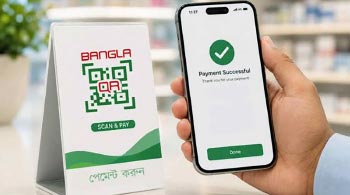 The use of Bangla QR, the country's interoperable digital payment system, is growing rapidly as Bangladesh Bank's (BB) mandatory unified QR framework gains traction across the banking and mobile financial services (MFS) sectors.
Following the central bank's directive requiring all banks and MFS providers to adopt Bangla QR, total payments settled through the platform reached Tk 1,250 crore in July, nearly six times higher than the Tk 212 crore recorded in January this year.
Effective from July 1, BB made it mandatory for all banks and MFS providers to replace their proprietary QR code systems with Bangla QR. Although the central bank launched the interoperable payment platform in 2023, the directive was enforced to enhance transaction transparency, reduce reliance on cash and ensure safer, faster and more cost-effective digital payments.
Under the current framework, a 1 per cent merchant charge is applied to QR transactions. To ease the burden on small merchants, however, the central bank recently decided to establish a Tk 100-crore incentive fund.
According to official data, Bangla QR recorded average daily transactions of Tk 40.32 crore in July, bringing the month's total to Tk 1,250 crore. Monthly transaction volumes during the first seven months of the year were Tk 212 crore in January, Tk 218 crore in February, Tk 229 crore in March, Tk 199 crore in April, Tk 479 crore in May, Tk 845 crore in June and Tk 1,250 crore in July.
Central bank statistics show that 37 institutions, including banks and MFS providers, have so far joined the Bangla QR platform. As of August 1, the number of registered merchants had reached 2,425,133, up from 2,255,541 on July 25, indicating that 169,592 new QR codes were installed or replaced within just one week.
While bKash continues to have the country's largest merchant network, commercial banks are rapidly expanding their Bangla QR footprint.
During the last week of July and the first week of August, Islami Bank Bangladesh PLC led the weekly deployment, installing 50,303 new QR codes to raise its total to 204,457. Pubali Bank PLC ranked second with 45,673 new QR codes, taking its total to 353,661.
State-owned commercial banks also accelerated QR deployment following the central bank's directive. Janata Bank installed 17,144 new QR codes, followed by Rupali Bank with 14,086, Bangladesh Krishi Bank with 11,583, Agrani Bank with 8,228, Sonali Bank with 6,822, Dutch-Bangla Bank PLC with 5,263, BRAC Bank PLC with 4,140 and TallyPay with 945.
A Bangladesh Bank official said the unified QR system offers significant convenience to both merchants and customers by eliminating the need for retailers to display multiple QR codes from different banks and MFS providers.
The official said payments made through a merchant's bank or MFS QR code are credited directly to that institution's account, providing banks and MFS providers with a low-cost source of deposits. As a result, financial institutions are showing growing interest in expanding their QR merchant networks.
However, market observers said that while the mandatory 1 per cent merchant charge was introduced to protect the revenue model of MFS providers, transaction growth could have been even faster had the fee not been imposed.
Loading...
Loading...
Also read



Editor : Iqbal Sobhan Chowdhury
Published by the Editor on behalf of the Observer Ltd. from Globe Printers, 24/A, New Eskaton Road, Ramna, Dhaka.
Editorial, News and Commercial Offices : Aziz Bhaban (2nd floor), 93, Motijheel C/A, Dhaka-1000.
Phone: PABX- 41053001-06; Advertisement: 41053012; 01793317829, 01550707291, E-mail: [email protected], [email protected] Online: email: [email protected] 41053014; 01550707297 Advertisement: 01550707296
Published by the Editor on behalf of the Observer Ltd. from Globe Printers, 24/A, New Eskaton Road, Ramna, Dhaka.
Editorial, News and Commercial Offices : Aziz Bhaban (2nd floor), 93, Motijheel C/A, Dhaka-1000.
Phone: PABX- 41053001-06; Advertisement: 41053012; 01793317829, 01550707291, E-mail: [email protected], [email protected] Online: email: [email protected] 41053014; 01550707297 Advertisement: 01550707296


