



| HEADLINE |

|

The Means to Success in World Politics
Soft Power
Published : Saturday, 8 August, 2026 at 12:00 AM
Joseph S. Nye Jr. l


 Imagine a child insisting on something they want. At that moment, parents respond differently. Some parents take a strict approach, setting clear limits and restrictions, while others gently offer a treat or a movie. This simple example shows that people approach power in different ways. Some rely on a hard approach, while others prefer softer, diplomatic ways. In the same way, countries apply these strategies in international relations.
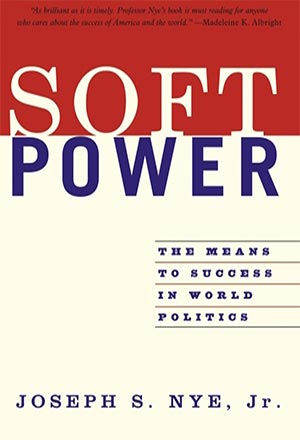
We can link this root approach of power to Joseph Nye’s famous book, “Soft Power: The Means to Success in World Politics,” where he coined the approach ‘soft power’. This book was published in 2004, and it quickly became one of the most popular books in international relations. The book’s main point is that soft power means the ability to get what we want through attraction rather than coercion or payments; meanwhile, it is more difficult to wield than military, economic, or hard power because soft power depends on resources often outside government control and needs acceptance by others. Being in this book, Nye explains that soft power arises from the attractiveness of a country’s culture, political ideals, and policies.
Reviewed by Tahia Munzarin
The book is structured into five chapters. The first chapter covers the changing nature of power in international politics and why soft power is becoming more important by using new polling data and historical research and exploring the implications and limits of soft power. The second chapter explores the sources of American soft power, including culture, domestic values, and foreign policy. Then, the third chapter looks at the soft power of other nations and non state actors. Chapter four examines the challenges of using soft power through public diplomacy, and lastly, the concluding chapter summarizes the implications of soft power for US foreign policy after the Iraq War.
However, this book has several strengths that make it a truly captivating read. Firstly, the book’s main strength is how Nye uses world history examples to show that gaining soft power is harder than gaining military power. People often believe that if a country has strong military or economic resources, it’s automatically powerful, but the author disagrees with this. For instance, before France fell in 1940, Britain and France had more tanks than Germany, but this military advantage didn’t predict who would win the battle.
Moreover, Nye delineates that winning the peace is harder than winning a war, and soft power is essential to winning the peace. However, he also notes that America perhaps achieved a stunning victory in Iraq, substantially demonstrating its hard power. Nevertheless, the way America went to war in Iraq gradually reduced its international reputation and credibility.
Secondly, an interesting aspect of this book is that the Nye suggests using soft power can also benefit other countries as well. Here, Nye highlights that US culture, like McDonald’s, Netflix, and Hollywood has a global influence and many people are attracted to American democracy. At this point, Nye highlights the example of Iran and Cuba. He addressed that America’s sanctions have helped Iran and Cuba become more self-sufficient and also have made their economies stronger with high reserves and stable trade.
Finally, another strength of this book is that Nye is not biased against only hard power. On one hand, he recognizes that hard power is still important when countries defend their independence or face violent groups. In this case, Nye provides an example of how, during the Bush administration in the United States, the president’s advisors made a mistake by focusing too much on military force and neglecting soft power. On the other hand, Nye demonstrates that soft power is a key solution for preventing terrorists from gaining support and for handling global issues. Therefore, America needs to understand and use soft power effectively.
Despite its numerous strengths, Nye’s concept of soft power has encountered several criticisms. Critics like David Frum, a former speech writer for President George W. Bush, and Richard Perle, who works at the American Enterprise Institute, completely reject this concept. David and Richard both consider themselves “realists” and believe that soft power has no potential to play a crucial role when states face military threats. Hence, they both support using military action against countries like North Korea, Iran, Syria, and Libya.
In a nutshell, certainly this book is well written and well researched and also a worthwhile read. However, if anyone asks me why he/she should read the book, then the answer would be an easier one because there’s so much information in this book, and indeed everyone can be able to understand regarding the new and comprehensive view of ‘power’, beyond the traditional view towards power. More importantly, the main takeaway the reader can learn from this book is that whether in personal life or international politics, hard power alone isn’t effective. Instead, using diplomacy and the right resources can lead to positive outcomes.

Loading...
Loading...



Editor : Iqbal Sobhan Chowdhury
Published by the Editor on behalf of the Observer Ltd. from Globe Printers, 24/A, New Eskaton Road, Ramna, Dhaka.
Editorial, News and Commercial Offices : Aziz Bhaban (2nd floor), 93, Motijheel C/A, Dhaka-1000.
Phone: PABX- 41053001-06; Advertisement: 41053012; 01793317829, 01550707291, E-mail: [email protected], [email protected] Online: email: [email protected] 41053014; 01550707297 Advertisement: 01550707296
Published by the Editor on behalf of the Observer Ltd. from Globe Printers, 24/A, New Eskaton Road, Ramna, Dhaka.
Editorial, News and Commercial Offices : Aziz Bhaban (2nd floor), 93, Motijheel C/A, Dhaka-1000.
Phone: PABX- 41053001-06; Advertisement: 41053012; 01793317829, 01550707291, E-mail: [email protected], [email protected] Online: email: [email protected] 41053014; 01550707297 Advertisement: 01550707296


