



| HEADLINE |

|
Rajshahi Central Jail struggles with overcrowding, staff shortage
Published : Sunday, 9 August, 2026 at 12:00 AM
Our Correspondent


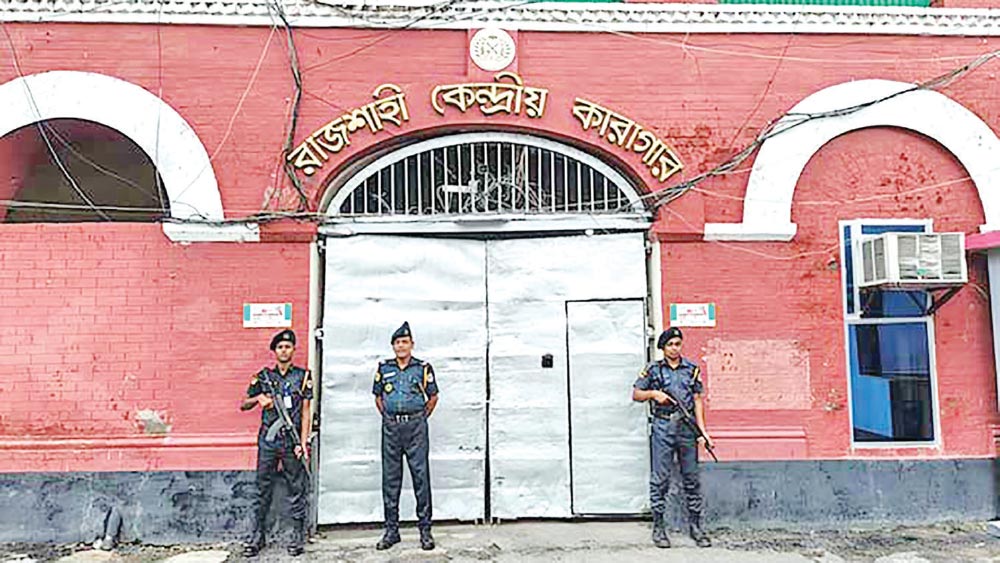 RAJSHAHI, Aug 8: Rajshahi Central Jail, established on the banks of the Padma in 1840 during British colonial rule, is struggling with nearly twice its sanctioned capacity, along with staff shortages, ageing buildings and water-logging during the monsoon.
The historic jail was upgraded to a central prison in 1914. Nearly two centuries later, its ageing infrastructure and limited manpower are making prison management increasingly difficult.
According to prison authorities, the facility has a capacity of 1,460 inmates �" 1,419 men and 41 women.
But it currently houses 2,534 inmates, including 2,422 men and 112 women.
This means the prison is accommodating 1,074 more inmates than its sanctioned capacity, putting additional pressure on its infrastructure, security and day-to-day management.
During a recent visit, three buildings inside the prison were found to be in poor condition and unsuitable for regular use. Walls and roofs have deteriorated at several points.
Water-logging is another major problem during the rainy season. Water accumulates in drains inside the prison and remains stagnant for extended periods, disrupting inmates’ movement and creating an unhygienic environment.
Prison authorities said immediate drainage improvements and infrastructure repairs are necessary to prevent the situation from worsening.
The jail is also facing a manpower shortage, with around 200 posts currently vacant, according to the authorities.
They said filling the vacant posts is essential for maintaining security, managing the overcrowded facility and running rehabilitation programmes effectively.
Despite these challenges, the authorities have introduced several initiatives in recent months.
Jail Superintendent Al Mamun, who took charge in April, introduced a shop called “Amar Shop” where inmates can buy essential goods at prices lower than those in the outside market.
A gentlemen’s parlour and a laundry shop have also been set up for prison officials and employees.
The prison’s old library has been renovated, while inmates who can recite the Quran have been involved in a daily Quran recitation programme.
Agricultural training has also been introduced as part of efforts to develop inmates’ skills. Ginger is currently being cultivated in around 500 sacks inside the prison.
Officials hope such training will help inmates find employment or become self-employed after their release.
The authorities also say the quality of inmates’ food has improved. Meals now include adequate protein, carbohydrates and other essential nutrients, they said.
Sports and cultural activities have also been expanded. Inmates can play chess, ludo, cricket and football, while tournaments are organised periodically. Music practice has also been introduced.
Recently, inmates were allowed to watch football matches on a large projector, which drew considerable interest among them.
Several measures have also been taken for prison staff. The deputy jailer’s dilapidated room was renovated, while a children’s park was built for employees’ children.
The authorities have also renovated the nameplate at the main gate, installed 10 dustbins and planted 175 fruit and forest trees inside the prison compound.
Al Mamun said the prison’s age and overcrowding were creating additional pressure on its management.
“Even so, we are trying to ensure a humane environment for the inmates,” he said.
He said some buildings required major repairs and that waterlogging during the monsoon needed a permanent solution.
“Alongside infrastructure development, filling the nearly 200 vacant posts would make prison management more effective,” he said.
“Our goal is not only to keep inmates in safe custody, but also to create an environment conducive to their correction and rehabilitation,” Al Mamun said.
“We are working to provide education, religious practice, sports, cultural activities, agricultural training, improved food and other necessary facilities so that inmates can return to society as better people after their release,” he added.
Loading...
Loading...
Also read



Editor : Iqbal Sobhan Chowdhury
Published by the Editor on behalf of the Observer Ltd. from Globe Printers, 24/A, New Eskaton Road, Ramna, Dhaka.
Editorial, News and Commercial Offices : Aziz Bhaban (2nd floor), 93, Motijheel C/A, Dhaka-1000.
Phone: PABX- 41053001-06; Advertisement: 41053012; 01793317829, 01550707291, E-mail: [email protected], [email protected] Online: email: [email protected] 41053014; 01550707297 Advertisement: 01550707296
Published by the Editor on behalf of the Observer Ltd. from Globe Printers, 24/A, New Eskaton Road, Ramna, Dhaka.
Editorial, News and Commercial Offices : Aziz Bhaban (2nd floor), 93, Motijheel C/A, Dhaka-1000.
Phone: PABX- 41053001-06; Advertisement: 41053012; 01793317829, 01550707291, E-mail: [email protected], [email protected] Online: email: [email protected] 41053014; 01550707297 Advertisement: 01550707296


