



| HEADLINE |

|
UGC plans research offices at all varsities
Published : Wednesday, 26 August, 2026 at 12:00 AM
Staff Correspondent


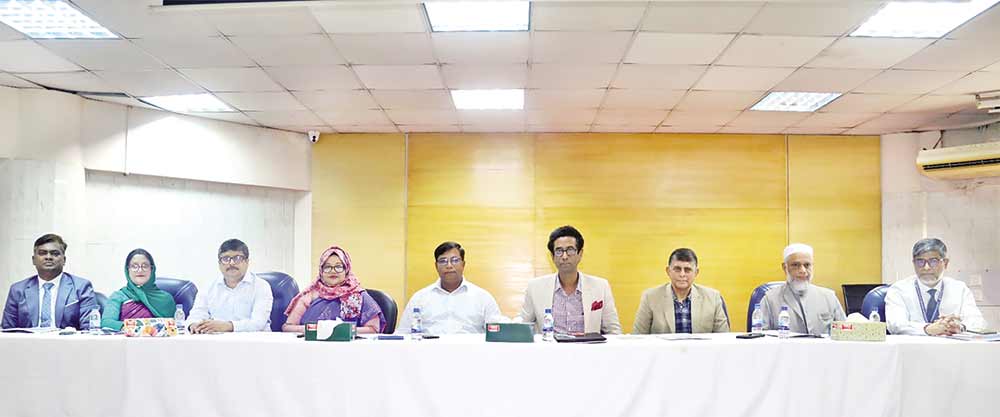 The University Grants Commission (UGC) has taken an initiative to establish International and Research Offices at all universities across Bangladesh as part of efforts to internationalise higher education, expand global research collaboration and strengthen the international capacity of the country’s universities.
The proposed offices will serve as institutional platforms for developing partnerships with foreign universities and research organisations, facilitating faculty and student exchanges, promoting joint research and degree programmes, securing international research grants and establishing joint laboratories and innovation centres.
UGC Chairman Professor Dr Mamun Ahmed disclosed the initiative while addressing an ‘Erasmus Plus Info Session’ as the chief guest at the UGC office recently.
Professor Mamun said the quality of higher education and research, as well as the international standing of universities, increasingly depends on global academic networks and institutional partnerships.
“Bangladeshi universities should not remain isolated. We want to develop them as active partners in the global education and research system,” he said.
He said the government has placed special emphasis on the internationalisation of higher education. The UGC’s five-year strategic plan and various development projects have also identified international collaboration as a priority.
The chairman said the initiative was not limited to sending Bangladeshi students abroad. Rather, the UGC wants to promote joint research, technology and knowledge exchange and collaborative academic programmes to address local and national challenges.
“We are not only thinking about sending students abroad. Our goal is to find effective solutions to local and national problems through joint research, laboratories, knowledge and technology exchange and academic collaboration with foreign universities and research institutions,” he said.
According to the UGC, the proposed International and Research Offices will identify opportunities for international scholarships, fellowships, research grants, academic exchanges and collaborative projects and help universities access them effectively.
The commission will also provide policy support, capacity-building opportunities and assistance in developing skilled manpower to ensure the offices function effectively and sustainably.
Professor Mamun also stressed the need to engage Bangladeshi academics and professionals working abroad. He said their expertise, research experience and international networks could make a significant contribution to the country’s higher education sector.
“We do not want to view this only as a ‘brain drain’. Rather, through ‘brain circulation’, we want to establish effective links between our universities and talented Bangladeshi academics, researchers and professionals living abroad,” he said.
The UGC is also planning to establish an academic diaspora network to connect Bangladeshi experts overseas with universities at home. Through the network, expatriate academics and researchers could contribute to teaching, research supervision, joint projects and institutional capacity building.
UGC Member Professor Dr Abdullah-Al-Mamun said institutionalised International Offices would make international cooperation more sustainable instead of leaving it dependent on individual initiatives.
He also highlighted the role of the European Union’s Erasmus Plus programme in promoting higher education, research, skills development and international collaboration.
UGC members, officials, university vice-chancellors, registrars and representatives involved in research and international cooperation attended the session.
Loading...
Loading...
Also read



Editor : Iqbal Sobhan Chowdhury
Published by the Editor on behalf of the Observer Ltd. from Globe Printers, 24/A, New Eskaton Road, Ramna, Dhaka.
Editorial, News and Commercial Offices : Aziz Bhaban (2nd floor), 93, Motijheel C/A, Dhaka-1000.
Phone: PABX- 41053001-06; Advertisement: 41053012; 01793317829, 01550707291, E-mail: [email protected], [email protected] Online: email: [email protected] 41053014; 01550707297 Advertisement: 01550707296
Published by the Editor on behalf of the Observer Ltd. from Globe Printers, 24/A, New Eskaton Road, Ramna, Dhaka.
Editorial, News and Commercial Offices : Aziz Bhaban (2nd floor), 93, Motijheel C/A, Dhaka-1000.
Phone: PABX- 41053001-06; Advertisement: 41053012; 01793317829, 01550707291, E-mail: [email protected], [email protected] Online: email: [email protected] 41053014; 01550707297 Advertisement: 01550707296


