



| HEADLINE |

|

Joining ‘Mecca Pact’ could further complicate ties with India: Reuters
Published : Wednesday, 26 August, 2026 at 4:23 PM
Observer Online Report


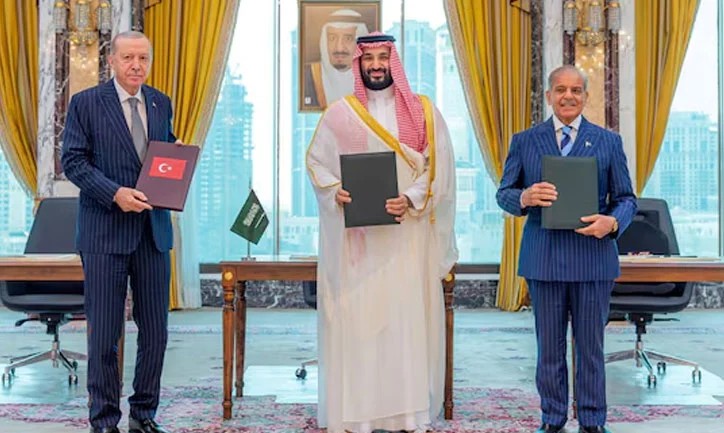
Collected Photo
Bangladesh is considering joining a mutual defence pact recently signed by Saudi Arabia, Türkiye and Pakistan, known as the “Mecca Pact,” Reuters reported, citing State Minister for Foreign Affairs Humayun Kabir.
Analysts told Reuters that joining the alliance could complicate Bangladesh’s long-standing policy of maintaining balanced foreign relations, particularly its ties with neighbouring India.
Relations between Bangladesh and India have become strained over Dhaka’s demand for the extradition of former Prime Minister Sheikh Hasina, who has been living in India since being ousted following a mass uprising in August 2024. Tensions have also grown over allegations that Indian border forces have forcibly pushed people into Bangladesh.
Humayun Kabir said Bangladesh’s participation in any security arrangement among Islamic countries in the Middle East would not be unusual.
“If there is any security arrangement among the Islamic countries in the Middle East, it is not unusual for us to consider participating in it,” he said, adding that the proposal was being viewed positively.
Speaking to reporters on Monday, Kabir said Bangladesh’s leadership, particularly Prime Minister Tarique Rahman, was being invited to participate.
A source at Bangladesh’s Foreign Ministry told Reuters that Saudi Arabia had invited Dhaka to join the pact, but did not say when the invitation was made. The source spoke on condition of anonymity because they were not authorised to speak to the media.
The three Sunni-majority countries signed the pact this month in the holy city of Mecca, Saudi Arabia, with a framework similar to NATO’s collective defence principle.
Under the agreement, an armed attack on any one member will be considered an attack on all members, amid heightened regional tensions following Iranian missile attacks across the Middle East.
Like Türkiye, Bangladesh is a secular republic, although more than 90% of its population identifies as Sunni Muslim.
The Saudi, Turkish and Pakistani embassies in Bangladesh did not immediately respond to requests for comment on the minister’s remarks.
Türkiye, which has NATO’s second-largest military, has said it is open to expanding the pact with Saudi Arabia, the world’s leading oil exporter, and nuclear-armed Pakistan.
A Test of Bangladesh’s Long-Standing Foreign Policy
Analysts said the prospect of joining a military alliance could test Bangladesh’s long-standing foreign policy of avoiding competing geopolitical blocs in order to attract investment, boost exports and maintain economic relations with rival global powers.
Bangladesh’s economy depends heavily on garment exports, most of which go to Britain, the European Union and the United States. Remittances sent by millions of Bangladeshi workers abroad, particularly those employed in the Middle East, are also a major source of foreign currency.
Geopolitical analyst Kallol Kibria said formal membership in a military alliance could complicate Bangladesh’s relations not only with India but also with China, Iran, Japan, Kuwait, Oman, Qatar, Russia, the United Arab Emirates and the United States.
“These relationships would not automatically break down,” Kibria said. “But once Bangladesh joins a military alliance, it would become much harder to avoid questions about which side Bangladesh is on.”
Potential Complications with India
Bangladesh and India are currently experiencing tensions over Dhaka’s demand for the extradition of former Prime Minister Sheikh Hasina and allegations of forced push-ins along the border. The invitation to join the Mecca Pact has emerged at a sensitive time as Dhaka awaits New Delhi’s formal response regarding Hasina’s return.
Analysts said India is unlikely to welcome Bangladesh joining a security alliance that includes Pakistan, its long-standing rival. However, they said Dhaka would ultimately need to consider the broader economic and strategic consequences of such a move.
Asif Shahan, a professor at the Department of Development Studies at the University of Dhaka, said joining an alliance could create risks for Bangladesh’s export-dependent economy, which relies on stable trade and diplomatic relations with a broad range of partners.
“If Bangladesh joins this alliance, several countries, including India, will not be happy,” Shahan said. “But that should not be the basis of Bangladesh’s decision.”
-HIS
Loading...
Loading...
Also read




Editor : Iqbal Sobhan Chowdhury
Published by the Editor on behalf of the Observer Ltd. from Globe Printers, 24/A, New Eskaton Road, Ramna, Dhaka.
Editorial, News and Commercial Offices : Aziz Bhaban (2nd floor), 93, Motijheel C/A, Dhaka-1000.
Phone: PABX- 41053001-06; Advertisement: 41053012; 01793317829, 01550707291, E-mail: [email protected], [email protected] Online: email: [email protected] 41053014; 01550707297 Advertisement: 01550707296
Published by the Editor on behalf of the Observer Ltd. from Globe Printers, 24/A, New Eskaton Road, Ramna, Dhaka.
Editorial, News and Commercial Offices : Aziz Bhaban (2nd floor), 93, Motijheel C/A, Dhaka-1000.
Phone: PABX- 41053001-06; Advertisement: 41053012; 01793317829, 01550707291, E-mail: [email protected], [email protected] Online: email: [email protected] 41053014; 01550707297 Advertisement: 01550707296


